Fixed-Rate vs. Adjustable-Rate Mortgages: Compare Payment Risk
Compare fixed-rate and adjustable-rate mortgages using an initial-period example, a delayed-move worksheet and a check of the payment risk you can carry.

The useful question is how much initial payment relief you would receive, and what obligations you would retain after that period ends. Compare those two parts separately before choosing a fixed-rate mortgage or an adjustable-rate mortgage (ARM).
A fixed mortgage rate stays unchanged; an ARM’s rate can change. An ARM may have a lower starting rate, but check the actual offers. The length of its introductory period varies.
On a standard fully amortizing fixed-rate loan, scheduled principal and interest stay level. The total mortgage payment can still change with items such as property taxes and insurance.
Unmanageable mortgage payments can put your home at risk of foreclosure. The CFPB’s ARM handbook also distinguishes the initial fixed period from the interval between later adjustments. Check both in writing; an unexplained slash label is insufficient.
Start with a comparable pair of offers
Use the same proposed borrowing amount and repayment length, then identify remaining differences. Record each offer’s date and whether its payment calculation assumes the same repayment structure. A comparison that changes the amount borrowed, repayment method and rate simultaneously will be hard to interpret.
Keep three separate records: scheduled payments, charges paid to obtain or end the loan, and principal still owed at your comparison date. This prevents a low monthly figure from swallowing the rest of the decision. If one offer requires more cash upfront, show that difference explicitly rather than treating the monthly gap as the entire benefit.
What the first five years can show
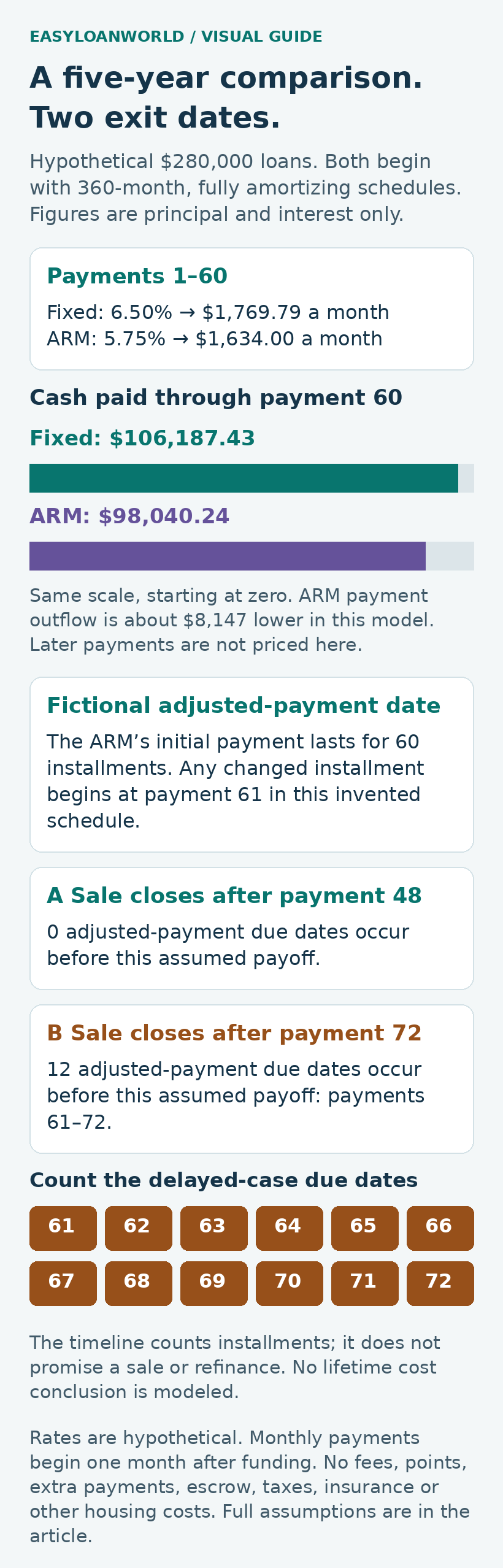
Consider two fictional $280,000 mortgages with 360-month, fully amortizing schedules. The fixed loan charges 6.50%. The ARM charges 5.75% for its first 60 payments; in this invented schedule, any changed payment begins at payment 61. These rates are educational inputs, not current offers or forecasts.
Payments occur monthly, starting one month after funding. The calculation divides the nominal annual rate by 12 and uses unrounded payments internally. Displayed amounts are approximate. It excludes closing costs, points, mortgage insurance, escrow, property taxes, homeowners insurance, HOA charges, late fees, irregular payment periods and extra payments. Neither loan has an interest-only period or negative amortization in this illustration.
The fictional fixed-rate loan
- Monthly principal and interest: about $1,769.79.
- Payments through month 60: about $106,187.43.
- Interest included in those payments: about $88,298.16.
- Principal remaining after payment 60: about $262,110.74.
The fictional ARM during its initial period
- Monthly principal and interest for payments 1–60: about $1,634.00.
- Payments through month 60: about $98,040.24.
- Interest included in those payments: about $77,774.36.
- Principal remaining after payment 60: about $259,734.12.
The ARM’s initial monthly payment is approximately $135.79 lower. Across the 60 payments, its modeled cash outflow is about $8,147 lower, its interest about $10,524 lower, and its remaining principal about $2,377 lower.
Do not add all three differences as separate savings. The interest difference is already explained by the lower payment outflow plus the lower ending balance. Nor is the $8,147 automatically money in a savings account: that depends on whether the household actually retains it. Charges excluded from this model could also consume some of that advantage.
This example answers a five-year question. It cannot establish the ARM’s lifetime cost because later rates and payments have not been modeled. Multiplying its starting payment by 360 would silently extend a 60-payment assumption across the entire loan.
For a real comparison, add a second page showing only differences excluded here. Give each item an amount, a payment date and the offer it belongs to. Leave unknown amounts visibly unresolved. That makes it harder to mistake a clean mathematical example for a complete transaction comparison.
Draw two exit timelines
The CFPB cautions against relying on a future sale or refinance before an ARM changes. Property values or your finances could change, leaving that planned exit unavailable.
For the fictional schedule above, write two versions of the same plan:
- Expected completion: The home sale closes after payment 48. No adjusted-payment due dates occur before that assumed payoff.
- Delayed completion: The sale closes after payment 72. Payments 61 through 72 create 12 adjusted-payment due dates before that assumed payoff.
The second timeline does not predict a two-year delay or a particular payment increase. It exposes the months that the original plan leaves untested. For your own comparison, use actual due dates and a realistic completion event. Listing a home or submitting a refinance application is earlier than completing a transaction that pays off the mortgage.
Beside each date, note what supports it: a tentative relocation plan, an employment arrangement, or another known event. Mark assumptions separately. If the date moves, recount the payments instead of continuing to use the original timeline.
Put the delayed case into the household plan
The Loan Estimate’s ARM-specific disclosures show important rate and payment information. Obtain the first possible change date and the contractual maximum payment from the lender, rather than substituting a hoped-for rate.
Build a private decision record with these entries:
- Money available for principal and interest. Begin with usable monthly income, then allow for other housing costs, required debts, essentials and the savings commitments you intend to maintain. Count escrowed costs once.
- The tested obligation. Enter the lender-confirmed maximum principal-and-interest amount and the document and date supporting it. Keep a forecast separate from a contractual limit.
- Cash remaining. Subtract that obligation from the amount available. Identify any required expense that would lose funding. A positive remainder is useful information, not proof that unexpected costs are covered.
- The initial payment difference. Decide where any retained cash would go. Record transfers actually made; do not treat unspent potential as an existing reserve.
- An unresolved decision. Name the missing fact, the person who can clarify it, and what answer would change your choice.
If the maximum payment does not fit today’s finances, revisit the proposed amount, product or timing. Expected raises and a hoped-for refinance do not make that payment affordable now.
Finish with a written reason for the choice
Complete this sentence privately: “The initial payment difference matters to us because ____. If our planned exit is delayed, our payment plan is ____, supported by ____.” A blank answer identifies work still needed before the product choice is settled.
Keep the comparison dated and retain the written offer behind each figure. When the loan terms change, update the record rather than relying on a conclusion built around an earlier price. The decision should remain understandable even when the person who prepared the worksheet is not in the room.
Already have a mortgage? The CFPB suggests checking your note and applicable closing disclosures, or asking your servicer, to identify its rate type. Not every mortgage uses the same disclosure form.
U.S. consumer education. Examples are hypothetical and exclude costs stated above. Research checked October 19, 2026.
Featured photo: Photo by Emma Frances Logan on Unsplash. Used under the Unsplash license. Illustrative house exterior; no borrower or loan is depicted. Photo by Emma Frances Logan on Unsplash.
Mortgage Charge Questions: Choose the Record That Answers Them
Match a questionable mortgage charge to account detail, service records or adjustments with a worked property-inspection example and a two-part index.

Partial Mortgage Payment: Track Money Held in Suspense
Follow a fictional $1,100 and $700 mortgage payment trail, compare dated records, and build a precise question about an unexplained entry.

Minnesota Contract for Deed: Check the Seller, Title and Balloon
Before signing a Minnesota contract for deed, organize seller, disclosure and title evidence, then test a fictional balloon-payment ledger.