Invoice vs. Bank Payments: Find a $1,000 Double Count
Follow a fictional refrigerator invoice through six bank payments. A complete register and a two-month checkpoint reveal exactly how an incorrect $14,200 total duplicates $1,000 already recorded.

A purchase list shows $3,200 for month 1, but the selected bank debits add up to $2,200. Both records can be correct. The useful check is to follow the invoice behind the difference and match every later payment to it.
This fictional six-month example does that, then builds a deliberately incorrect $14,200 total. The task is to find the extra $1,000 without removing a genuine bank payment.
Why the records differ
The BLS glossary places an item’s entire purchase cost in the acquisition period and leaves later installments for that item out of expenditures. That convention helps explain the two records below.
The register here is an original, selected transaction exercise. It is not a household survey estimate or a complete household budget. Official source pages were checked on October 21, 2026.
Fix the invoice and agreement first
All figures are invented U.S. dollars. Label the refrigerator invoice EX-FRIDGE-01 and use these assumptions throughout:
- The refrigerator is delivered and acquired in month 1 for an all-in $1,200. There is no trade-in, rebate, return, reimbursement, separate delivery charge or later price adjustment.
- The buyer pays $200 from the bank account at acquisition. The seller finances the remaining $1,000 directly; no loan proceeds enter that bank account.
- Five $200 principal installments follow in months 2 through 6. The invented agreement has no interest, fees, deferred interest, deposit, insurance add-on, late payment or extra payment. It describes no actual offer.
- Another $2,000 of personal goods and services is acquired and fully paid each month. This basket excludes the refrigerator and every payment toward it.
- All payments are completed in their assigned months. There is no other opening debt or transaction in this selected record. Income, opening bank cash, savings, transfers, payroll deductions, mortgages and other assets or liabilities are outside it.
Keep the invoice attached to all six debits
Give each refrigerator debit the same invoice reference, EX-FRIDGE-01, plus its own month. There is one invoice and six related bank payments: the initial $200 and five later installments. A later debit therefore has a document to match against.
For this exercise, A adds the monthly basket and any refrigerator invoice entered that month. C adds the basket and that month’s refrigerator debit. D tracks the amount still unpaid on this invoice. The letters identify these three columns only.
C totals only the selected completed payments, not a bank balance or net cash change. The example cannot establish affordability, liquidity, reserve adequacy or loan eligibility, and it is not a forecast.
| Month | Other items acquired and paid | Refrigerator invoice entered | Refrigerator bank debit | A: Invoice-side total | C: Bank-side total | D: Unpaid at month-end |
|---|---|---|---|---|---|---|
| 1 | $2,000 | $1,200 | $200 | $3,200 | $2,200 | $1,000 |
| 2 | $2,000 | $0 | $200 | $2,000 | $2,200 | $800 |
| 3 | $2,000 | $0 | $200 | $2,000 | $2,200 | $600 |
| 4 | $2,000 | $0 | $200 | $2,000 | $2,200 | $400 |
| 5 | $2,000 | $0 | $200 | $2,000 | $2,200 | $200 |
| 6 | $2,000 | $0 | $200 | $2,000 | $2,200 | $0 |
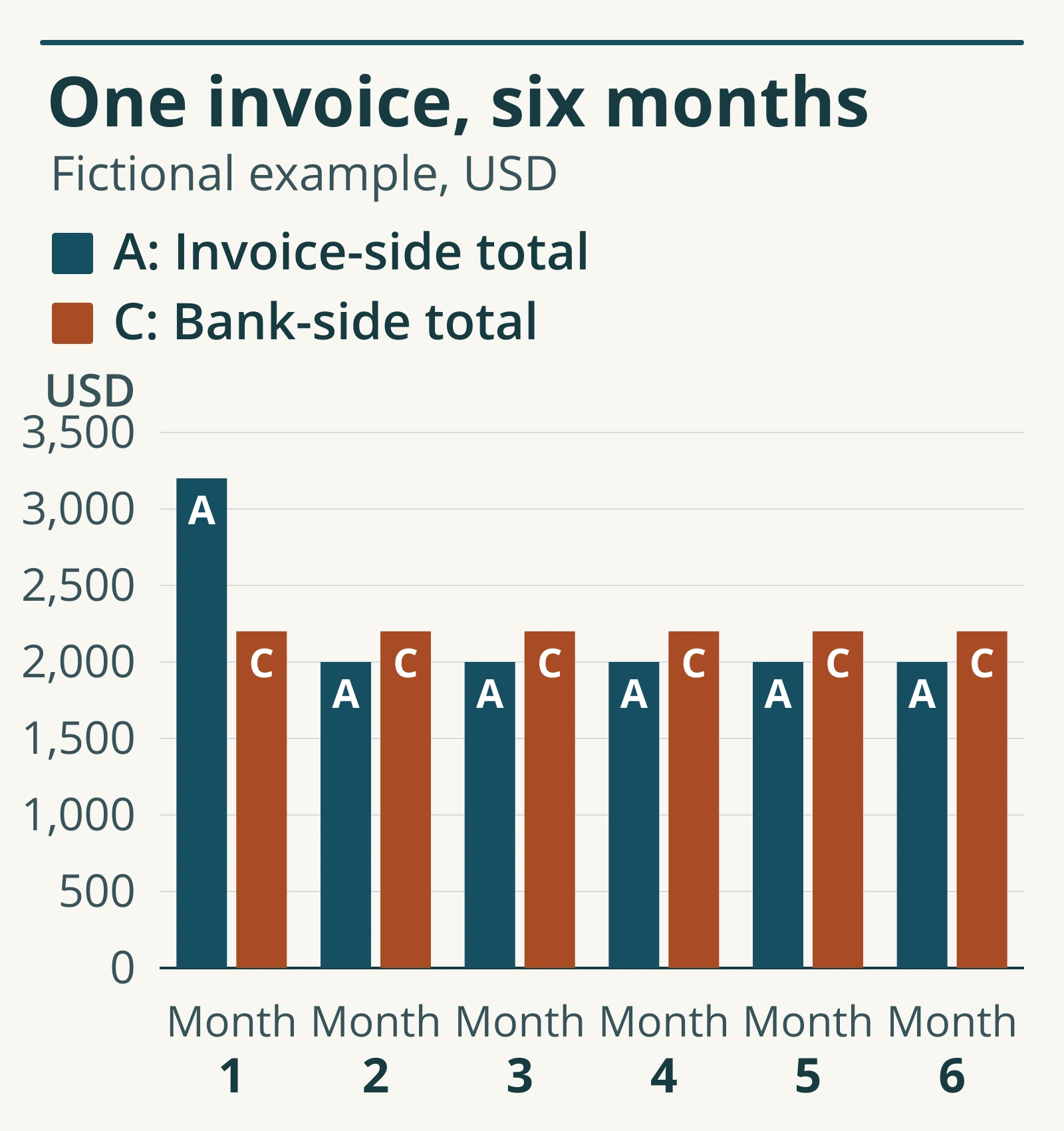
The month-1 refrigerator debit is the down payment. Each later refrigerator debit is one stipulated principal installment. D is a closing balance, so adding its six entries would not produce another purchase or payment total.
Check month 2 before looking at the final total
In month 1, A is $3,200 and C is $2,200. The $1,000 gap matches the seller-financed part of EX-FRIDGE-01.
In month 2, A is $2,000 and C is $2,200. The extra $200 on the bank side matches the installment attached to that same invoice. The unpaid amount falls from $1,000 to $800.
Through month 2, the invoice side totals $5,200 and the bank side totals $4,400. Their $800 difference matches D. Checking here matters: two correct records can still have different cumulative totals while this invoice remains partly unpaid.
Within these stipulated transactions, each month’s A minus C equals the change in D. The cumulative A minus cumulative C equals closing D because this example starts with no unpaid balance. These are checks on this complete example, not formulas for every household transaction.
Build the wrong total, then find the duplicated dollars
Start with all six A entries: $13,200. Now append the five later $200 refrigerator installments: another $1,000. The resulting $14,200 is an invalid hybrid, exceeding the correct $13,200 total by $1,000.
To locate the duplication, open EX-FRIDGE-01. Its $1,200 is already inside month 1’s A entry. The five later installments settle the remaining part of that very invoice. They add no second refrigerator to the six-month record.
The repair depends on the column being prepared. For A, remove the five appended installments from the hybrid. For C, preserve all six genuine refrigerator debits and use the actual bank-side entries. Do not erase those payments from the bank record just to make one month’s columns agree.
This particular error appends only the five later installments. The initial $200 has not been appended again. Naming the exact entries explains why this overcount is precisely $1,000.
Close the record without losing the monthly history
Across six months, the other basket contributes $12,000. A adds the refrigerator’s $1,200 invoice once. C adds six $200 refrigerator debits. Both totals are $13,200, and final D is $0.
The equal completed totals validate this closed example. The month-1 and month-2 checks still describe different timing. A six-month sum cannot replace those monthly entries.
Keep a national average outside this register
BLS averages include consumer units that did not buy the item. Dividing an annual average by twelve cannot supply this example’s monthly bank entries. The table guide explains the population behind those averages.
Make a private matching sheet from your documents
For one real purchase, collect the invoice, the agreement and the bank entries. Keep the sheet private. Use these fields to preserve the evidence behind each number:
- Seller and invoice reference; date the item was received
- Total shown on the invoice; amount paid initially; amount left to finance
- A separate line for every subsequent debit, with its actual date, amount and invoice reference
- The principal reduction supported by the seller’s or lender’s statement, and the balance that statement reports
- Any difference you cannot yet explain, together with the missing document or clarification needed
Compare a debit with its matching statement before copying it into the principal column. If the evidence is incomplete, leave the difference open. Do not invent a balancing adjustment or assume the real agreement has this example’s no-charge terms.
The finished sheet should let you point from each payment back to its invoice and explain every remaining difference. That is the test this example is designed to support.
Mortgage Quote vs. Freddie Mac’s Average: Five Checks
Work through an invented mortgage quote with five record checks. Track what is known, what is missing and what to ask for in writing.
Home-Sales Headlines: Read the Signing and Closing Calendars
Follow 210 fictional home contracts across signing and closing months, then check which event and comparison base a housing headline actually uses.
Delinquency Rate or New Delinquencies? Read the Two Denominators
A complete fictional balance ledger explains an 8% delinquency stock and a 2.22% quarterly entry fraction, plus three reasons a snapshot can change.