Manufactured-Home Quotes: Compare the Bundle Before the Cash Needed
Compare two fictional manufactured-home quotes for the same owned site. Reconcile included work, missing prices, deposits, debt and payment timing.

A dealer’s higher headline price can cover work another dealer lists separately. Start by matching the home specification and the work included for the same site. Only then compare the selected-scope price, the debt and the cash you would supply.
Example limits: The two alternatives below use identical home requirements on the same already-owned site. All prices, funding terms, payments and dates are fictional U.S. dollar examples. Land acquisition, taxes, financing charges, later maintenance and all unstated costs are excluded. These are selected-scope subtotals, not a complete project budget, formal Cash to Close calculation or borrowing-cost comparison.
Put the same work on both sides
Give each proposal the same specification version. Identify the provider responsible for each item and the exact bundle that pays for it. Here, Dealer B includes two items that Dealer A prices outside its home invoice.
On narrow screens, swipe tables sideways. Keyboard users can focus a table area and use the arrow keys.
| Selected item | Quote A | Quote B |
|---|---|---|
| Dealer bundle | $140,000 for the specified home | $151,000 for the specified home, delivery and foundation work |
| Delivery | $7,000 separately priced | Included in the $151,000 dealer bundle |
| Foundation work | $13,000 separately priced | Included in the $151,000 dealer bundle |
| Site access | $7,000 separately priced | $7,000 separately priced |
| Utility connections | $9,000 separately priced | $9,000 separately priced |
| Modeled permit-cost allowance | $2,000 | $2,000 |
| Optional upgrade omitted from both specifications | Not required for the matched specification | Not required for the matched specification |
| Separately priced items outside the dealer bundle | $38,000 | $18,000 |
| Selected-scope subtotal | $178,000 | $169,000 |
B’s dealer bundle is $11,000 higher, but its separately priced items are $20,000 lower. The selected-scope price is therefore $9,000 lower. Do not add a second delivery or foundation charge to B merely because those items have their own comparison rows.
HUD’s installation guidance identifies permits, site preparation and access, soil and foundation suitability, possible enclosure, and utility connections as considerations. It advises checking with the retailer and state or local officials, and listing installation services individually in the contract. See HUD’s manufactured-home resources.
The table is a selected example, not a complete installation checklist. It does not establish local compliance, engineering suitability, occupancy approval or financing eligibility. Omitting an optional upgrade from both specifications does not excuse necessary site work.
Use four distinct states when reconciling the written proposals:
- Separately priced: record the amount, provider and quoted work. A valid $0 price needs explicit written support.
- Included in a named parent bundle: identify that bundle and its price. Included work is paid for within the bundle; it is not free.
- Required but unpriced: keep the item unresolved. A blank amount is not zero.
- Not required for the matched specification: retain the specification or other supporting evidence for that status.
Split the lower contribution into price and debt
For this example only, assume a lender funds 90% of each dealer invoice and none of the separately priced outside items. This invented premise is not a HUD or FHA rule, a real lender offer or an approval. Because B’s dealer invoice contains more of the selected work, its assumed loan starts larger.
| Amount being compared | Quote A | Quote B |
|---|---|---|
| Selected-scope subtotal | $178,000 | $169,000 |
| Initial debt: 90% of dealer invoice | $126,000 | $135,900 |
| Borrower contribution toward that scope | $52,000 | $33,100 |
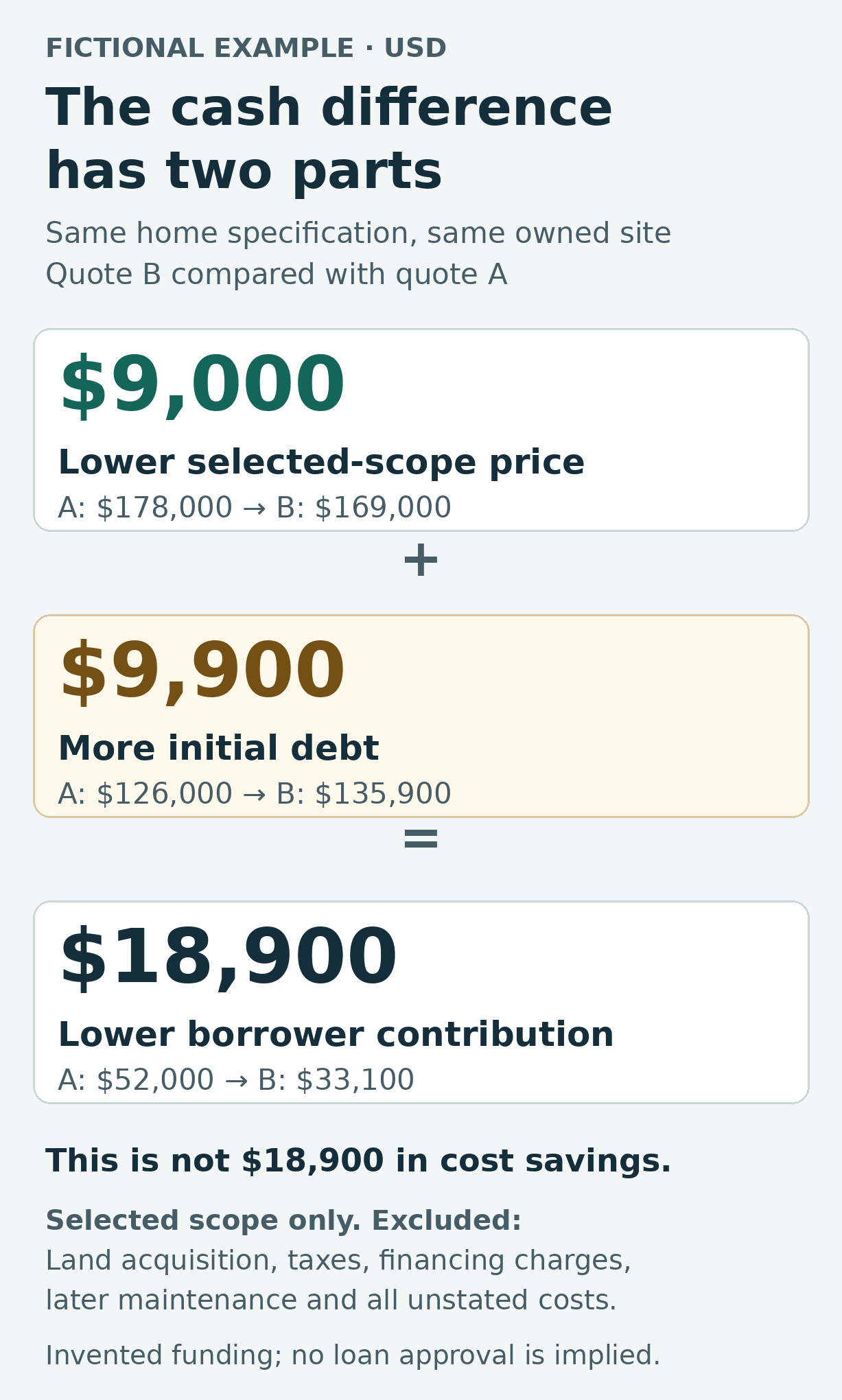
B’s $18,900 lower borrower contribution consists of $9,000 lower selected-scope price plus $9,900 more initial debt. Calling the entire $18,900 a saving would mix a price difference with money still owed. These figures do not establish which financing arrangement costs less over time.
Credit the deposit once, to its invoice
Each alternative assumes one $10,000 deposit applied to its dealer invoice. A and B are separate possible purchases; the buyer is not paying both deposits. The deposit is already inside each selected-scope subtotal.
| Remaining amount | Quote A | Quote B |
|---|---|---|
| Borrower contribution still to supply | $42,000 | $23,100 |
| Dealer invoice balance before further payments | $130,000 | $141,000 |
The dealer balance still includes the lender-funded amount. It is not all payable from the borrower’s cash. Under the direct-payment assumptions, A’s $130,000 balance is covered by $126,000 from the lender and $4,000 more from the borrower. B’s $141,000 balance is covered by $135,900 from the lender and $5,100 more from the borrower.
Keep a missing required price visible
Now remove B’s $9,000 utility-connections price while leaving that work required. The known-priced subtotal becomes $160,000 plus an unpriced required item. It is not a completed $160,000 quote, and you cannot finalize the borrower contribution from it.
Ask for a written, dated price covering the matched work, or written confirmation that the work is included in a specifically identified priced bundle. Record the provider, exclusions and quote expiry. Until that evidence resolves the row, keep the amount open rather than inserting $0 or using A’s price as though B had quoted it.
Check where the funding goes and when
The following fictional dates assume the stated payments actually occur. They show cash movements, not contractual due dates. Direct lender payments go to the provider and never become cash in the borrower’s account.
| Date | A: borrower payment | A: cumulative outlay | B: borrower payment | B: cumulative outlay |
|---|---|---|---|---|
| October 1 | $10,000 deposit | $10,000 | $10,000 deposit | $10,000 |
| October 2 | $18,000 outside items | $28,000 | $18,000 outside items | $28,000 |
| October 3 | $20,000 outside items | $48,000 | No payment | $28,000 |
| October 10 | $4,000 dealer balance | $52,000 | $5,100 dealer balance | $33,100 |
On October 2, each $18,000 payment covers site access ($7,000), utility connections ($9,000) and the permit-cost allowance ($2,000). A’s October 3 payment covers delivery ($7,000) and foundation work ($13,000). On October 10, the lender also pays the dealer $126,000 for A or $135,900 for B.
Borrower outlays before October 10 are $48,000 and $28,000. The example does not establish the order of payments within October 10, so those earlier-date figures are not proven cash requirements immediately before the lender releases funds. With funding paid directly to the dealer, the borrower’s cumulative outlay reaches $52,000 or $33,100 regardless of that same-day ordering.
Later reimbursement changes the cash requirement. Suppose B instead requires the borrower to pay the full selected scope first: $10,000 on October 1, $18,000 on October 2 and the remaining $141,000 dealer balance on October 10. Peak cumulative borrower outlay is $169,000, including the deposit. From the after-deposit checkpoint, another $159,000 must be paid before reimbursement.
If the borrower actually receives a $135,900 loan reimbursement on October 20 for part of that already-paid dealer invoice, net contribution then falls to $33,100. The reimbursement is a receipt by the borrower, not a second payment of the provider’s invoice. The $135,900 temporary funding requirement above the final contribution is not another expense or an available bridge loan. If reimbursement is only expected, the $169,000 outlay remains until receipt.
No starting available-cash balance is supplied, so $169,000 is a cumulative cash requirement, not a calculated shortfall. To find a real shortfall, compare dated payments with spendable cash earmarked for them and cleared additions. If incoming funds and bills share a date, obtain evidence of usable-funds timing. For a hypothetical cash-flow check when timing is unverified, model the payments as leaving your account before the incoming funds become usable.
Build one evidence-backed comparison sheet
Use one row per scope item and link payment entries to the invoice they cover. Keep these fields:
- Matching basis: home specification, version and same-site assumptions.
- Scope and responsibility: item, provider, inclusion state and named parent bundle.
- Price evidence: quoted amount, allowance status, exclusions, expiry and supporting document.
- Deposit: amount, payment status, receipt and once-only invoice allocation.
- Dates: contractual due date, actual payment date and usable funding date, kept separate.
- Funding: payer, recipient, direct payment or reimbursement, amount, status and written release conditions.
- Open questions: missing price or scope evidence, who will resolve it and the document received.
The next decision is whether the proposals cover the same required work and whether their payment arrangements are workable. A lower selected-scope price or contribution alone does not select the better quote. Resolve the full real scope, affordability, contract conditions and financing costs before choosing. For the separate mortgage-offer comparison, use the Loan Estimate worksheet.
California Supplemental Property Tax: Check the Bill, Payment and Cash
Organize one California supplemental property tax bill, its payment evidence and the cash earmarked for it. A fictional example shows why a funding gap…
Title Insurance Quotes: Compare Policies, Services and Payers
Compare fictional $2,150 and $2,275 title packages using matched coverage, complete service charges and a separate payer worksheet.

Flood Insurance Quote: Test Two Deductibles Against Your Cash Reserve
Test fictional flood quotes against a $6,000 reserve: $180 in annual savings comes with $3,000 more building deductible exposure.