Mortgage Discount Points: Calculate Break-Even Before Paying Upfront
Compare mortgage points using payment break-even, loan balances at payoff, and cash needed at closing, with two clearly separated worked examples.

Estimated reading time: 9 minutes
Mortgage discount points exchange money paid upfront for a lower interest rate. To estimate a simple payment break-even, divide the additional upfront cost by the monthly principal-and-interest reduction. Then check the loan balances and other costs at the date you might repay the mortgage: payment break-even alone doesn’t identify the least expensive loan.
This U.S. guide uses invented numbers for education, not a current rate quote or individualized financial or tax advice. Sources checked October 19, 2026.
Choose the calculation that answers your question
| Your question | The useful comparison |
|---|---|
| When do lower payments recover my extra upfront cash? | Divide incremental cash-paid costs by the monthly principal-and-interest reduction. This is simple payment break-even. |
| Which loan costs less if I repay it on a particular date? | Compare upfront financing costs, payments made and remaining balances at that same date. Include other differing charges once. |
| Can I afford the upfront choice? | Compare cash required at closing and cash left for other obligations. A favorable long-term model does not supply cash for closing today. |
Keep the two examples below separate. Example 1 starts with a supplied $90 payment reduction and shows a 34-payment cash-recovery point. Example 2 calculates payments from 6.50% and 6.25% fictional rates. Its payment-recovery point is later, while its month-60 financing-cost comparison also recognizes the difference in remaining debt.
For your own offers, write down an early payoff date you could plausibly face as well as your expected date. If the result changes between those dates, the decision depends on how long this loan stays in place. Request both amortization schedules and preserve the original quote terms so the comparison can be checked.
Mortgage discount points: start with matching quotes
Request a zero-point offer and a paid-point alternative using the same loan amount, term, loan type, quote date and rate-lock assumptions. Compare other lender fees and credits too. Zero points doesn’t mean zero closing costs, or necessarily the cheapest offer across lenders. The CFPB explains the points-and-credits tradeoff.
Give each quote a label, such as A and B, and retain its date and assumptions. If one lender updates a price while another quote expires, request refreshed comparisons. Otherwise, a calculation that looks precise may be comparing offers that were never available together.
Points and origination fees do different jobs
One point costs 1% of the loan amount. It doesn’t reduce the interest rate by one percentage point, and there’s no universal conversion from points to rate reduction. Discount points appear in Section A on page 2 of the Loan Estimate and Closing Disclosure. Ask what rate change the quoted charge actually buys.
An origination fee pays the lender for making the mortgage. A percentage-based fee isn’t automatically a discount point. Put ordinary lender charges in a separate worksheet row rather than assuming they purchase a lower rate.
Mortgage discount points: calculate payment break-even
The CFPB’s discount-points research describes dividing points cost by monthly payment savings as an approximate break-even calculation. The length of time you keep the mortgage matters. The calculation below is an original illustration, not the report’s market data.
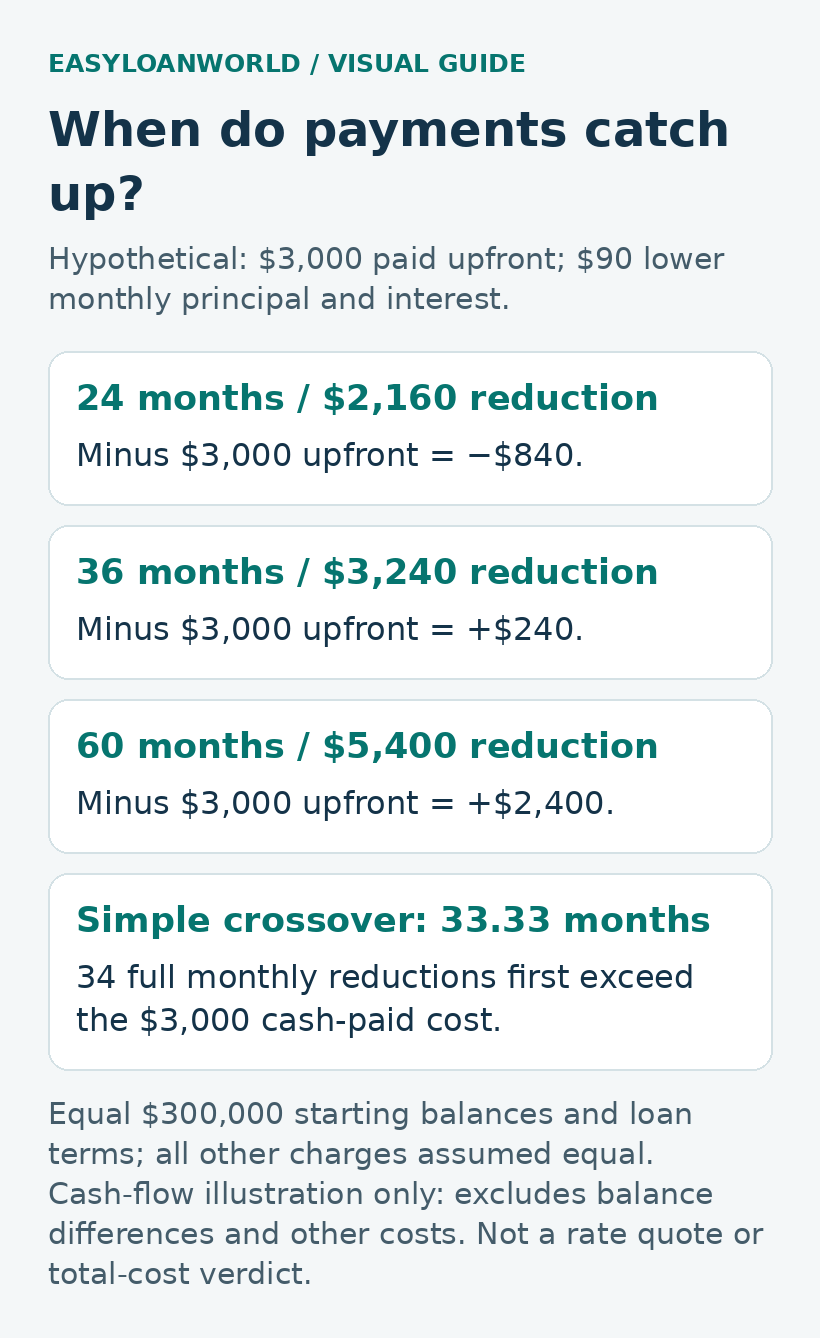
Suppose both offers start with a $300,000 balance and the same loan term. A has no discount points. B charges one point, or $3,000, paid from cash. B’s quoted monthly principal-and-interest payment is $90 lower. Assume all other charges are equal; no interest rates are assumed in this example.
$3,000 ÷ $90 = 33.33 months. With monthly installments, 34 full payment reductions first exceed the upfront $3,000. After 33 reductions, the total is only $2,970; after 34 it is $3,060.
| Loan kept for | Cumulative installment reduction | Reduction minus $3,000 upfront |
|---|---|---|
| 24 months | $2,160 | −$840 |
| 36 months | $3,240 | +$240 |
| 60 months | $5,400 | +$2,400 |
These are net cash-flow differences before other costs and loan-balance differences, not guaranteed savings or economic profit. At 36 months, the $240 margin is narrow. A fee omitted from the comparison could reverse the result.
For a separate sensitivity test, suppose B also has a $450 fee that A doesn’t. The incremental upfront cost becomes $3,450. Dividing by $90 gives 38.33 months, requiring 39 full monthly reductions. This change isn’t included in the table.
Test three possible payoff dates
Choose an early, likely and later date for keeping this particular loan. The 24-, 36- and 60-month checkpoints above are starting points, not recommended timelines. Replace them with dates that fit your circumstances.
A homeowner might plan to stay in the property for ten years but consider refinancing sooner. That makes the current loan’s holding period shorter than the home’s holding period. Don’t build the decision on a promised refinance: future rates, eligibility and availability are uncertain.
Write one sentence explaining each date. For example: “At 24 months, I may move for work”; “36 months is my planning case”; “60 months assumes no move or refinance.” This makes the uncertainty visible instead of hiding it inside one optimistic number.
Why payment break-even isn’t total borrowing cost
A mortgage installment includes principal repayment as well as interest. Calling every dollar of installments a financing cost would count repaid borrowing as though it were a fee. Different rates also change how quickly principal is repaid, so the alternatives can leave different balances at the same payoff date.
For equal starting loan balances, a useful undiscounted comparison is:
Upfront financing costs + principal-and-interest installments through the chosen date + remaining principal repaid at that date − original principal.
Use costs net of applicable lender credits, counted once. Add any differing mortgage insurance and applicable payoff charges separately. Don’t then add interest again: the expression already leaves interest and upfront financing costs after principal is reconciled. Request amortization schedules to check each remaining balance and total interest.
This is a borrowing-cost comparison, not a complete household wealth model. Opportunity cost and tax effects require explicit, defensible assumptions. Keep them separate from the basic arithmetic; don’t presume points produce a particular tax benefit.
If points are financed, the starting balances change. The cash-paid example can’t be reused unchanged, and financed costs haven’t disappeared. Ask for a consistent full comparison of cash flows and payoff balances, especially for irregular payments or changing rates.
Mortgage discount points: test a separate rate-based example
The earlier $90 payment reduction was a supplied fictional quote, without assumed rates. This calculator needs rates, so use a new example rather than pretending to derive that $90: $300,000 principal, 360 months, a 6.50% baseline rate and 6.25% with one cash-paid point. Enter zero other incremental upfront costs and a 60-month holding period. None of these inputs is a current offer or a standard price for buying a quarter-point rate reduction.
The baseline installment should be $1,896.20 and the lower-rate installment $1,847.15, with approximately $49.05 monthly payment reduction. The $3,000 points cost produces a simple payment break-even of about 61.16 months; the sixty-second whole monthly reduction first exceeds it. Don’t reuse the earlier 34-payment result, which belonged to a different $90 reduction.
At sixty months, cumulative payment reductions are about $2,943.15, slightly below the upfront cost. The lower-rate loan also leaves about $821.21 less principal: $280,011.72 remaining instead of $280,832.93. Combining payment reductions and lower remaining debt, then subtracting $3,000, gives approximately $764.36 net financing-cost savings in this separate model.
That positive financing-cost result doesn’t mean $764.36 extra cash has accumulated in the household’s account. It recognizes a smaller payoff obligation as well as lower payments. Payment recovery and borrowing-cost savings answer related but different questions, which is why their apparent crossover dates can differ.
For real mortgage discount points, enter each verified quote and change the holding period to test an earlier exit. Include only incremental cash-paid costs in this tool, keep other differing charges visible and verify both payoff balances. Financing the points changes the starting balance and falls outside this equal-principal comparison.
Keep the two worked examples labeled in your notes. One illustrates a quoted payment difference; the other derives payments from stated rates. Combining the first example’s $90 reduction with the second example’s balances would produce a hybrid that describes neither offer.
A fill-in quote worksheet
Make two copies of this checklist, one for each offer. Mark missing fields “request from lender” rather than entering zero.
- Lender and quote date/time: ___; rate-lock expiration and assumptions: ___.
- Starting balance: ___; term: ___; fixed or adjustable structure: ___; interest rate: ___.
- Points percentage: ___; points dollars: ___; other lender fees: ___; credits: ___.
- Upfront cash attributable to financing costs: ___; monthly principal and interest: ___; differing mortgage insurance: ___.
- At each chosen payoff date: installments paid ___; total interest ___; remaining principal ___; applicable exit charges ___.
- Expected loan-holding period: ___; cash remaining after closing: ___.
Ask four questions before deciding: Which fees reduce the rate? What else changes between these offers? What are the financing costs and payoff balances at my three dates? How much accessible cash will remain?
A favorable calculation doesn’t replace a cash-reserve decision. Record the money needed for near-term repairs and ordinary disruptions before committing additional cash to points. For individualized help, HUD’s housing-counseling network offers independent guidance; ask the agency about services and fees.
Common questions
Does one point always buy the same rate reduction?
No. Use the reduction in the actual written offer, not a rule of thumb.
Can points make sense if I may refinance?
Possibly, but compare costs through that earlier payoff date and test what happens if refinancing is unavailable.
Is an origination fee the same as points?
No. Check the fee’s purpose rather than relying on its percentage or label.
What if the payment reduction is zero?
A positive extra upfront cost has no finite positive break-even under this payment-reduction shortcut.
Use the Loan Estimate comparison worksheet to confirm that loan assumptions, fees and credits match before calculating the difference.
Featured photo: Photo by RDNE Stock project on Pexels. Used under the Pexels license. Illustrative stock photograph; the calculator display isn’t a mortgage quote, property price or part of the worked example. Photo by RDNE Stock project on Pexels.

One Mortgage Form, Two Borrowers
Match each person’s share.