Mortgage Preapproval vs. Your Comfortable Homebuying Budget
Build a homebuying budget that separates lender preapproval, monthly ownership costs, cash to close, and the savings you want left afterward.

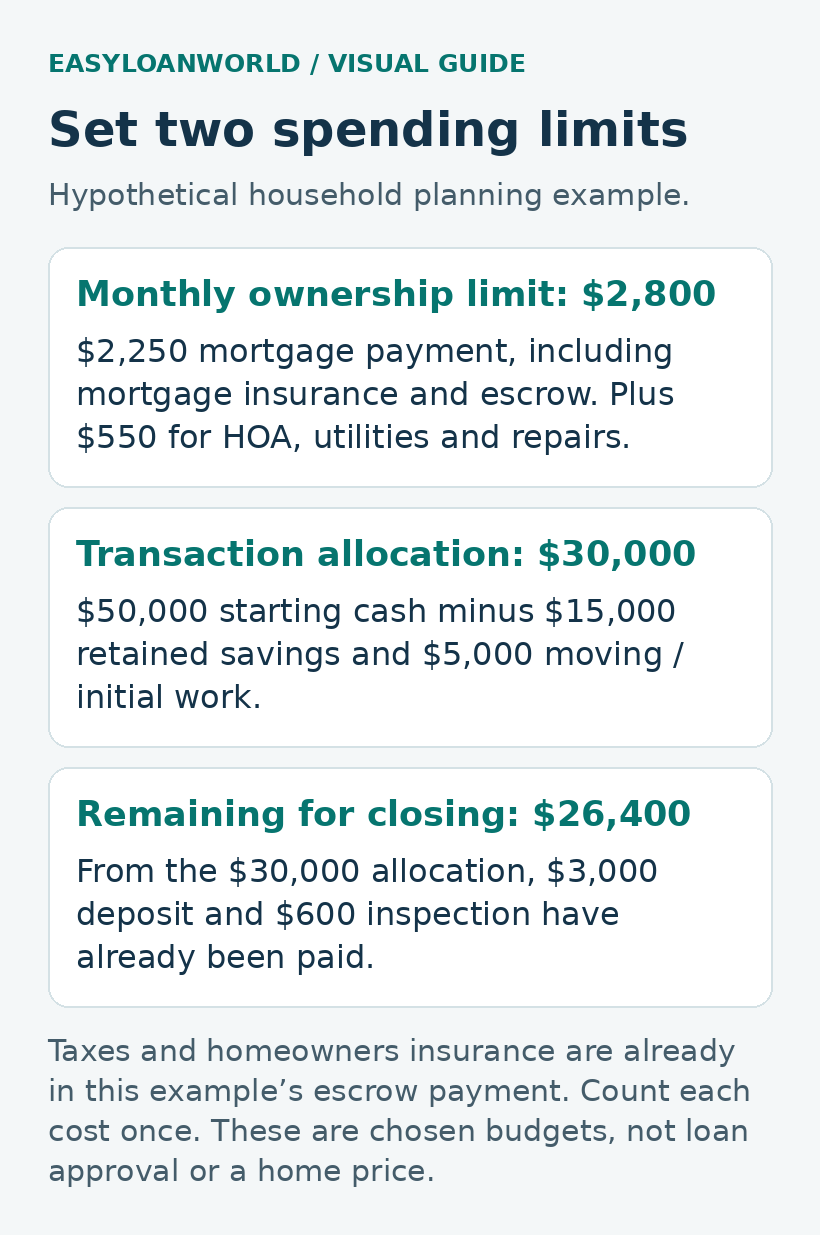
A mortgage preapproval can help you start shopping, but it does not tell you how much homeownership will comfortably fit into your life. Set two household limits before choosing a property: what you can spend each month and what you can use for the purchase while keeping enough cash afterward.
Those limits may be lower than the lender’s number. That is useful information, especially when two homes with similar prices have very different insurance, association, utility, or repair costs.
This U.S. educational guide uses fictional planning examples, not lending standards, mortgage quotes, or individualized financial advice.
First, understand what the lender’s letter means
Preapproval and prequalification describe conditional lending assessments, not guaranteed funding. Lenders use the labels differently, so ask what information was checked and which conditions remain. The CFPB explains why the label alone does not establish the lender’s process.
Read the actual number carefully. Is it a maximum loan amount, an assumed purchase price, or a figure tied to a particular down payment? A loan amount and a home’s price are different starting points for your worksheet.
- What borrower information has the lender verified?
- What assumptions were made about down payment, taxes, insurance, and other debts?
- When does the letter expire, and what changes require another review?
- What property-related conditions still need to be satisfied?
Keep the answers beside the letter. They are more useful than treating its headline number as a shopping target.
Choose a monthly ownership ceiling
Build this ceiling from take-home money actually available to your household. Keep the lender’s qualification calculation separate: it may use gross income and different expense measures. A lender’s approval threshold is not a promise that your preferred savings goals, childcare plans, or travel spending will still fit.
Start with a recent ordinary month, then review several months for irregular expenses. A monthly plan that forgets an annual car insurance premium can look comfortable until that bill arrives. Convert predictable nonmonthly expenses into monthly amounts before deciding what is available for housing.
For variable income, write down which portion you are relying on. Test whether the plan still works without the extra shifts or seasonal work you would prefer not to depend on. This is your planning choice, not a universal income rule.
Fictional household worksheet
- Monthly take-home income: $6,500
- Nonhousing commitments and living expenses: −$2,500
- Continuing savings goals: −$700
- Unallocated breathing room: −$500
- Total monthly homeownership ceiling: $2,800
The $2,800 is available for the whole ownership budget. It is not automatically the amount available for principal and interest. The household has deliberately protected its other priorities before shopping.
Create a cost card for each property
Include principal and interest, applicable mortgage insurance, property taxes, homeowners and other required insurance, association charges, utilities, and repairs. Some taxes and insurance may already be collected through escrow in the mortgage payment. Count each expense once. The CFPB’s home-spending guide explains why ownership budgeting extends beyond the loan installment and needs updating as property details arrive.
Use a separate line for a known assessment or major repair. A generic monthly maintenance allowance should not conceal a roof replacement you already expect soon after moving in.
Fictional Property A: monthly cost card
- Principal and interest: $1,650
- Mortgage insurance: $100
- Property taxes: $350
- Homeowners insurance: $150
- HOA dues: $100
- Utilities: $200
- Repair and replacement set-aside: $250
- Total ownership spending: $2,800
Assume only taxes and homeowners insurance are escrowed. The mortgage payment, including mortgage insurance and escrow, is $2,250: $1,650 + $100 + $350 + $150. The household then allocates another $550 for HOA dues, utilities, and repairs.
Adding the $500 of taxes and homeowners insurance again would overstate the budget. Leaving out the extra $550 would understate it. Label every line “inside mortgage payment” or “outside mortgage payment” to catch either mistake.
Set a separate limit for upfront cash
Your down payment is only part of your upfront plan. Keep transaction costs, moving expenses, initial work, and retained savings visible rather than assigning your entire account balance to the down payment. The CFPB’s down-payment planning guidance uses this separation to help buyers assess available purchase funds.
Suppose this fictional household starts with $50,000 before making any purchase payments. It protects $15,000 for emergency savings after the purchase and $5,000 for moving and initial work. That leaves a $30,000 transaction allocation.
If it has already paid a $3,000 earnest-money deposit and a separate $600 inspection from that original balance, $26,400 of the transaction allocation remains for closing. Its actual remaining cash is $46,400, of which $20,000 remains earmarked for the other priorities.
Now compare that $26,400 with the current estimated cash to close. Check that the estimate already reflects the earnest-money credit. Do not subtract that deposit a second time. An expense paid earlier and credited on the closing paperwork is not another future payment.
For your own calculation, record:
- Funds available today
- Estimated cash to close from current paperwork
- Other unpaid preclosing expenses not included there
- Moving and initial-work money
- Cash left afterward and your minimum retained balance
- Any separately identified lender reserve requirement
A household savings preference and a lender’s reserve requirement are separate checks. Do not automatically add them together as if the same dollars could never satisfy both; ask the lender which funds qualify.
Stress-test the actual home before making the offer
Replace placeholders with property-specific evidence. Request insurance quotes, ask how the tax estimate was calculated, review association documents and known assessments, and use inspection findings to identify near-term work. Ask whether reassessment could change the future tax bill rather than assuming the seller’s current bill will be yours.
For Property A, imagine the household chooses a $150 monthly contingency for higher tax, insurance, or repair needs. Spending becomes $2,950, which exceeds its chosen ceiling by $150. This is a test, not a prediction. The result gives the household a concrete choice: reconsider the property, purchase price, other spending, or timing.
Run a second version with lower income if that is a realistic concern. Do not make an unaffordable purchase depend on a future refinance, raise, or resale price that has not happened.
Three questions buyers often ask
Can I borrow less than the preapproval amount?
You can pursue a smaller purchase or loan, subject to the lender’s terms. Ask for updated property-specific figures instead of proportionally shrinking every cost: taxes, insurance, and fees do not all move together.
Is escrow my home-maintenance fund?
No. An escrow collection for taxes and insurance does not replace the repair set-aside in your household budget. Keep those jobs separate in your cost card.
Does the letter lock my interest rate?
Do not assume so. Ask for the written rate-lock terms, expiration, and conditions. Put the answer beside your payment estimate so you know what still needs confirmation.
Before committing: check that the home passes both limits using current information. A workable monthly bill and sufficient upfront cash are two distinct requirements.
Featured photo: Photo by Curtis Adams on Pexels. Used under the Pexels license. Illustrative stock photograph; not a home listing, price illustration or property recommendation.
California Supplemental Property Tax: Check the Bill, Payment and Cash
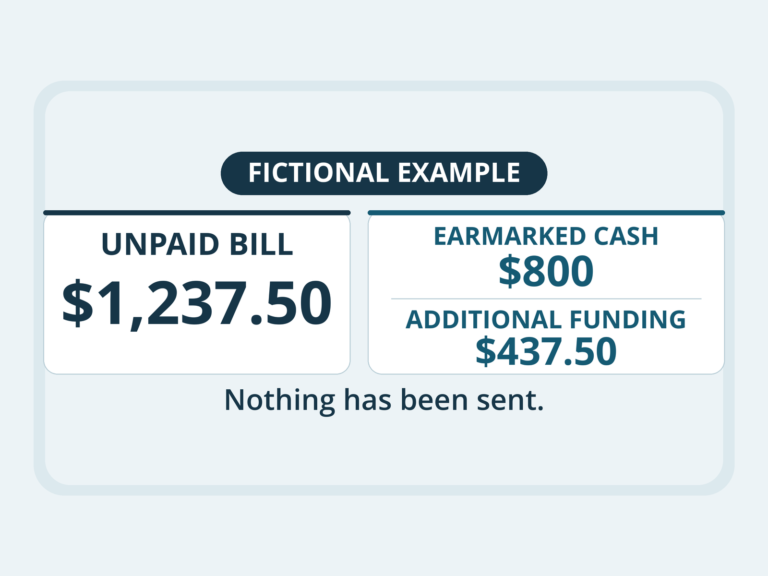
Organize one California supplemental property tax bill, its payment evidence and the cash earmarked for it. A fictional example shows why a funding gap…
Title Insurance Quotes: Compare Policies, Services and Payers
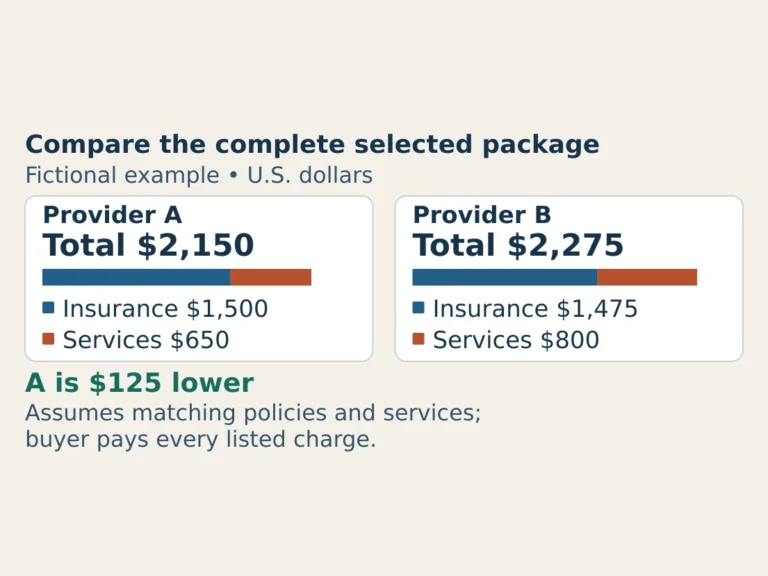
Compare fictional $2,150 and $2,275 title packages using matched coverage, complete service charges and a separate payer worksheet.

Flood Insurance Quote: Test Two Deductibles Against Your Cash Reserve
Test fictional flood quotes against a $6,000 reserve: $180 in annual savings comes with $3,000 more building deductible exposure.