Mortgage Recast vs. Refinance: Compare Payments, Payoff Dates and Costs
Compare mortgage recasting, refinancing and extra principal payments with a worked example covering monthly payments, payoff dates and remaining interest.

A mortgage recast recalculates the required payment after extra principal has been paid on an eligible existing loan. The rate and remaining term stay the same. Chase explains how recasting works.
Refinancing replaces the mortgage with a new loan, usually with closing costs. A lower payment can come partly from extending repayment. The CFPB’s mortgage definitions distinguish these changes.
There is another comparison worth making: pay the same lump sum toward principal and keep paying the old monthly amount. Before choosing, decide whether you need a lower required payment, an earlier payoff or more cash available for emergencies.
This U.S. guide is educational, not individualized financial, legal or tax advice. Sources checked October 19, 2026. Example rates and costs are hypothetical, not current quotes.
Check eligibility before transferring cash
Recasting is subject to investor and servicing rules. Chase currently says its process requires no credit check or appraisal and has no minimum principal reduction. Its published policy excludes FHA, VA and USDA loans; these are Chase’s terms, not a universal eligibility promise.
Bank of America’s recast FAQ illustrates different requirements: at least $5,000 in extra principal within six months, the first six required monthly payments made, current status and no recast in the previous 12 months. It lists no recast fee and says it cannot provide estimates before completion. Confirm your own servicer’s current process.
Ask whether an estimate is available before paying principal, when the final agreement arrives and what happens if you decline it afterward. Do not send money on the assumption that a lower required payment is guaranteed.
Check for a prepayment penalty before a large paydown or refinance. For refinancing, obtain a dated payoff quote: statement principal may exclude accrued interest and other amounts due. The CFPB explains payoff amounts and penalties.
One $50,000 paydown, four different outcomes
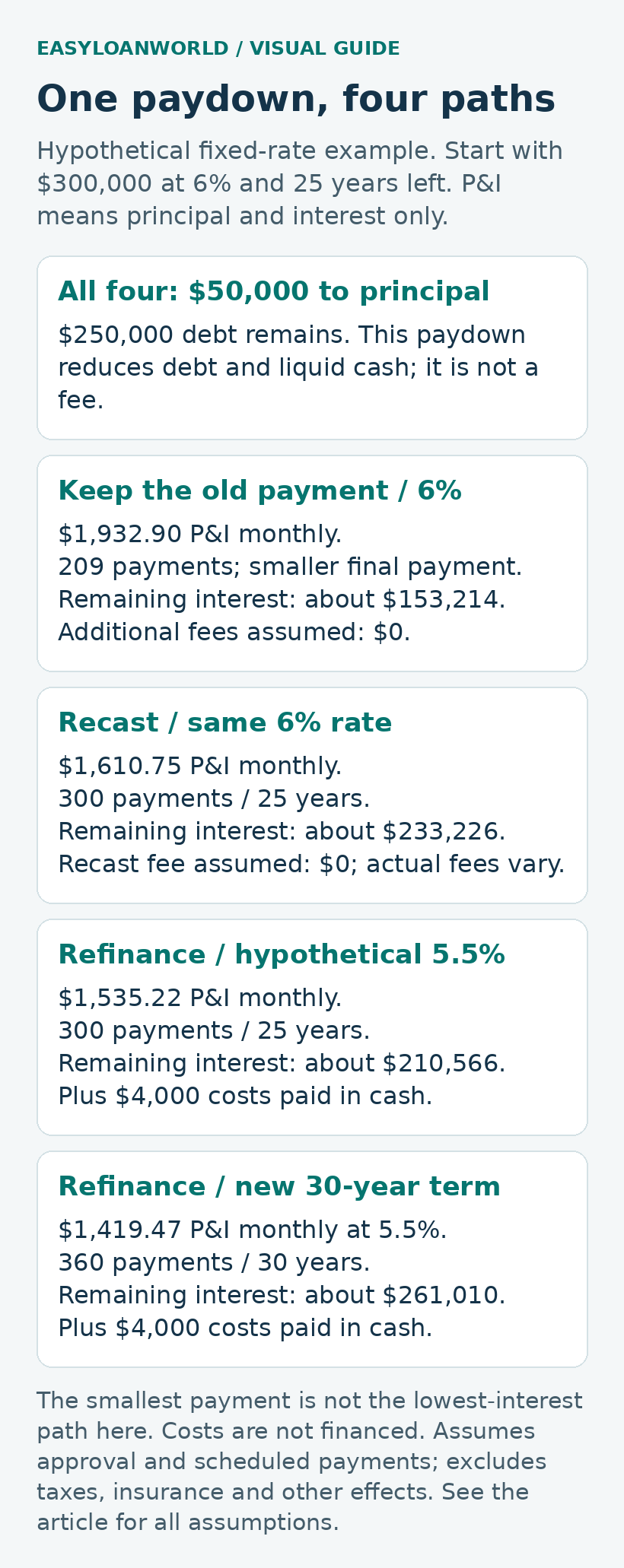
Assume a current, fully amortizing fixed-rate mortgage with $300,000 remaining, a 6% note rate and 300 months, or 25 years, left. Its monthly principal and interest payment, called P&I here, is approximately $1,932.90.
Each alternative immediately applies $50,000 to principal, leaving $250,000. Assume a $0 recast fee. Each refinance also requires $4,000 of cash-paid borrowing costs. Those costs are additional to the paydown and are not added to the new balance. Availability and approval of the hypothetical refinance loans are assumed only for this calculation.
The $50,000 reduces both cash and debt; it is not a fee. Refinance paths therefore use $54,000 upfront in this simplified example, while the other paths use $50,000.
-
Keep the loan and the old payment
- Rate: 6%; no recast
- Monthly P&I: $1,932.90
- Payoff: 209 payments, with a smaller final payment
- Remaining interest: approximately $153,214
- Additional fees assumed: $0
-
Recast over the remaining 25 years
- Rate: 6%; same existing loan
- Monthly P&I: $1,610.75
- Payoff: 300 payments
- Remaining interest: approximately $233,226
- Additional fees assumed: $0
-
Refinance for 25 years
- Hypothetical rate: 5.5%; new loan
- Monthly P&I: $1,535.22
- Payoff: 300 payments
- Remaining interest: approximately $210,566
- Additional cash-paid costs: $4,000
-
Refinance for 30 years
- Hypothetical rate: 5.5%; new loan
- Monthly P&I: $1,419.47
- Payoff: 360 payments
- Remaining interest: approximately $261,010
- Additional cash-paid costs: $4,000
These are hypothetical P&I-only comparisons. Calculations use monthly amortization and unrounded payments, then round results for display. Actual rounding and payment timing can change exact amounts. They exclude escrow, mortgage insurance, penalties, accrued payoff interest, arrears, deferred balances, tax effects, investment returns and opportunity costs.
For a standard fixed-rate mortgage, P&I depends on the balance, interest rate and term. Taxes and insurance can increase the actual bill, as the CFPB’s payment explainer notes.
Separate the paydown from the payment reduction
In this example, the no-recast path has the highest required payment but the earliest payoff and least remaining interest. The recast lowers the obligation by about $322 a month while spreading the smaller balance across all 300 remaining months.
Compared with making the same paydown and continuing the old payment, taking that lower installment gives up about $80,012 in modeled interest savings. This does not mean a recast always increases interest versus doing nothing.
Keeping the original loan without any paydown would produce approximately $279,871 in remaining interest. It would also preserve $50,000 in cash. That is a different comparison, not a fifth equal-paydown option.
A recast may still permit voluntary extra principal payments; Chase explicitly allows them. Confirm your own loan’s terms.
If the recast borrower keeps paying $1,932.90 under the same rate, balance and timing assumptions, with no extra fee, the actual payoff path matches the no-recast calculation. The lower minimum offers flexibility; using it changes the repayment outcome.
A lower rate can still mean more remaining interest
The 30-year refinance has this example’s smallest installment, yet produces about $261,010 in interest plus $4,000 of costs. That exceeds the recast’s approximately $233,226 in interest, despite the lower rate. Extending repayment adds five years.
The CFPB’s refinancing handout explains that shorter terms can raise payments while reducing interest, and longer terms can lower payments while increasing total cost. Ask whether a lender offers a term matching your remaining years; the illustrated 25-year loan is not universally available. Qualification, credit, property value and how long you expect to keep the loan also matter.
Compare actual offers at your likely exit date
Lifetime totals assume you keep making the modeled payments until payoff. If you expect to sell or refinance earlier, request a comparison through that month, including the balance still owed.
After 60 payments in this example, the no-recast balance is about $202,354 versus $224,830 after recasting. Interest paid is about $68,328 versus $71,475. The no-recast borrower has also made larger monthly payments; the lower balance alone does not measure overall financial wealth.
For the two refinance paths, five-year interest plus the $4,000 costs is approximately $69,292 for 25 years and $70,320 for 30 years. Their remaining balances are about $223,179 and $231,152, respectively.
Use a worksheet with one entry per option:
- Your main goal, affordable total payment and expected exit month
- Current principal, dated payoff quote, note rate, P&I and months left
- Principal paydown and liquid savings left afterward
- Recast eligibility, minimum, timing, repeat limits, fee and required documents
- New loan’s rate structure, term, starting balance and cash-paid versus financed costs
- Required P&I, full housing payment, exit-date balance and cumulative interest
- Mortgage insurance, escrow treatment and any prepayment charge
For these equal starting balances, interest paid over a period equals P&I paid plus ending principal minus starting principal. Add cash-paid fees separately. Do not count the remaining principal twice.
A “no-closing-cost” refinance may use a higher rate to fund a lender credit or add costs to the balance. It is not necessarily free, explains the CFPB’s no-cost-loan guide.
Financed costs would require recalculating this example. For actual paperwork, use our guides to comparing Loan Estimates and closing costs versus cash to close.
Protect cash reserves and confirm the change
Set aside money for emergencies, repairs and known bills before choosing a paydown. Home equity cannot directly cover an unexpected expense, and future borrowing against it is not guaranteed. A lower minimum payment may be valuable even when it is not the lowest-interest path.
Confirm how to designate a principal payment, then check its application. Keep making the required payment until the servicer confirms the new amount and effective date. Save the agreement and check automatic payment settings.
If you are already struggling with required payments, ask your servicer or a housing counselor about assistance options. A large cash paydown should not be treated as the only route to help.
Quick questions
Does this comparison assume PMI disappears?
No. It excludes mortgage insurance. Ask separately about any cancellation requirements and incorporate the confirmed result into your actual comparison.
Can I divide $50,000 by the monthly reduction to find break-even?
No. That treats debt repayment like a fee. Compare fees, interest, remaining debt and usable cash over the same period instead.
Featured photo: Photo by Jakub Żerdzicki on Unsplash. Used under the Unsplash license. Illustrative stock photograph of home-finance tools; no actual loan offer or property price is depicted. Photo by Jakub Żerdzicki on Unsplash.
Mortgage Charge Questions: Choose the Record That Answers Them
Match a questionable mortgage charge to account detail, service records or adjustments with a worked property-inspection example and a two-part index.

Partial Mortgage Payment: Track Money Held in Suspense
Follow a fictional $1,100 and $700 mortgage payment trail, compare dated records, and build a precise question about an unexplained entry.

Minnesota Contract for Deed: Check the Seller, Title and Balloon
Before signing a Minnesota contract for deed, organize seller, disclosure and title evidence, then test a fictional balloon-payment ledger.