Order Size Costs
Compare annual components.
Estimated reading time: 1 minute
NC State’s inventory tutorial compares annual ordering and holding costs when evaluating order quantities.
Fictional business: annual demand is 6,000 units, ordering costs $30 per order, and holding costs $4 per unit annually. Assume steady consumption, immediate replenishment when stock reaches zero, no shortages, and average stock equal to half each order.
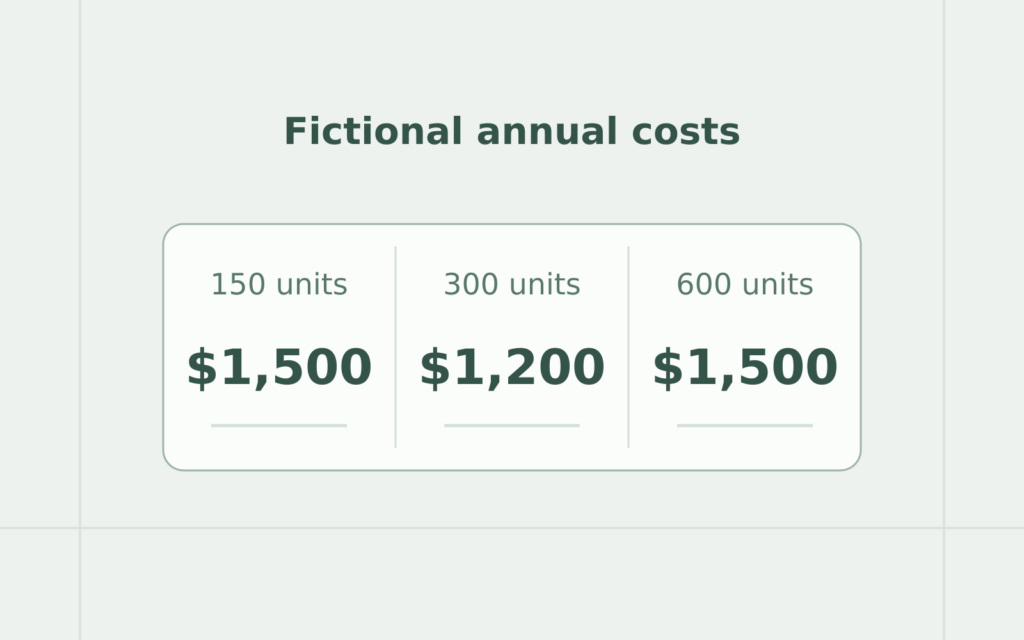
Ordering 150 units means 40 orders: $1,200 ordering cost. Average stock is 75 units, costing $300 to hold. Total: $1,500.
Ordering 300 units means 20 orders costing $600, plus 150 average units costing $600. Total: $1,200.
Ordering 600 units means 10 orders costing $300, plus 300 average units costing $1,200. Total: $1,500.
Thus, the 300-unit option costs $300 less than either tested alternative. Minimizing order count alone misses holding costs.
Identical unit purchase prices make annual goods cost equal across these cases; it is excluded, not free. This model does not establish delivery reliability, storage capacity or funding availability. Check those constraints and demand uncertainty before treating a cost comparison as an order instruction.