PMI Removal vs. FHA Mortgage Insurance: Find the Rule for Your Loan
Separate conventional PMI cancellation from FHA MIP rules, check your loan's dates and balances, and prepare the right questions for your servicer.
Estimated reading time: 8 minutes
PMI removal starts with identifying the loan and its applicable rule. Before sending extra principal or paying for an appraisal, identify whether your loan has conventional PMI or FHA annual MIP and which ending rule applies. A promising equity estimate is only a starting point. Request a written explanation of the value or date used, remaining conditions and effective date for your actual mortgage.
This guide separates conventional private mortgage insurance (PMI) from FHA annual mortgage insurance premiums (MIP). Mortgage insurance protects the lender; it isn’t homeowners insurance.
Scope: The conventional summary concerns covered single-family principal-residence loans closed on or after July 29, 1999. Lender-paid insurance has different rules. Older loans, high-risk exceptions, modifications and special programs need individual review. The FHA discussion concerns standard forward mortgages, not reverse mortgages.
Find the PMI removal route before calculating equity
| Route | Starting point | Key question for the servicer |
|---|---|---|
| Conventional borrower-requested cancellation | 80% of original value, reached on schedule or through actual principal reduction | Which written-request, payment-history, lien and value-evidence conditions remain? |
| Conventional scheduled automatic termination | Scheduled 78% of original value | What is the scheduled termination date, and are payments current? |
| Conventional midpoint backstop | The month after the amortization period’s midpoint | Does PMI still remain, and are payments current for this route? |
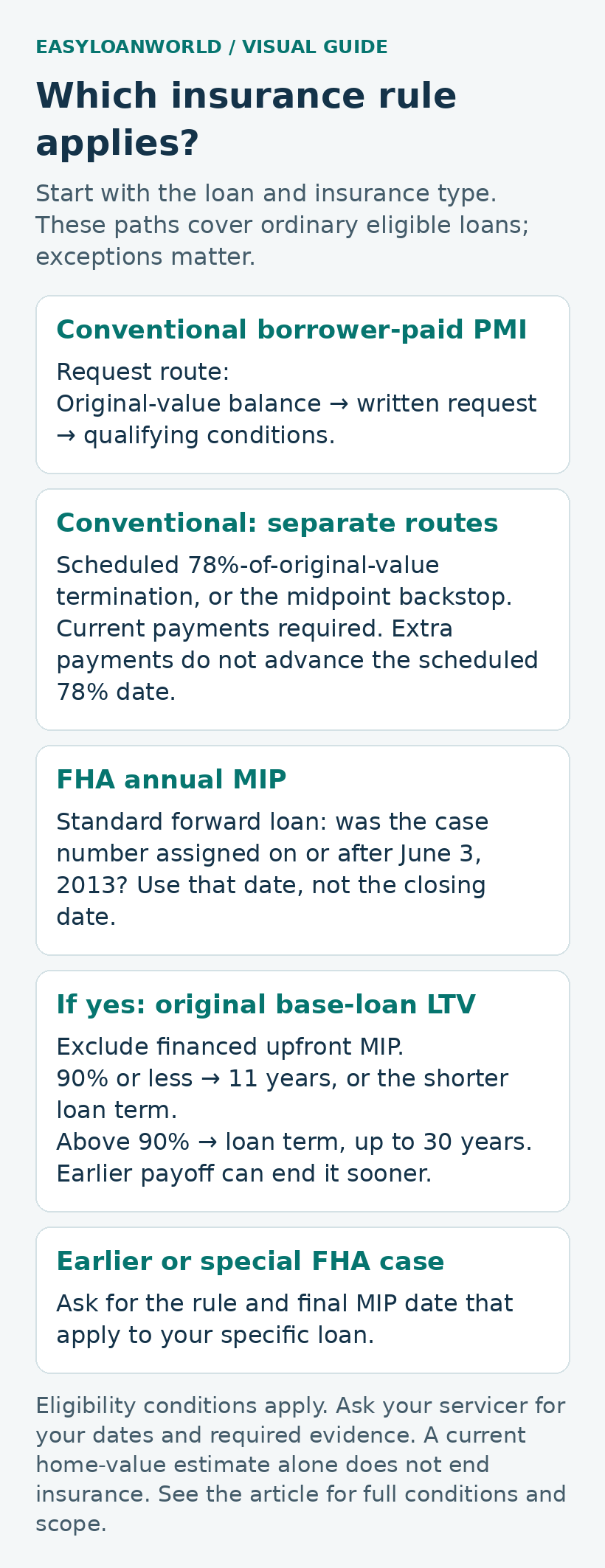
| FHA cases assigned on or after June 3, 2013 | Original base-loan LTV, case-assignment date and term | What final monthly MIP date is recorded? Current equity alone does not replace this duration rule. |
| An eligible investor current-value route | The investor’s own seasoning, LTV, payment-history and valuation requirements | Does the loan qualify for that route, and which valuation process is accepted? |
Older FHA cases require the separate eligibility check below. Don’t choose a row solely because its percentage looks favorable; establish the mortgage type and rule first.
PMI removal: distinguish the conventional routes
1. Request cancellation at 80%
You can request cancellation when principal is scheduled to reach 80% of original value, or earlier through actual principal reduction. Original value generally means the lower of the purchase price and original appraised value; for refinancing, generally the refinance appraisal.
The request must be written. You must be current, have good payment history, certify no junior liens and provide required evidence that value hasn’t fallen below original value. A qualifying request must be granted. See the CFPB’s cancellation requirements.
2. Scheduled automatic termination at 78%
For covered loans, PMI must end when the scheduled balance reaches 78% of original value if payments are current. If overdue, it ends the first day of the month after payments become current. Extra payments don’t advance that scheduled date. Falling property value doesn’t block this route, and a valuation can’t be required.
3. The midpoint backstop
If PMI remains, termination is required the month after the amortization period’s midpoint, provided payments are current. Investor policies can’t narrow federal rights. These distinctions are explained in CFPB Bulletin 2015-03. The cancellation, termination and modification provisions are also set out in the current official text of 12 U.S.C. §4902.
FHA annual MIP: start with case assignment and original loan-to-value (LTV)
For standard FHA case numbers assigned on or after June 3, 2013, original base-loan LTV, excluding financed upfront MIP, generally determines annual-MIP duration:
- 90% or less: 11 years, or the shorter mortgage term.
- Above 90%: the mortgage term, up to 30 years.
Case-assignment and closing dates differ. Annual and upfront MIP are separate. Later equity doesn’t change duration. See HUD’s duration policy.
Eligible older cases may have a 78% route: HUD identifies cases closed after December 31, 2000, assigned before June 3, 2013, and meeting its additional eligibility rules. This doesn’t cover every pre-2013 loan. Paying the mortgage off early can also end insurance. See HUD’s premium-discontinuation guidance.
For the applicable older-case route, terms exceeding 15 years also require at least five years of MIP. Ask for the final monthly MIP payment date in the servicing record rather than estimating it from your closing anniversary. HUD explains that record here.
Hypothetical FHA comparison: Two otherwise eligible 30-year loans have case numbers assigned on or after June 3, 2013. At original base-loan LTVs of 89% and 96.5%, their ordinary MIP paths are respectively 11 years and the loan term, subject to earlier payoff.
PMI removal: work the numbers before committing cash
Hypothetical conventional example: Assume an original value of $300,000, a current principal balance of $244,000 and borrower-paid PMI. These invented figures illustrate the arithmetic; they aren’t an eligibility determination.
- 80% of $300,000 is $240,000.
- The gap from $244,000 to $240,000 is $4,000.
- 78% of $300,000 is $234,000.
Reaching the first number doesn’t satisfy every cancellation condition. The second threshold identifies a scheduled-termination calculation, not an instruction to pay $10,000 for immediate removal.
Request the actual disclosure or amortization schedule. The two balance figures alone can’t tell you the calendar dates. Record the date and balance together so that a service representative can see exactly which calculation you’re discussing.
A principal payment is also different from a fee: it reduces debt and available cash. In your planning notes, put an optional principal payment on a separate line from any proposed valuation charge. That prevents treating both amounts as money permanently spent to cancel insurance.
For a limited expense check, suppose a servicer quotes a $250 valuation fee and the hypothetical PMI charge is $100 monthly. The fee equals 2.5 months of that charge. That arithmetic assumes cancellation follows; it doesn’t establish eligibility or guarantee a saving. Find out what happens if the valuation doesn’t support the request before ordering it.
PMI removal when your home has appreciated
A $350,000 online estimate would put the example’s $244,000 balance at about 69.7% of estimated current value. Write “online estimate” beside that result. Don’t silently substitute it for the $300,000 original-value figure.
Some investor routes use current value. For an eligible Fannie Mae one-unit primary home, ordinary thresholds are 75% LTV for loans two to five years old and 80% for loans older than five years. Qualifying improvements have a separate exception. Payment history and an approved valuation process also matter. An online estimate isn’t that valuation. These are Fannie Mae’s rules, not universal conventional-loan requirements.
Build a one-page evidence worksheet
Create a note with four columns: item, your document, servicer’s answer, and unresolved question. Leave unknowns blank instead of filling them with estimates. This makes the call or secure-message exchange easier to follow and gives you a record to check afterward.
- Identity: Loan program, insurance label, who pays the premium, and the statement where you found those details.
- History: Closing date and any refinance or modification. For FHA, record the case-assignment date separately.
- Starting figures: Document supporting original value or original base-loan LTV; note the page number, not just the amount.
- Today’s evidence: Current principal, payment status, payment-history records and any junior lien.
- Relevant dates: Copy the servicer’s scheduled cancellation, termination or final MIP date, as applicable.
- Review logistics: Requested route, missing documents, permitted valuation provider, quoted cost, submission channel and response date.
- Outcome: Written decision, stated effective date, revised payment and the next statement you checked.
For an initial inquiry, adapt this wording:
“Please identify my mortgage-insurance type and the ending rule that applies. Please provide the relevant balance or date, remaining requirements, accepted valuation process and any cost before I order it. If I am ineligible, please explain the reason and next review date in writing.”
For an original-value PMI application, expressly request cancellation in writing. Keep a copy of what you send, including attachments and the confirmation number. If the answer merely says “insufficient equity,” ask which value, balance and review route produced that answer. A precise explanation is more useful than repeating the same calculation over the phone.
If refinancing enters the conversation
Refinancing replaces the existing loan and usually involves closing costs. A new conventional loan may still require PMI.
Build two side-by-side scenarios for the period you expect to keep the mortgage. Record cash due, new debt balance, rate, remaining versus proposed term, insurance charges and the balance at the end of that period. Ask for missing figures before deciding whether the disappearance of one line item improves the whole transaction. Our closing costs versus cash to close guide helps organize the upfront figures.
After the servicer responds to your PMI removal question
Keep making the full required payment until the servicer confirms a revised amount; don’t subtract insurance yourself. Save the decision beside the next statement and compare the insurance line and total due separately, since taxes and other escrow items can change independently. If the figures disagree, send the servicer both documents and identify the specific difference.
Insurance-ending rules and worked examples rechecked October 25, 2026. U.S. educational information, not individualized financial or legal advice.
If a replacement mortgage is proposed, compare recast and refinance costs separately from whether the current insurance can end.
Featured photo: Photo by Roger Starnes Sr on Unsplash. Used under the Unsplash license. Illustrative stock photograph; no mortgage type, mortgage-insurance status or borrower is identified for this property. Photo by Roger Starnes Sr on Unsplash.

One Mortgage Form, Two Borrowers
Match each person’s share.