Reverse Mortgage Responsibilities: Build a HECM Property-Cost Plan
Organize property bills, payment responsibilities and unanswered questions before evaluating a HECM proposal. Includes a fictional planning example.
Estimated reading time: 8 minutes
HECM property costs remain part of the household plan even without regular monthly mortgage repayments. List the bills, distinguish a chosen maintenance allowance from known charges, and identify questions for counseling.
This guide concerns Home Equity Conversion Mortgages, or HECMs. Borrowers don’t make regular monthly mortgage repayments, but interest and fees add to the loan balance. That repayment structure doesn’t eliminate property expenses. See the CFPB’s HECM overview.
The worksheet below is an original organizing method for a U.S. household. It isn’t an eligibility assessment, loan recommendation or substitute for individual financial or legal advice.
HECM property costs: match the loan arrangement
HECM borrowers must pay property charges such as taxes and homeowners insurance on time, maintain the home and use it as their principal residence. Failing these requirements can lead to foreclosure. Payment arrangements can involve direct payment, servicer payment or reserved loan funds; some arrangements provide money for the homeowner to pay. Confirm your specific arrangement with the lender or servicer. The CFPB explains these responsibilities.
For property taxes and homeowners insurance, a fully funded reserve pays bills directly; partial funding sends you money to pay. Check your statement or ask the servicer about set-asides.
A fictional property-cost worksheet
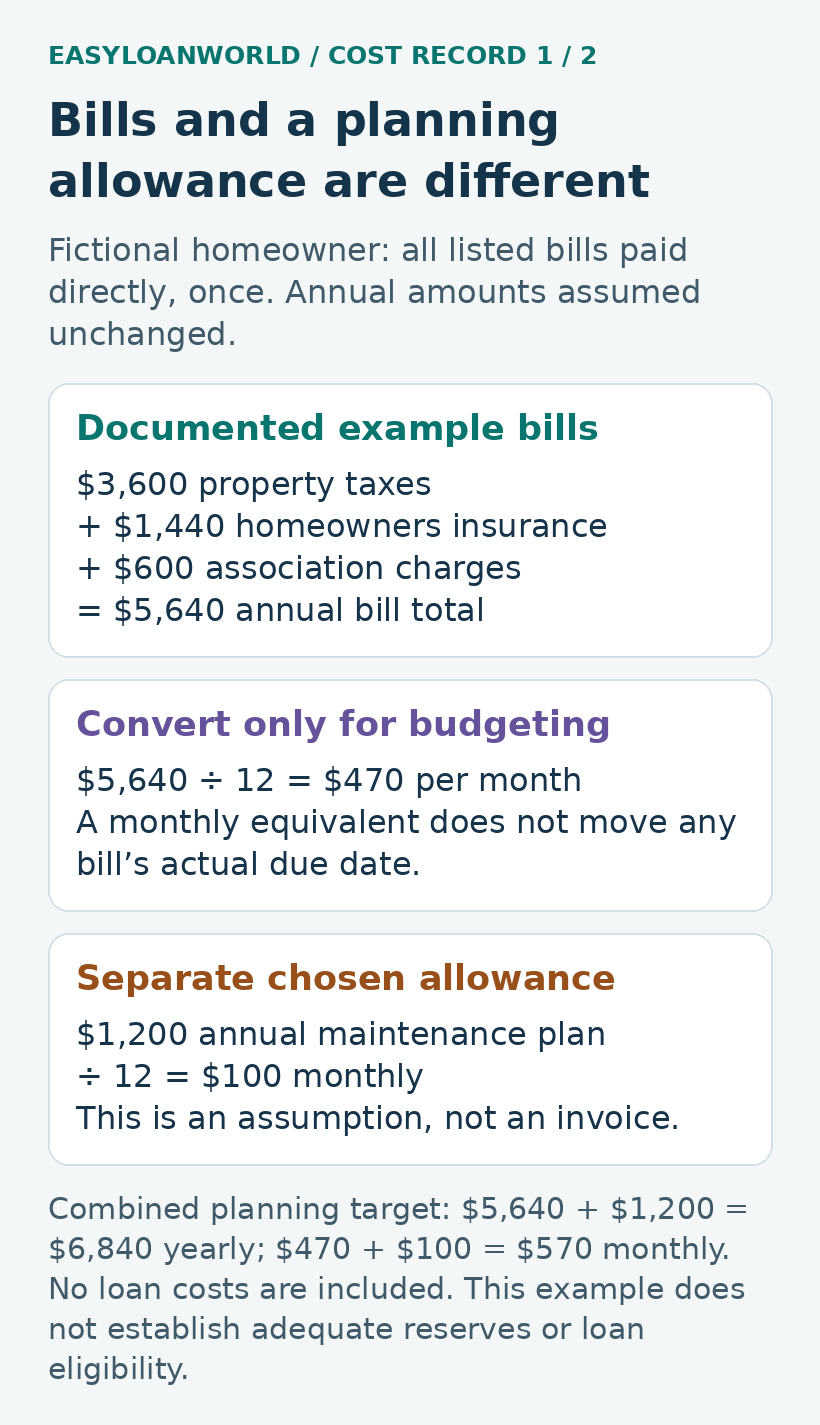
Assume a fictional homeowner pays all these costs directly. None is paid again through a servicer arrangement. Annual property taxes are $3,600, homeowners insurance is $1,440 and association charges are $600. All three amounts are assumed unchanged for this example.
The actual-bill total is $5,640 a year: $3,600 + $1,440 + $600. Dividing by 12 gives a monthly budgeting equivalent of $470. That conversion helps compare annual figures with a monthly household budget; it doesn’t change any bill’s due date.
The homeowner also chooses a $1,200 annual maintenance planning allowance. This is a discretionary assumption, not an actual invoice, required payment or prediction of repair costs. It adds $100 per month to the planning figure, producing a combined target of $6,840 a year, or $570 per month.
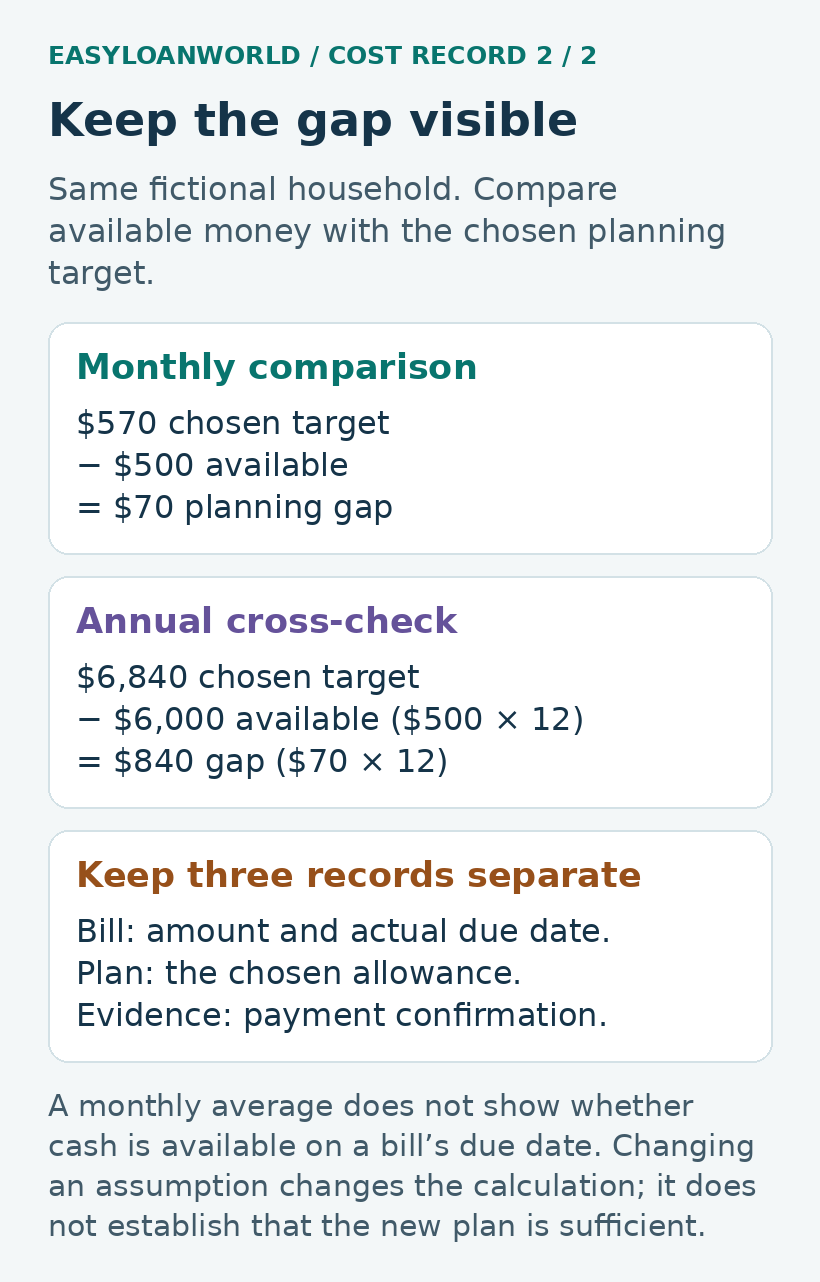
Suppose the household has $500 per month available after its other outgoings. Against the chosen $570 target, the gap is $70 monthly, or $840 annually. Record that gap openly. Calling the allowance “optional” doesn’t establish that a smaller allowance would meet the household’s needs.
This arithmetic establishes neither loan eligibility nor adequate reserves. It omits loan costs and says nothing about what a particular home will need. The homeowner must also check whether money will be available on the actual bill dates. A monthly average alone can’t answer that question.
HECM property costs: test when a bill arrives
The $470 monthly equivalent is a way to summarize annual bills. It doesn’t establish that the household can pay a large charge early in the year. Build a dated cash schedule beside the annual total.
For a new isolated example, assume the $3,600 annual tax bill is due after exactly three monthly contributions of $300 to a dedicated tax fund. The fund starts at zero, earns nothing and has no other deposits or withdrawals.
At the due date, only $900 is in that fund. The gap is $3,600 − $900 = $2,700. Saving $300 monthly would equal $3,600 over a full 12 months, but it does not supply all that money after three months.
If the fund instead starts with $2,700 already dedicated to that bill, the three $300 contributions bring it to exactly $3,600. That separate starting-balance assumption closes the modeled timing gap.
These dates are fictional, not a tax calendar or payment instruction. Use the actual bill’s due date, amount and available funds for the household’s own schedule.
Keep the annual target and first due date together
Taxes, insurance and association charges may have different schedules. Record their actual dates and whether a bill has already been paid. One annual total can hide a concentration of charges before enough monthly income arrives.
For an independent insurance example, assume a $1,440 premium is due after six monthly deposits of $120 into a zero-start fund. The contributions total $720, leaving a $720 timing gap at that point.
The arithmetic doesn’t establish whether installments are available or whether changing the payment schedule is appropriate. Ask the relevant provider about actual options and terms rather than assuming the annual bill can be divided at will.
Keep a bill already paid out of the remaining-cash requirement. If an account balance is recorded after payment, subtracting the same bill again would exaggerate the future gap.
HECM property costs: separate arrangements from responsibility
The original worksheet assumes direct payment of every listed charge. If the actual arrangement uses a servicer or reserved loan funds, the household worksheet must identify which specific bills are handled through that arrangement.
For example, a tax amount shown in an arrangement shouldn’t also be recorded as another identical bill paid directly unless the records show a separate obligation. The charge exists once even if several documents describe it.
At the same time, don’t assume every property expense is covered because one tax or insurance arrangement exists. Ask which charges and periods it addresses and what remains for the homeowner to pay.
A partially funded arrangement that sends money to the homeowner needs a receipt-and-payment sequence. Money expected from the arrangement isn’t evidence that the final bill has already been paid to its recipient.
Confirm unknowns with the lender or servicer using the actual statement and bill. A generic annual budget can’t settle who will transmit a particular payment or when funds become usable.
Test a changed bill without rewriting the allowance
Use another independent scenario. Keep taxes at $3,600 and association charges at $600, but increase the assumed annual insurance bill from $1,440 to $1,800. The actual-bill total becomes $6,000, or $500 monthly.
Keep the chosen $1,200 annual maintenance allowance unchanged. The combined planning target becomes $7,200 annually, or $600 monthly. Against the original $500 available monthly, the target gap becomes $100 per month, or $1,200 annually.
The $360 higher insurance bill raises the monthly target by $30. It doesn’t show that the maintenance allowance should fall by $30 or that a reduced allowance would be adequate for the home.
Label the changed bill and hold the other inputs fixed when explaining this sensitivity. Otherwise the reader can’t tell whether a new result came from insurance, taxes, available money or a different maintenance choice.
Distinguish a planning allowance from a repair invoice
The original $1,200 maintenance allowance isn’t a prediction or maximum. A later actual repair invoice must be recorded at its own amount and due date. It shouldn’t be declared covered merely because the annual worksheet contains a maintenance line.
For a fictional example, suppose $900 has accumulated in a dedicated maintenance fund when a $1,500 repair bill becomes due. The current funding gap is $600. That result depends on the available fund, not just the chosen annual allowance.
Don’t enter the $1,200 annual allowance as an additional cash deposit if only $900 has actually accumulated. An intended contribution and money already held are different quantities.
The exercise doesn’t judge the necessity or price of a repair. It makes the funding question explicit so the homeowner can discuss the actual bill, timing and available assistance or arrangements with appropriate people.
Prepare questions the counselor can investigate
Bring the property bills, actual payment arrangements, dated available cash, loan proposal and list of unknowns. Separate recurring charges from proposed repairs and discretionary planning assumptions.
Ask how the proposed arrangement handles taxes and insurance, what remains the homeowner’s responsibility and how changes would be communicated. Request clarification of an unexplained statement entry instead of assuming that reserved funds are unrestricted spending cash.
Also identify expected household or residence changes for the counseling discussion. The arithmetic can’t answer occupancy, future-move or borrower-protection questions. Those need the applicable loan information and individual guidance.
A useful HECM property costs plan explains both the annual burden and the money available at each bill date. It should identify an unresolved shortfall plainly, without treating the absence of regular mortgage repayments as the absence of property obligations.
When revising the worksheet, date each changed bill and keep the earlier amount for comparison. A new annual premium changes the annual target, while a different due date changes the cash schedule. Updating only one of those records could leave the next payment gap hidden even when the yearly sum is correct.
Turn unknowns into a counseling agenda
HECM borrowers must receive counseling from a HUD-approved reverse-mortgage counseling agency. You can consult a counselor while considering the loan. Discuss household occupants, possible future moves and alternatives, as well as the proposal itself. The CFPB’s counseling preparation page offers a starting point.
When reviewing a transaction, keep closing costs and cash due separate from the property expenses you expect afterward.
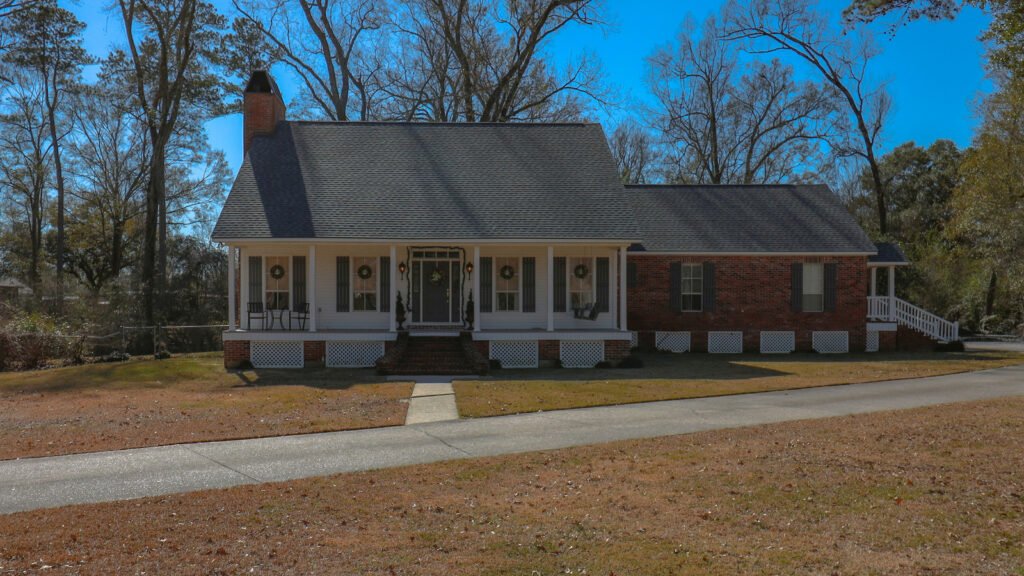
Featured photo: A house exterior with a porch and lawn. Photo: Ronnie George / Unsplash. Used under the Unsplash license.

One Mortgage Form, Two Borrowers
Match each person’s share.