Federal Business Funding: A UEI Is Not Active SAM Registration
Separate the entity identifier, registration status and funding opportunity before treating administrative progress as business revenue.
Estimated reading time: 4 minutes
A Unique Entity ID can appear in a business file even when the company doesn’t have an active SAM.gov registration. Before relying on a federal funding opportunity in a business plan, identify which record you actually have.
Identity and registration are different
SAM.gov’s registration guidance distinguishes obtaining an identifier from completing entity registration. A business can receive a UEI without registering. SAM says registration is needed to apply directly for federal awards as a prime awardee; some other transactions, such as certain subaward reporting, may require only an identifier.
Keep the intended relationship with the government visible. Applying directly, participating through another organization and merely appearing in a record aren’t interchangeable descriptions. Ask the relevant program contact what that specific opportunity requires rather than assuming every reference to a UEI means the same process.
Read the status as well as the identifier
EXIM’s registration FAQ explains several status labels. These distinctions help identify the next question; they don’t determine an award.
| Status | Meaning |
|---|---|
| ID Assigned | Identifier assigned; registration not started |
| Work in Progress | Registration begun; more information needed |
| Submitted | Information submitted; final validations underway |
| Active | Registration process completed |
An assigned UEI doesn’t expire, but the registration does. EXIM specifically requires active registration throughout its transaction; a UEI alone is insufficient for EXIM business. Don’t extend that program statement into an invented universal rule for every federal transaction.
EXIM also warns that resolution of an FSD support ticket doesn’t itself update entity information. A closed help case and completed registration are separate records.
An Inactive Registration label can reflect a previously active registration that expired. Finding the old identifier therefore doesn’t resolve the renewal question. Ask the responsible administrator for the current registration record rather than treating an earlier saved confirmation as current evidence.
Check purpose, cost and the renewal record
The official registration checklist distinguishes All Awards registration, covering contracts and financial assistance, from Financial Assistance Awards Only registration. The latter isn’t the same registration purpose as competing for procurement contracts.
SAM.gov itself is free: obtaining a UEI, registering and maintaining the registration carry no SAM.gov charge. A private service invoice shouldn’t be mistaken for a government registration fee or proof of activation.
Registration must be renewed every 365 days to remain active. Preserve the displayed expiration date and identify who inside the business follows the renewal. Don’t substitute the date of a reminder email for the registration’s actual expiration date.
The checklist describes validation steps and possible corrections after submission. Treat an anticipated processing interval as planning information, not an activation guarantee. Leave enough room to resolve questions and verify the resulting status instead of promising that submission alone finishes the task.
Registration isn’t the whole business case
SBA’s contracting guide treats registration as one part of preparation. It separately discusses market demand, competitive pricing, business capability, size standards and compliance. An identifier or active registration isn’t a substitute for those requirements.
SBA also warns that winning a first contract can take time and resources. Keep the cost of pursuing an opportunity separate from confirmed contract revenue. An administrative milestone doesn’t establish that a buyer has selected the company or that cash is available for payroll.
For the separate size question, our receipts-based contracting guide explains why last year’s sales alone are insufficient. This article doesn’t determine size, certification, eligibility, contract award or payment entitlement. Those questions need their own applicable requirements and evidence.
Make the internal handoff useful
Imagine a fictional business whose owner asks, “Are we ready?” One employee has an old saved document, another remembers a recent conversation, and a third is preparing a proposal calendar. Combining those observations into a single yes or no would hide what each person actually knows.
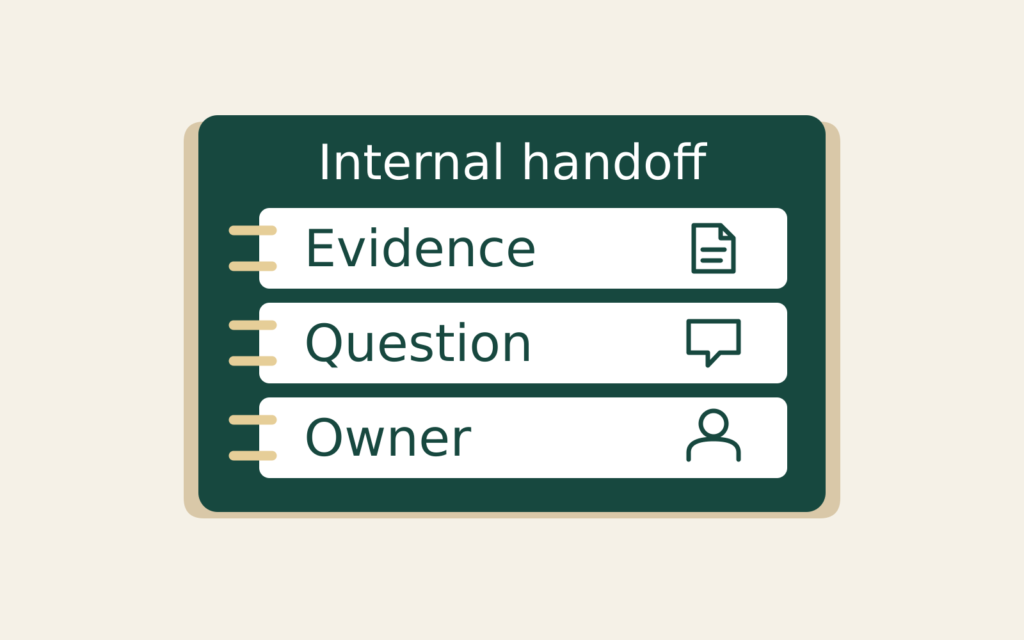
Instead, create a short internal handoff with three clearly separated headings: evidence held, question unresolved and person responsible for clarification. Record the source and observation date beside each entry. Keep a quoted status distinct from an employee’s expectation about what will happen next.
For example, “Document A saved on Monday; current version not yet checked” identifies a limited fact. “Everything approved” doesn’t explain what was reviewed, by whom, or for which purpose. Neither wording should replace the actual underlying document.
Keep sensitive tax and banking details out of this ordinary planning note. It needs references and responsibilities, not copies of credentials or financial account numbers. Any authorized administrative work belongs in the official process, outside this educational worksheet.
The useful result is a specific next question with an identifiable owner—not a fictional completion date or a promise of funding. This guide doesn’t register an entity, change permissions, submit an application or recommend a financing transaction.
Sources checked October 29, 2026. General U.S. business-finance education.