USDA Direct or Guaranteed: Your Starting Point
Turn an unclear financing reference into a focused inquiry with dated evidence, a responsible contact and unanswered questions.
Estimated reading time: 8 minutes
Comparing USDA Direct and Guaranteed starts with naming the program and the right contact. Keep preliminary property checks, borrower questions and any unanswered eligibility issues in separate records.
A property listing that says “USDA possible” leaves an important question unanswered: which program is being discussed? Before collecting a large packet of records, identify the program and the person or office responsible for reviewing it. The goal here’s a focused inquiry, not a self-qualification score.
USDA Direct and Guaranteed: match the program and contact
Single Family Housing Direct: USDA describes this program for low- and very-low-income applicants. Begin with the local Rural Development (RD) office through the Direct program page. Income alone is insufficient: suitable-housing, other-credit, repayment and additional conditions apply.
Single Family Housing Guaranteed: This program serves low- and moderate-income households through approved lenders. The lender handles the application and scenario questions. Use the Guaranteed program page to find the official lender resource. USDA doesn’t endorse a particular listed lender; income, primary-residence and other requirements remain.
Write the full program name at the top of your private inquiry card. If an advertisement or conversation uses only “USDA,” ask for that missing name before treating its explanation as applicable to your intended application.
Give each preliminary check its own line
USDA’s eligibility site separates property and income resources. Its map is preliminary; RD makes the final property determination after receiving a complete application.
For Direct, use the current local income guidance linked from its program page. A self-assessment is preliminary, and you can submit a complete application for an official determination regardless of that result.
For Guaranteed, follow its program-specific income resource and ask the approved lender which household and income information applies. Don’t substitute a national median or your household’s take-home budget for a program determination.
Record the lookup date and the resource used. Keep an unresolved definition written as a question; don’t silently replace it with the interpretation that produces the most favorable answer.
Try the workflow on an unclear listing
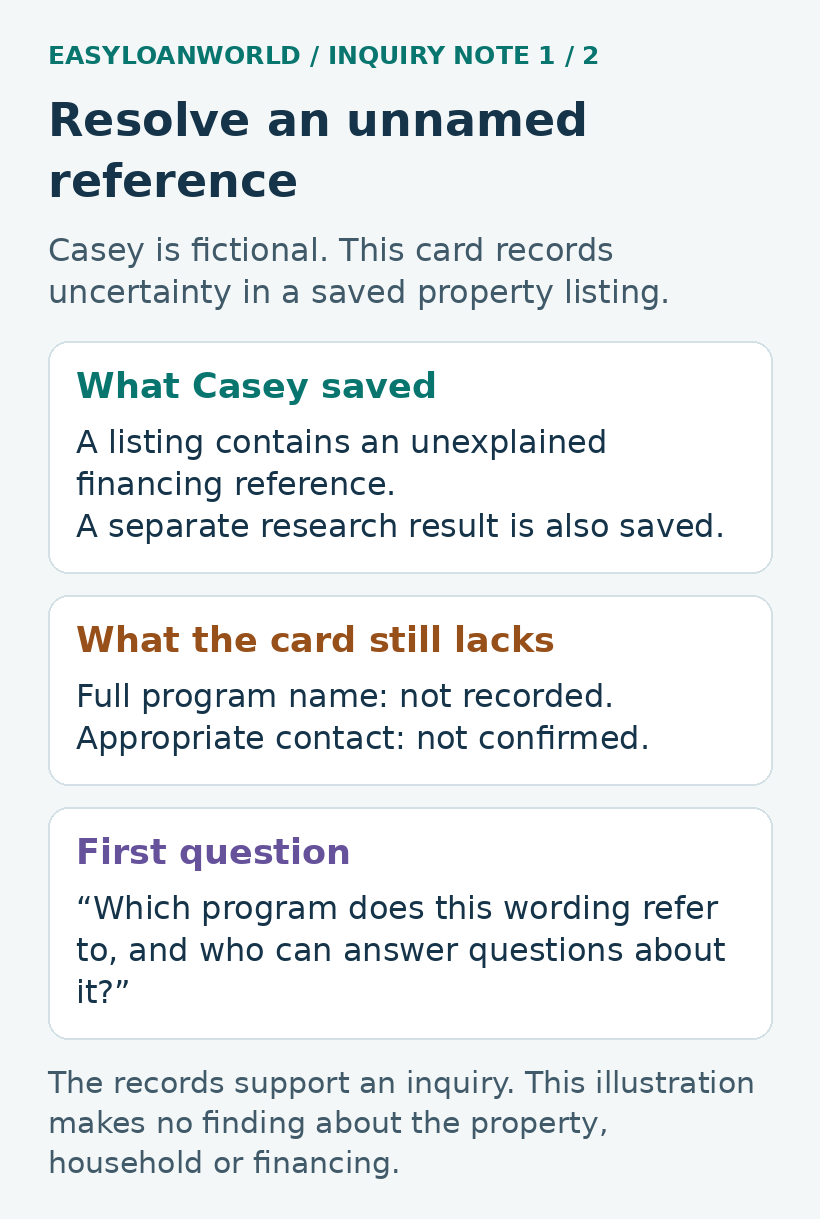
Casey, a fictional buyer, has saved a map result for an area and a listing with an unexplained financing reference. Casey asks which program the seller’s wording concerns, then builds an inquiry for that program’s contact. The saved map supplies context for the question; it doesn’t finish the application.
Casey also has an unfavorable Direct self-assessment. That isn’t an official denial.
The useful next question is specific: “Which requirement remains unresolved, and what information would let you review it?” Casey’s working card stays open until the appropriate contact explains the next step. This example gives no income limit, borrowing amount or predicted outcome.
USDA Direct and Guaranteed: sort the evidence by program
Return to Casey’s unclear listing, saved map and unfavorable Direct self-assessment. Add a fictional conversation with a lender about the Guaranteed program. Those four records don’t form one completed review.
The listing leaves the program unnamed. The map supplies preliminary property information. The self-assessment concerns Direct, while the lender conversation concerns Guaranteed. Label each before combining their conclusions.
For example, an unfavorable Direct self-assessment can’t be restated as a Guaranteed lender’s denial. The record belongs to a different preliminary process. Likewise, a lender willing to discuss Guaranteed doesn’t approve Casey for Direct.
The next task is to identify which program Casey is asking about now and route the actual question accordingly. Keep the other records as background rather than letting a shared “USDA” label erase their differences.
No outcome is assigned to Casey. This example deliberately supplies no actual income limit, complete application or property determination. Its result is a correctly labeled inquiry packet.
Keep property, borrower and process questions separate
For a property question, record the intended address or area privately, lookup source, date and exact result. Ask the appropriate contact what remains for the official property review. A saved preliminary map isn’t the complete application.
For a borrower question, record the information requested by that program and the definition that needs clarification. A property in a potentially eligible area can’t answer whether the household meets other conditions.
For a process question, identify who receives the application, what current materials are requested and how a complete submission is confirmed. A link to an online resource doesn’t show that the responsible office has received a packet.
Keep those questions in separate rows even if the same person can help with several. That prevents one answered question from making the entire inquiry appear resolved.
If a sales description conflicts with an official response, retain both and ask about the specific difference. Don’t select the more favorable statement as the controlling one without resolving which program, property and stage it concerns.
USDA Direct and Guaranteed: label income figures before comparing
For a separate record-reading exercise, suppose a fictional household has $60,000 annual gross wages and a $4,000 monthly take-home budget. These are different measures. Annual gross divided by twelve is $5,000 monthly gross, not $4,000.
Multiplying the $4,000 take-home amount by twelve gives $48,000 of annual take-home money under the simplified assumptions. It doesn’t convert that measure into the program’s applicable income definition.
The exercise supplies no program threshold or qualification result. It demonstrates why a household’s spendable budget can’t silently replace an income measure requested for an official review.
Ask the responsible contact whose income and which records apply to the actual program. Keep the dates and definitions of the documents supplied. A calendar-year tax record and a current pay statement may answer different questions.
If a definition is uncertain, label it as a question rather than excluding a person or amount to fit a table. This guide doesn’t calculate household, adjusted or repayment income for an application.
Make the contact route verifiable
Use the official program page and current location-specific contact resources. For Direct, identify the appropriate RD office. For Guaranteed, identify the approved-lender route described by that program.
A lender appearing on an official resource isn’t a USDA endorsement of that particular company. Compare actual lender communications and terms separately rather than treating a listing as a recommendation.
Record the contact’s role and the question being asked. A real estate listing agent, a lender and an RD office can supply different information. A statement from one shouldn’t be presented as a determination issued by another.
If a contact refers you elsewhere, preserve the referral and update who owns the next task. An unanswered inquiry should remain open until the proper recipient explains what it needs.
Track a response without overstating its status
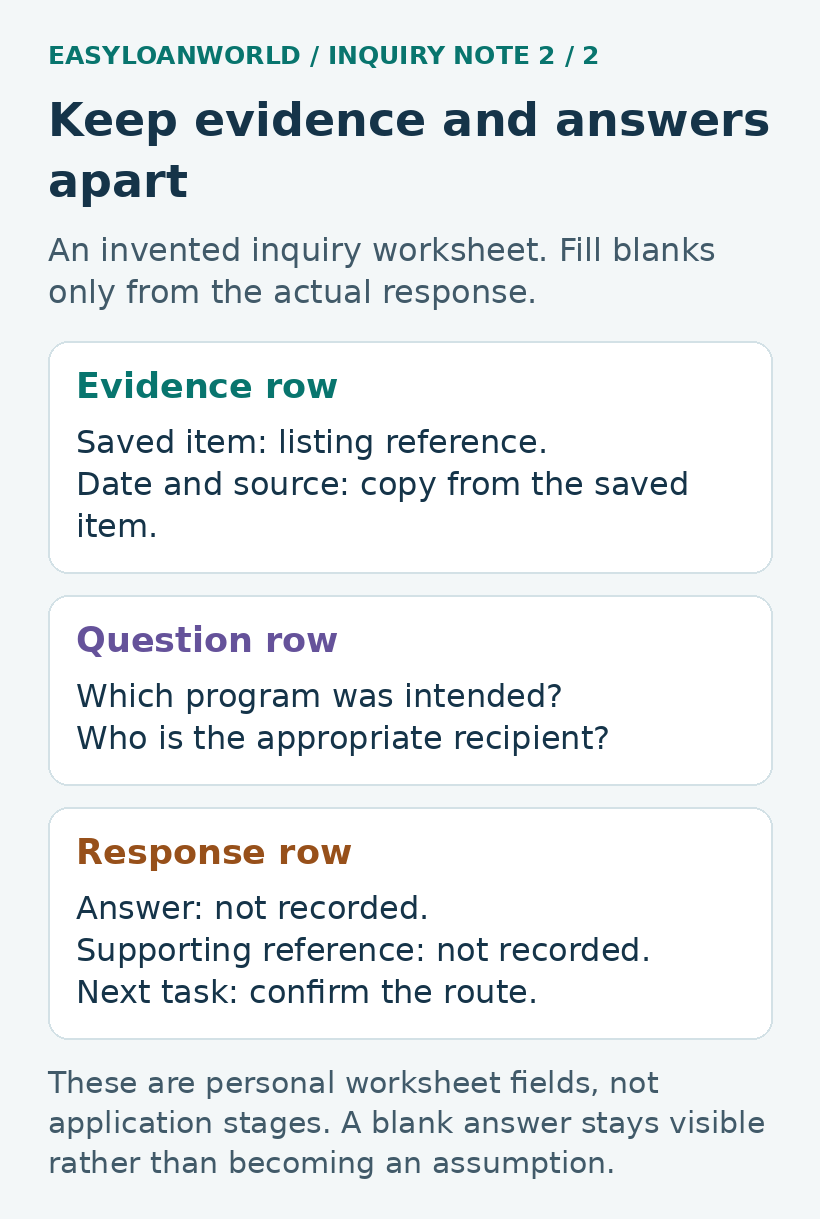
Use stages such as question sent, clarification requested, requested material supplied and determination received. These are practical log labels, not official USDA statuses. Copy any actual official wording separately.
If the response asks for missing information, list the specific item and source. Don’t label the request as approval or denial. Likewise, a successful upload is evidence of an upload, not proof of substantive acceptance.
For Direct payment-assistance questions, retain the actual explanation of subsidy and any possible repayment obligation. An illustration of a reduced payment doesn’t establish the full future obligation or determine recapture in your situation.
Keep the homebuying cash plan separate from the program inquiry. Actual closing costs, ongoing housing expenses and household spending still need their own confirmed inputs even if a program route appears promising.
The useful first result is a record another reviewer can follow: exact program, dated evidence, appropriate contact, question and next step. It doesn’t turn preliminary research into eligibility, a loan amount or permission to make a purchase commitment.
For the USDA Direct and Guaranteed comparison, keep a question’s source program attached when sharing it with the appropriate contact. A response explaining Direct shouldn’t be copied into the Guaranteed column merely because it sounds relevant. Ask which definition or requirement applies before treating the two processes as interchangeable.
Record the location and effective date associated with the resource consulted. If the intended purchase area changes, revisit the applicable local guidance and contact rather than carrying a previous area’s answer into the new inquiry. A national summary can orient the conversation without replacing the program’s current location-specific review.
Prepare a short inquiry card
- Intended purchase area and exact program name.
- Date and source of any preliminary research.
- Income guidance consulted and the definition you need clarified.
- Official contact route and the question for that recipient.
- Answer received, supporting reference and remaining task.
Direct payment assistance is a subsidy; some or all may require repayment when title transfers or occupancy ends. Ask RD how this applies before relying on an assistance illustration.
Keep real addresses, income and identity documents private. This card is an original planning aid, not a USDA form or a request to upload records to EasyLoanWorld. A clearly routed question is a useful first result even when a financing decision remains outstanding.
Before relying on a possible program route, complete a separate homebuying budget check using your household’s own costs and cash limits.
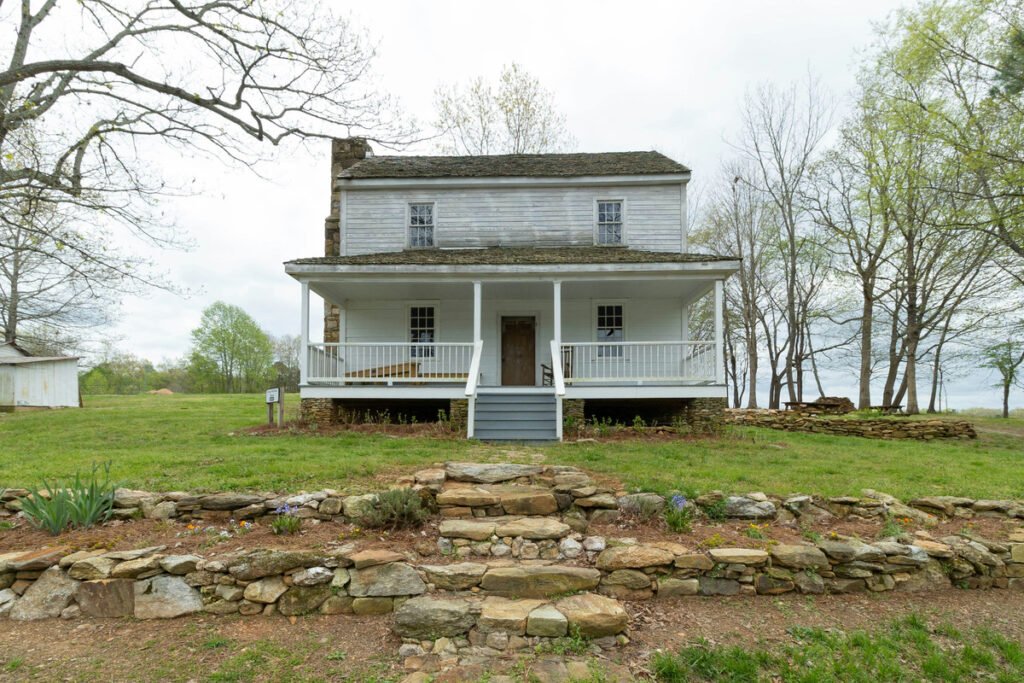
Featured photo: A country house, shown for illustration. Photo: Leslie Cross / Unsplash. Used under the Unsplash license.

One Mortgage Form, Two Borrowers
Match each person’s share.