USDA Subsidy Recapture: Improvement Cost Is Not the Value Credit
Compare a fictional project file with its supporting valuation before relying on an improvement figure in a payoff review.
Estimated reading time: 5 minutes
A folder of home-improvement receipts can be useful when reviewing a USDA Direct loan payoff. But a contractor’s price and an improvement’s contribution to property value answer different questions. Mixing them can produce a confident-looking worksheet with the wrong input.
This guide concerns a Section 502 Direct borrower preparing information for a subsidy-recapture review. It isn’t a Guaranteed-loan guide, a tax-basis calculation or a renovation recommendation. The exercise below checks supporting records; it doesn’t calculate an actual payoff.
Start with the obligation, not the receipts
USDA’s subsidy-recapture fact sheet explains that payment assistance can require repayment under the borrower’s subsidy repayment agreement. A sale or ending occupancy can trigger repayment; paying off the loan while continuing to occupy the property can allow deferral. An improvement file doesn’t itself resolve those separate questions.
Locate the signed agreement, identify the transaction being considered and ask the Servicing Office which current documents it needs. Keep the planned payoff date attached to the inquiry. Don’t treat an old account balance, a verbal estimate and a final payoff statement as interchangeable records.
Ask for the right valuation evidence
The July 2026 USDA servicing handbook, paragraphs 2.23 and 2.24, calls for an appraiser to identify the value added by capital improvements. Borrowers seeking that credit should specifically request this service. The appraisal addendum itemizes the improvements and their contributions. Receipts can help identify work performed, but can’t establish its added value.
USDA’s older borrower packet, capital-improvements page, distinguishes additions such as a garage or deck from maintenance such as painting. Its historical refinance application isn’t a current application instruction; use it here only for that distinction and obtain current case-specific instructions from USDA.
Read a fictional three-project file
Suppose Morgan has three completed projects. The figures below are invented, not contractor estimates, appraisal benchmarks or promised credits. For this exercise, assume the garage and deck have been accepted as eligible additions and the specified contributions are documented in the appraisal addendum. Repainting is excluded. No other projects are included.
| Project | Cost paid | Contribution used |
|---|---|---|
| Added garage | $30,000 | $18,000 |
| Added deck | $8,000 | $5,000 |
| Repainting | $4,000 | Excluded |
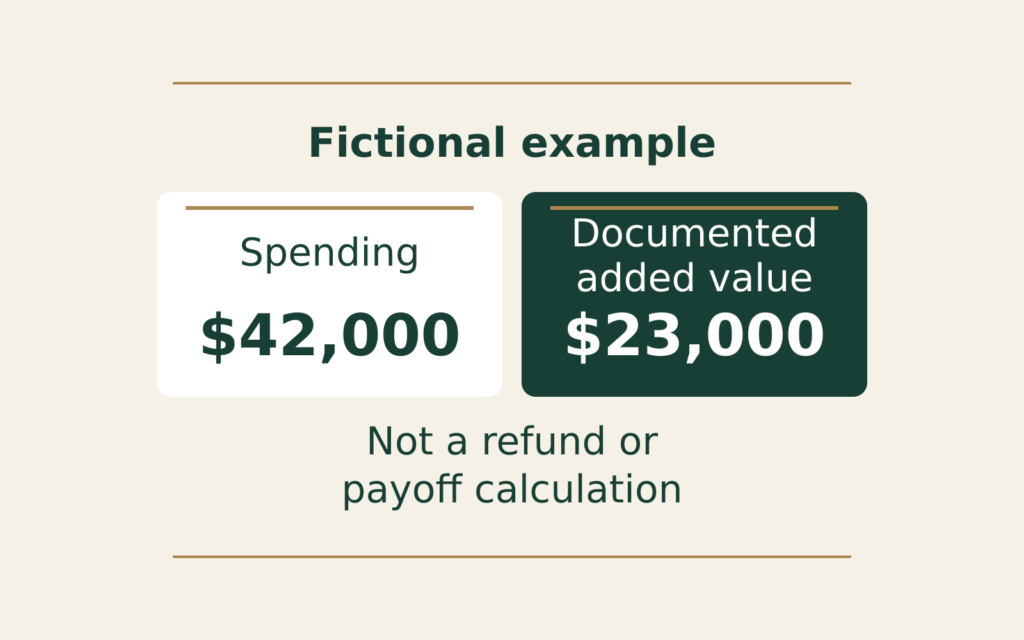
| Total | $42,000 | $23,000 |
The spending column is $30,000 + $8,000 + $4,000 = $42,000. The contribution column is $18,000 + $5,000 = $23,000. Their $19,000 difference consists of $12,000 for the garage, $3,000 for the deck and the excluded $4,000 painting expense.
This comparison doesn’t say Morgan wasted $19,000. The projects could have provided years of use that this record exercise doesn’t price. Nor is $23,000 a reimbursement, tax deduction or dollar-for-dollar reduction in the final payoff. It’s one documented input in the stipulated review.
Find a payment double count before discussing value
Morgan’s garage folder contains a $9,000 deposit receipt, a $21,000 final-payment receipt and a $30,000 contractor invoice marked paid. Adding all three documents would produce $60,000, even though the two payments already settle the invoice.
Build a small cross-reference: invoice G-01, deposit payment D-01, final payment D-02. The payment check is $9,000 + $21,000 = $30,000. Attach the invoice to that result rather than treating it as a third cash outflow. Retain the original documents and mark their roles on a separate cover sheet.
That correction fixes Morgan’s spending history. It doesn’t revise the assumed $18,000 garage contribution. If the invoice total changes because a contractor corrects a billing mistake, record that correction separately from any later revision to an appraisal.
Handle a missing item without filling the blank yourself
Now imagine the deck appears in the project list but is missing from the received addendum. Morgan shouldn’t copy $8,000 from the receipt into the missing field, or quietly retain the exercise’s $5,000 as though a real appraiser supplied it.
A useful question is: “The project list includes the deck completed on this date, but I cannot find its itemized entry in the addendum. Was it reviewed, omitted or grouped with another item?” Attach the project reference and preserve the response. A missing entry and an expressly excluded entry are different record states.
If a revised document arrives, note its date, the replaced version and the changed line. Compare totals after checking the individual entries. This prevents a revised garage line from being added to an older garage line while an unchanged deck is accidentally dropped.
Keep the final payoff question open
The USDA fact sheet’s worksheet places capital-improvement credit within a larger calculation. Other inputs and limitations affect recapture. Completing the project comparison alone can’t establish the amount owed.
Send a focused question through the verified servicing process: “Which version of the supporting valuation was used, and where does the confirmed improvement amount appear in the calculation?” Ask for an explanation of any difference, not an automatic substitution of your preferred number.
Keep three outputs separate: reconciled spending records, the reviewed improvement evidence, and the final payoff information. The useful result is a file in which every amount has a source and a purpose—not a self-issued credit. Keep identifying records private and don’t upload them to EasyLoanWorld. This is general financial education, not individualized legal, tax or lending advice.

One Mortgage Form, Two Borrowers
Match each person’s share.