How to Know If Your Financial Records Are Ready for Tax Season
Tax-Season Ready Means More Than Having a Folder of Receipts
Having a collection of receipts, bank statements, and tax forms does not necessarily mean your financial records are ready for tax season. What matters is whether those records tell a consistent story about the money that came into your business, the expenses that went out, and the documents supporting the amounts you plan to report. The IRS says good records should help establish income and expenses and support the items included on a tax return.
For a self-employed person, readiness is therefore less about having a perfect accounting system and more about being able to answer basic questions without reconstructing the entire year. You should be able to identify your business income, trace significant expenses to supporting documents, explain unusual transactions, and locate records when needed. If several of those answers are uncertain, the records probably need another review before filing.
Start With the Income, Not the Receipts
A useful first test is to determine whether your records capture all of the business income for the year. Look beyond the obvious invoices and check bank deposits, payment platforms, card processors, marketplace accounts, checks, and other sources through which customers or clients paid you.
This is especially important for freelancers and people with multiple income streams. A payment may arrive through a platform rather than directly into a business bank account, while another client may pay by check or electronic transfer. The IRS specifically recommends keeping records that show the amounts and sources of gross receipts, including invoices, deposit information, and other supporting documents.
Compare Income Records With Actual Payments
Once you have listed your income sources, compare them with the transactions appearing in your financial records. You are not simply looking for a matching total; you are checking whether individual payments can be explained and whether anything appears to be missing or duplicated.
For example, imagine a freelancer’s invoice records show twelve client payments during the year, but the bank and payment-platform records appear to contain fourteen deposits related to business activity. That difference deserves investigation before tax preparation. It could represent another client payment, a transfer between accounts, a refund, or something else entirely.
Make Sure Expenses Have Supporting Documents
Your expense list should be more than a collection of numbers entered into accounting software. For important purchases, you should be able to locate supporting documents such as receipts, invoices, account statements, canceled checks, or electronic payment records that help establish what was purchased and how much was paid.
The IRS notes that supporting documents contain information needed to record business transactions and support entries in the books and on the tax return. The exact records needed can vary by expense type, so keeping a consistent system for storing them is more useful than assuming every purchase requires exactly the same documentation.
Check the Expenses That Are Harder to Explain
Some expenses are straightforward because their business purpose is obvious. A software subscription used for client work or supplies purchased specifically for business operations may be relatively easy to identify. Other transactions deserve more attention because their business connection is less obvious.
Review expenses involving vehicles, travel, meals, home-office use, equipment, mixed personal and business use, and unusual purchases separately. Certain categories have additional substantiation or tax rules, so a transaction appearing in a business account does not automatically mean the entire amount should be treated as a deductible business expense.
Look for Personal Transactions in Business Records
If you have been using the same account or card for both personal and business spending, tax-season preparation is a good time to identify those transactions. A grocery purchase, household subscription, family expense, or personal transfer should not quietly remain inside a business expense category simply because it passed through the business account.
This review is particularly important for small businesses where the owner handles most transactions personally. The IRS explains that a recordkeeping system should clearly show business income and expenses, and that the records should support the items reported on the tax return. Separating personal activity makes that process considerably easier.
Review Bank and Payment-Platform Statements Together
Bank statements are useful, but they may not tell the entire story for a modern freelancer. Payments can pass through platforms, marketplaces, payment processors, and digital financial services before reaching a bank account, while platform fees or refunds can affect the amount that ultimately arrives in the bank.
Review the relevant statements together instead of assuming the bank deposits alone represent your complete business activity. The IRS’s current document guidance specifically points self-employed taxpayers toward records from banks, payment apps, card processors, and online marketplaces when gathering information for tax filing.
Do Not Ignore Small Amounts
Small transactions are easy to dismiss during a year-end review, particularly when they are only a few dollars each. But a large number of small purchases can become meaningful when added together, and missing records can also make your overall bookkeeping less reliable.
The point is not to spend hours investigating every insignificant transaction individually. Instead, establish a consistent process for recording purchases as they occur. The IRS notes that expenses can be forgotten when they are not recorded when they happen, which is one reason timely recordkeeping is valuable.
Check Recurring Expenses for the Whole Year
Subscriptions and recurring services deserve a separate review because they are easy to overlook. A software service that was active for only part of the year, for example, should not automatically be assumed to have generated twelve identical business expenses.
Compare recurring charges with invoices, account statements, or subscription histories where available. This can reveal canceled services that continued billing, annual renewals that were missed in the bookkeeping, or personal subscriptions that were accidentally paid from a business account.
Reconcile the Numbers Before Filing
A useful readiness test is whether your bookkeeping totals can be reconciled with your underlying financial records. The numbers in your accounting system should not exist independently from the bank statements, payment records, invoices, and other documentation supporting them.
If your bookkeeping shows $80,000 of business income but the records you have assembled do not reasonably explain that figure, stop and investigate the difference. It may be a simple timing issue or an omitted transaction, but filing with unexplained differences creates unnecessary uncertainty.
Pay Attention to Business Assets
Equipment and other property used by the business may require more information than an ordinary operating expense. If you purchased a computer, vehicle, machinery, furniture, or another significant asset, keep records showing when and how it was acquired, its cost, how it was used, and other information relevant to its tax treatment.
The IRS specifically identifies asset records as important because they may be needed to determine depreciation, basis, and the tax consequences when property is later sold or otherwise disposed of. This means an old purchase should not disappear from your records simply because you have already paid for it.
Check Estimated Tax Payments
Self-employed people should also verify records of estimated tax payments made during the year. Payment confirmations, bank records, and information available through an IRS Online Account can help establish what was actually paid rather than relying on memory.
This is separate from calculating the final tax liability. Estimated payments are amounts already paid toward tax, so missing one in your records can make the information provided to the tax preparer incomplete. The IRS lists estimated tax payments among the records self-employed taxpayers should gather when preparing for filing.
Make Sure Your Tax Forms Tell the Same Story
Tax forms received from clients, platforms, banks, or other institutions should be compared with your own records. A mismatch does not automatically mean that one side is wrong, but it should be investigated before filing.
For example, a freelancer may receive a Form 1099-NEC from one client while having additional business income that does not produce a 1099. Conversely, a form may show an amount that needs to be compared with invoices and payment records. The IRS notes that income from self-employment and gig activities generally needs to be reported even when the taxpayer does not receive an information return.
Know Which Records Support Your Return
A ready set of records should make it possible to connect the major figures in your tax return to underlying documentation. For a sole proprietor, business income and expenses are generally reported on Schedule C, while Schedule SE is used to calculate self-employment tax.
That does not mean every self-employed person has the same filing requirements. Business structure, income sources, investments, property, employees, and other circumstances can introduce additional forms and reporting obligations. The useful question is whether your records contain the information needed for the forms that actually apply to you.
Your Records Should Still Make Sense Six Months Later
One overlooked test of good records is whether another person could understand a transaction after the original purchase has faded from memory. A bank statement saying “Online Purchase — $143.28” may tell you almost nothing months later unless you also kept the receipt or another explanation.
This is why a short business-purpose note can be useful for unusual expenses. You do not need to write an essay about every purchase. A concise description connecting the transaction to the business can make later review much easier, especially when the transaction is not self-explanatory.
Use One Consistent Storage System
Tax records become difficult to manage when documents are scattered across email, phone photographs, paper folders, cloud storage, and several unrelated applications. Your system does not need to be sophisticated, but it should give you a predictable place to find supporting information.
The IRS allows businesses to choose a recordkeeping system suited to their circumstances, provided it clearly shows income and expenses. Electronic records can also be used when they satisfy the applicable recordkeeping requirements. A simple organized folder structure can therefore be perfectly practical for a small operation.
Do Not Wait Until Filing Day to Find Missing Records
If you discover a missing receipt or unexplained transaction while preparing your return, give yourself time to investigate it. Search old emails, payment confirmations, bank statements, vendor accounts, and other sources that may help reconstruct the transaction.
Trying to solve every missing-document problem immediately before filing can create unnecessary pressure. More importantly, rushed bookkeeping can lead to guesses. When the available evidence is unclear, it is better to identify the uncertainty and obtain appropriate tax or accounting guidance than to invent an explanation simply to make the records balance.
A Simple Readiness Check
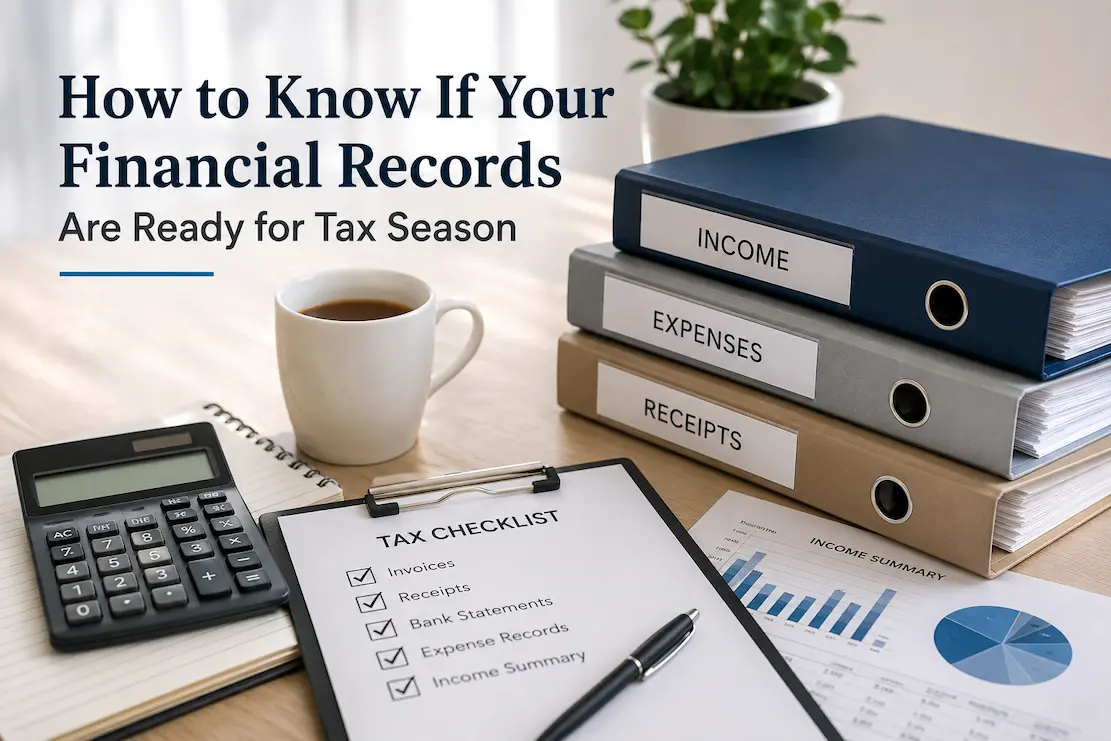
Before considering your records ready, ask whether you can answer five basic questions: How much business income did I receive? Can I explain the major deposits? Can I support the expenses I plan to report? Have I separated personal transactions? Can I locate the records supporting unusual or significant items?
If the answer to all five is reasonably clear, your records are in much better shape than a folder containing unorganized receipts. You do not need every document arranged in a particular format mandated by the IRS; the agency generally allows businesses to choose a recordkeeping system suited to their operations as long as it clearly shows income and expenses.
When Your Records Need Professional Review
Some situations are difficult to resolve using a general checklist. A business with employees, multiple entities, significant assets, international transactions, complicated deductions, or major changes during the year may need more specialized accounting or tax assistance.
Professional review can also be useful when your records contain substantial unexplained differences or when you are unsure how a particular transaction should be treated. The purpose is not to make every small business use an accountant. It is to recognize when the financial circumstances have become too complicated for a simple bookkeeping routine.
Keep the Records After Filing
Being ready to file does not mean you can immediately discard the underlying documentation. The IRS says the period for keeping records generally depends on the action, expense, or event documented and the period of limitations applicable to the return. Different situations can require different retention periods.
Keep copies of filed returns and the records supporting them in an organized location. Property records can require particularly careful retention because information about acquisition and improvements may be relevant when the property is later disposed of. Good organization after filing can make the next tax season easier rather than starting the same document hunt again.
The Real Test Is Whether the Numbers Can Be Explained
Financial records are ready for tax season when the important numbers are not just present but understandable. Income can be traced to its sources, expenses can be connected to supporting documentation, personal transactions have been identified, and unusual items have an explanation.
That standard is more useful than trying to create a perfect-looking folder. The IRS’s recordkeeping guidance focuses on records that clearly show income and expenses and support the amounts reported on a return. A practical system should therefore prioritize accuracy, traceability, and consistency over unnecessary complexity.
Conclusion
Getting financial records ready for tax season is essentially a reconciliation exercise. You are bringing together income records, bank and payment statements, receipts, invoices, expense information, estimated tax payments, and other documents so that the financial story of the year can be understood without guesswork.
For a self-employed person, the strongest warning sign is not an untidy folder. It is an unexplained number. If you cannot identify where significant income came from, why a major expense was incurred, whether a transaction was personal or business-related, or what document supports an important figure, that area deserves attention before filing.
A simple monthly bookkeeping habit makes this process much easier. Instead of rebuilding the year every tax season, you gradually create a record that already explains what happened. By the time filing season arrives, preparation becomes a review of information you have maintained throughout the year rather than an attempt to reconstruct it from memory.
Frequently Asked Questions
How do I know if my financial records are ready for tax season?
Your records are in reasonable shape when you can identify your business income, reconcile major transactions, support the expenses you plan to report, separate personal activity, and locate documentation for unusual or significant items. The IRS says records should support income, expenses, and other items reported on a tax return.
What records should a self-employed person gather?
Depending on the business, useful records can include invoices, bank statements, payment-platform statements, receipts, expense records, Forms 1099, mileage or travel records, asset documentation, and estimated tax payment records. The exact documents needed depend on the person’s circumstances and the transactions involved.
Do I need to keep every receipt?
You should keep supporting documentation needed to substantiate income, deductions, and credits reported on your return. The appropriate records can differ depending on the type of expense, so it is safer to maintain documentation rather than assuming a transaction is too small to matter.
What if my bank total does not match my bookkeeping?
Do not simply change one number to make the records agree. Investigate the difference first. Look for transfers, omitted transactions, refunds, duplicated entries, payment-platform activity, or personal transactions that were recorded incorrectly.
Can I use electronic records instead of paper documents?
Yes. The IRS allows electronic recordkeeping systems when they satisfy the same basic requirements applicable to other business records. The system should provide a complete and accurate record that can be accessed when needed.
How long should I keep my tax records?
There is no single retention period that applies to every document. The IRS generally ties retention to the period of limitations for the relevant tax return, while certain situations and types of records have different requirements.