Business Line of Credit vs. Term Loan: Match Funding to the Cash Need
Compare a business line of credit and term loan using cash timing, repayment, fees and renewal risk, with a practical funding worksheet.
Before choosing a business line of credit or term loan, put two dates on paper: when the business must spend the money and when it can realistically repay it. Then test the required payments against a slower month. An approved limit alone does not answer either question.
This guide compares the structures, then uses two separate hypothetical funding needs to show how to evaluate them. The examples are planning exercises, not current offers or a ranking of lenders.
What changes between a credit line and a term loan?
A conventional term loan delivers a lump sum with a repayment schedule. A revolving line lets a business draw available funds, repay principal and borrow again while the agreement permits. That distinction concerns access to money; it does not establish which offer costs less. Chase explains the two structures.
Do not assume every term loan has a fixed rate or equal payments. For a specific example, Bank of America’s unsecured term loan describes fixed equal monthly payments and interest on the outstanding balance. Ask how your own offer calculates interest as principal is repaid.
Revolving does not mean permanently available. Bank of America’s line disclosures say availability is generally one year, renewal is at the bank’s discretion, and an annual maintenance fee can apply without borrowing. A zero drawn balance therefore does not necessarily mean zero cost.
Nor does a line necessarily require interest-only payments. Chase’s business and commercial line descriptions illustrate different minimum-payment and maturity arrangements. Its page also specifies personal guarantees. Check the complete agreement rather than treating an unsecured label or an LLC name as an answer about personal liability.
Compare three dates before comparing a headline rate
- The spending date. Write the amount actually needed after deductions, and whether the seller requires one payment or several. If money arrives after the supplier’s deadline, an otherwise attractive quote does not solve that expense.
- Every required payment date. Put the first installment and subsequent obligations beside expected customer collections. Include principal due later, not just an affordable-looking first payment.
- The end of availability or repayment. Ask when draws stop, when the balance must be repaid, and what happens if a requested renewal is refused. Do not build a plan that only works if another financing offer appears.
Use those dates to describe the need precisely. “Pay a supplier now and repay from a named customer collection” is a different problem from “buy equipment that must earn its cost over several years.” The following scenarios deliberately address different problems. Their total costs are not a controlled price comparison.
Example 1: a $12,000 supplier payment and a 60-day collection gap
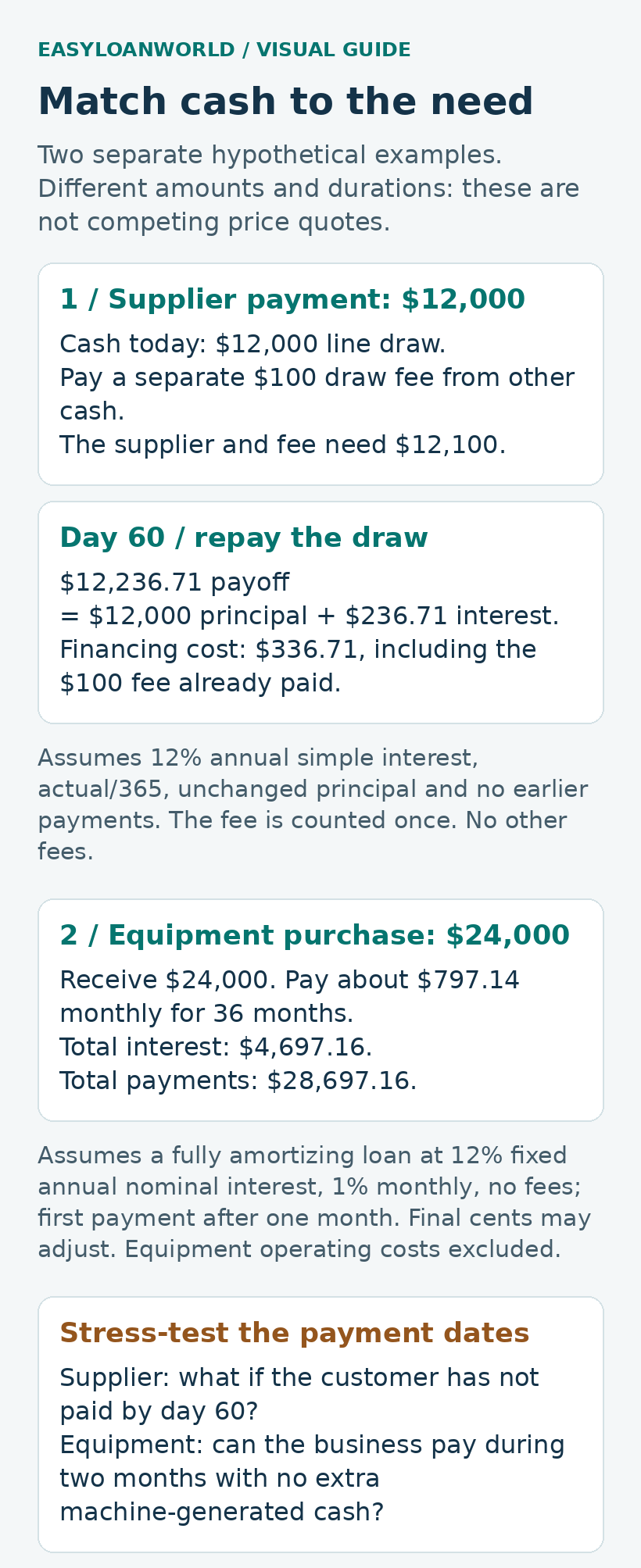
Hypothetical assumptions: A business draws $12,000 today. The line charges 12% annual simple interest using actual days divided by 365, plus a $100 draw fee paid separately today. Principal stays at $12,000, no payments are required before day 60, and the business pays the balance and interest then. There are no other fees. These are invented terms, not standard line-of-credit terms.
- Interest: $12,000 × 0.12 × 60 ÷ 365 = $236.71.
- Total financing cost: $236.71 interest + $100 fee = $336.71.
- Day-60 payoff: $12,236.71, because the $100 fee was already paid.
- Cash needed today: $12,100 for the supplier and fee. The $12,000 draw leaves $100 to cover from other cash.
The fee belongs in the cost comparison, but adding it to the payoff again would count it twice. Likewise, repaying the $12,000 principal is a cash obligation, not an additional $12,000 financing charge.
What if the customer pays 30 days later?
If the same balance and rate continue for 90 days, total interest becomes $355.07 and financing cost becomes $455.07. The additional 30 days add about $118.36 of interest.
That arithmetic does not grant permission to miss the assumed day-60 payoff. If payment is due then, the business needs another cash source or an agreed change. The 90-day calculation assumes the balance can remain outstanding on unchanged terms without added charges; an actual agreement may produce a different result. A late customer payment and a late financing payment are separate events.
Decision prompt: Can existing cash cover the day-60 obligation if this customer has not paid? If the answer is no, write “cash shortfall” before treating the expected collection as certain.
Example 2: a $24,000 machine with a 36-month repayment plan
Hypothetical assumptions: A business receives a $24,000 fully amortizing term loan at 12% fixed annual nominal interest. The monthly rate is 1%, with 36 monthly payments beginning one month after funding and no fees.
- Calculated monthly payment: about $797.14.
- Total payments: $28,697.16 using the unrounded payment calculation.
- Total interest: $4,697.16.
Rounding each actual payment to cents may change the final payment by pennies. These figures exclude the machine’s maintenance, installation, insurance and operating expenses.
Now write a conservative estimate of the machine’s additional monthly cash contribution after its operating costs. Compare that estimate with the $797.14 payment and the rest of the business budget. Sales attributed to the machine are not automatically cash available for debt payments.
Stress-test two months with no additional machine-generated cash. Can the business still make the required payments? Also ask whether the machine remains useful throughout the repayment period. This exercise assesses the proposed purchase and its timing; it does not prove a term loan is always the better structure.
Copy this expense-to-cash worksheet
Complete one worksheet for the expense, then attach the written terms for each offer. Use actual expected collections rather than counting an issued invoice as money already in the bank.
- Expense: What are we buying? What net amount is needed, on which dates? Is this a one-time need or will it recur before the first borrowing is repaid?
- Repayment source: Which collections will cover the obligation? Write the expected dates and a second version with the main customer 30 days late.
- Useful life: How long will the purchase contribute to the business? Does the proposed payment period fit that expectation?
- Offer cash flows: Record cash received, every scheduled payment, separately paid costs, remaining principal at maturity, and the renewal or draw-expiry date.
- Operating room: For each payment period, start with cash on hand, add expected collections, then subtract ordinary expenses, taxes, existing debts, the new obligation and a business-chosen cash buffer.
- Lowest balance: Identify the tightest date in both the expected and delayed-collection versions. A positive balance at month-end does not fix a shortage before payroll.
- Decision label: Mark “timing fits,” “needs clarification” or “cash shortfall,” and write the next fact or change needed. These are planning labels, not an approval or suitability test.
Questions to settle in writing
Review fees, collateral and reporting obligations for both offers. Chase’s comparison identifies annual, draw, origination and late-payment charges, along with line reviews and financial-statement requirements. Ask which apply to your contract; do not assume an unused line is free or a term loan has no ongoing conditions.
- Is the rate fixed or variable? What changes it, and how is interest calculated?
- Does each payment reduce principal? Is any balloon or other unpaid balance due later?
- What is the exact early-payoff amount and treatment of fees?
- What assets and guarantees support the obligation, and what conditions restrict additional borrowing?
- Which documents must we submit after funding, by which dates?
SBA-backed loan programs are another avenue to investigate. Eligibility differs by lender and program; repayment ability and business purpose matter. Investigating a program does not establish qualification or a lower price.
Bottom line: Choose a structure only after tracing the expense, usable funding and repayment dates through the business’s cash plan. If the plan needs an unconfirmed renewal or a perfectly timed customer payment, resolve that dependency before signing.
Primary sources checked October 19, 2026. U.S. general education, not individualized financial, legal or tax advice. A qualified business finance adviser or attorney can review the specific offer and obligations.
Featured photo: Photo by Alberto Rodríguez on Unsplash. Used under the Unsplash license. Illustrative stock photograph of warehouse inventory. No financing status is identified for the pictured business. Photo by Alberto Rodríguez on Unsplash.
SBA Surety Bonds vs. Working-Capital Loans: Four Contractor Scenarios
Follow Riverton Build through four fictional alternatives at one pre-start review. Identify what remains unresolved and prepare a focused next conversation.
Export Payment Documents: A Two-Packet Review
A worked export-packet review follows an unresolved instruction proposal, an incomplete selected inventory and an unknown carrier arrangement, without inventing the missing evidence.
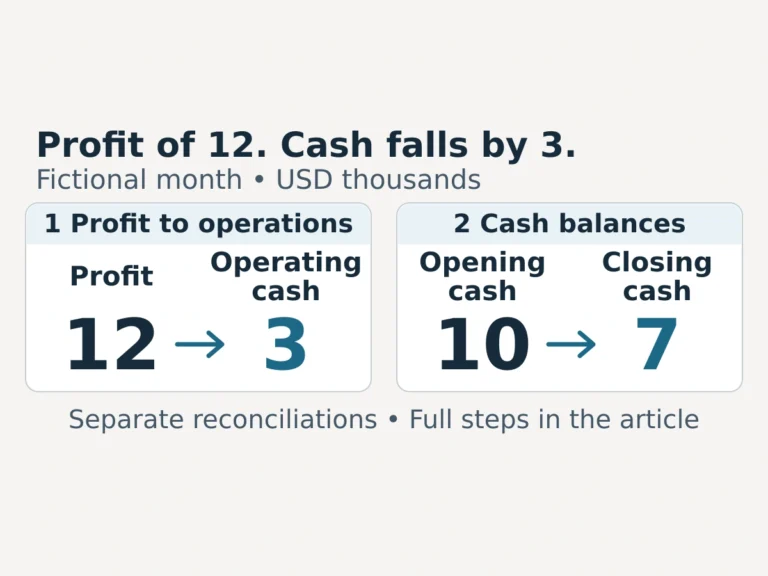
Profitable Business, Falling Cash: Reconcile the Difference
An invented one-month example reconciles net income, customer receipts, supplier payments, equipment, debt and an owner distribution to the closing cash balance.