Merchant Cash Advance Factor Rates: Calculate Cost Beyond the Quote
Calculate merchant cash advance costs from net funding, fees and payment dates. Use three worked examples and an offer-comparison worksheet.

A merchant cash advance factor rate is not an APR. The Federal Reserve’s small-business credit guide distinguishes factor quotes from annual percentage rates and notes that financing can require daily or weekly collections.
Start by translating the quote into dollars: what reaches your bank account, what is scheduled to leave it, and when. Then examine how those collections fit the cash needed to keep the business running. A multiplier alone cannot complete that comparison.
Identify the arrangement before using a calculator
The FTC’s small-business financing guidance describes MCA providers as purchasing a fixed amount of future receivables. Some financing uses flat charges and frequent collections. Do not assume an MCA label alone determines whether a particular agreement is legally a loan or a receivables purchase; contract-specific questions require qualified legal review.
For the calculations below, a factor of 1.30 multiplies the stated advance. That is an explicit assumption. Before applying the same calculation to a quote, ask which amount its multiplier applies to and whether the result includes every charge.
Example 1: the stated advance is not necessarily the cash received
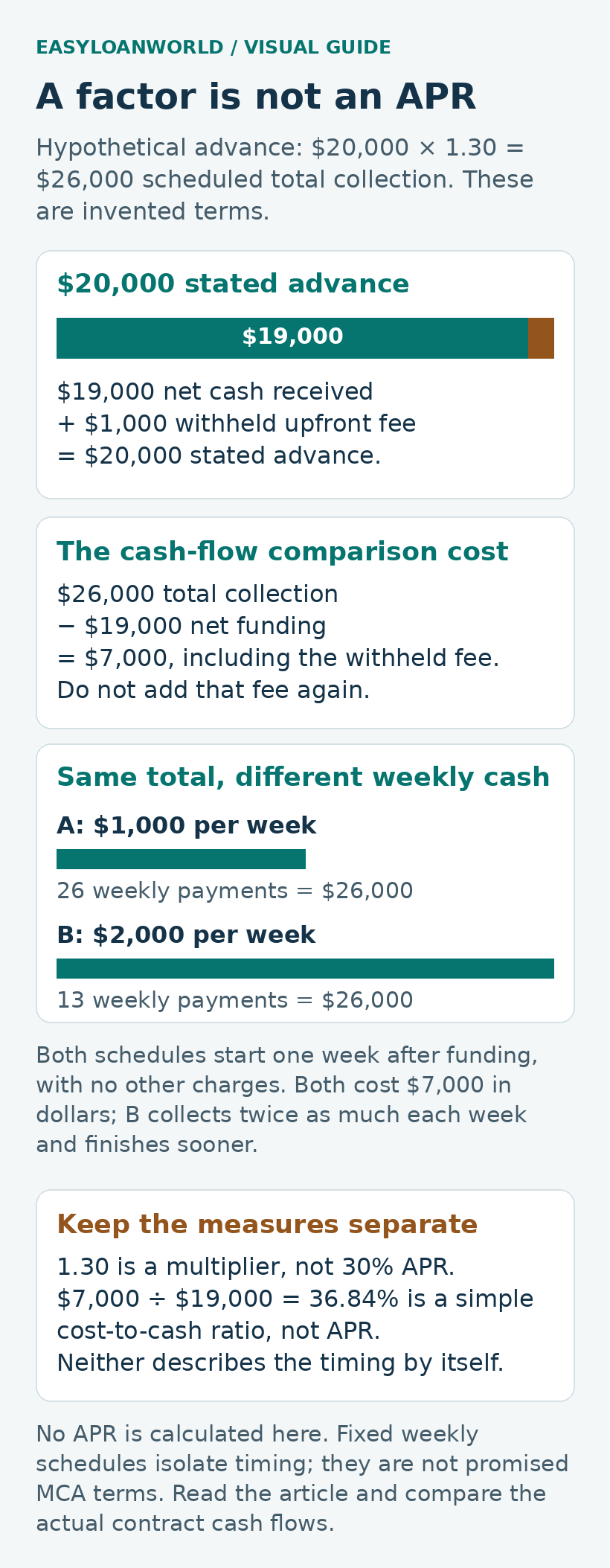
Hypothetical offer: The stated advance is $20,000, the factor is 1.30, and a $1,000 upfront fee is withheld. There are no other deductions, separate payments or later charges in this example.
- Scheduled total collection: $20,000 × 1.30 = $26,000.
- Net funding: $20,000 − $1,000 = $19,000.
- Factor markup: $26,000 − $20,000 = $6,000.
- Comparison cost including the withheld fee: $26,000 − $19,000 = $7,000.
The $7,000 already includes the $1,000 withheld fee. Adding that fee again would count it twice. This comparison-cost calculation describes the example’s cash flows; it is not a determination of the statutory finance charge for every contract.
Dividing $7,000 by $19,000 gives about 36.84%. That is a simple dollar-cost-to-net-funding ratio. It is not an APR and does not describe a particular time period. Calling the 1.30 factor “30% APR” would also mislabel the quote.
There is a separate funding problem: a business that needs $20,000 to pay a supplier still has a $1,000 gap after this $19,000 deposit. Record that shortfall before comparing how attractive the headline amount sounds.
Example 2: the same factor, two different payment calendars
Keep the same $19,000 net funding and $26,000 total collection. Now compare two invented schedules, each beginning one week after funding, with no additional fees:
- Schedule A: 26 weekly payments of $1,000. The last payment occurs at week 26.
- Schedule B: 13 weekly payments of $2,000. The last payment occurs at week 13.
Both collect $26,000 and both have the same $7,000 comparison cost. Schedule B removes twice as much money each week and finishes in half the time. The unchanged multiplier cannot show that difference.
APR relates the amounts and timing of funding, finance charges and payments on an annual basis. New York’s disclosure framework explains these inputs and why an estimated sales-based APR can change when actual receipts differ. Subtracting one from a factor, or simply annualizing its markup, does not perform that calculation.
In this constructed comparison, collecting the same dollar charge sooner increases the annualized cost. It does not increase the $7,000 dollar cost. It also does not mean faster business sales are undesirable. The question is how an offer’s timing and any early-payment discount affect the financing comparison.
These fixed schedules isolate timing; they are not promised MCA terms.
An arrangement tied to actual receipts may have neither fixed collections nor a fixed completion date.
Obtain a dated cash-flow calculation using the proposed contract instead of labeling a guessed online result as the provider’s disclosed APR.
Example 3: a sales percentage still leaves operating bills
Hypothetical assumptions: Exactly 15% of eligible daily receipts is collected, with no minimum, separate fees or adjustment delay. The remaining money must cover essential daily operating costs and other debt totaling $1,100.
- $2,000 receipts day: $300 collected; $1,700 remains before operating costs and other debt. After the assumed $1,100 obligations, $600 remains.
- $1,200 receipts day: $180 collected; $1,020 remains before those obligations. The business is $80 short after the same $1,100 costs.
The 15% collection share answers how much of those receipts leaves that day. It is distinct from the factor multiplier that set the example’s total collection. Neither the $1,700 nor the $1,020 is profit.
A lower collection on a slower day does not automatically preserve enough operating cash. Also, this example assumes an immediate percentage split. If a proposed contract instead uses a fixed bank debit and later reconciliation, do not substitute $180 for its actual required debit without checking the mechanism.
The FTC has identified concerns about providers failing to deliver promised reconciliations. Check how to request an adjustment, which records it needs, when it takes effect and how any difference is credited. A reconciliation clause is not proof that a debit will change automatically.
Use an offer-comparison worksheet
Make one copy per offer. Attach the contract section or written answer behind each entry rather than relying on a sales conversation.
- Cash received: Stated advance, each deduction, amounts paid to an existing financier, and the net deposit available for this business need.
- Total collection: Contracted or estimated total, plus a separate list of charges triggered by particular events.
- Multiplier: Exact factor and the dollar amount it multiplies. Recalculate the resulting dollars.
- Annualized comparison: Estimated APR, who prepared it, and assumptions about receipts, payment dates and fees. Request a written explanation if it is missing or unclear.
- Collection calendar: First payment, frequency, business days versus calendar days, fixed debits versus receipt percentages, and any minimums.
- Receipts covered: Which sales channels count? How are refunds and chargebacks handled? What bank or processor access does the agreement require?
- Adjustment process: Reconciliation request steps, documents, timing and the contract section that explains them.
- Early exit or replacement: Written early-payoff amount, any discount formula, and how much replacement funding would first satisfy old obligations. Separate genuinely new cash from amounts routed elsewhere.
- Operating cash: Remaining cash after collections, business expenses, taxes, other debts and a chosen buffer, both at expected sales and during a slower period.
Ask what disclosures apply to your offer
As a state-specific example, New York’s sales-based financing statute calls for covered offers to disclose funding and net disbursement, finance charge, estimated APR, collection terms, other potential charges, early-payoff treatment and security interests.
Its coverage exemptions matter. These requirements are not a statement that every provider or every U.S. business transaction receives identical disclosures.
Federal consumer-credit disclosure standards are not a blanket guarantee for business financing, as the Federal Reserve guide explains. Ask which requirements cover the particular offer.
Before agreeing: If usable cash, collection mechanics or adjustment rights remain unclear, seek written clarification. Have a qualified adviser review a comparable annualized calculation, and obtain legal help for contract obligations or disputes. Do not treat this worksheet as proof that a product is affordable, suitable or legally classified in a particular way.
Primary sources checked October 19, 2026. U.S. general education, not individualized financial or legal advice. All dollar amounts, factors, percentages and schedules in the examples are invented illustrations, not current offers or typical prices.
Featured photo: Photo by Clay Banks on Unsplash. Used under the Unsplash license. Illustrative stock photograph of a retail card payment. No merchant cash advance, borrower status or endorsement by the pictured people or brands is implied. Photo by Clay Banks on Unsplash.

SBA Surety Bonds vs. Working-Capital Loans: Four Contractor Scenarios
Follow Riverton Build through four fictional alternatives at one pre-start review. Identify what remains unresolved and prepare a focused next conversation.

Export Payment Documents: A Two-Packet Review
A worked export-packet review follows an unresolved instruction proposal, an incomplete selected inventory and an unknown carrier arrangement, without inventing the missing evidence.
Profitable Business, Falling Cash: Reconcile the Difference
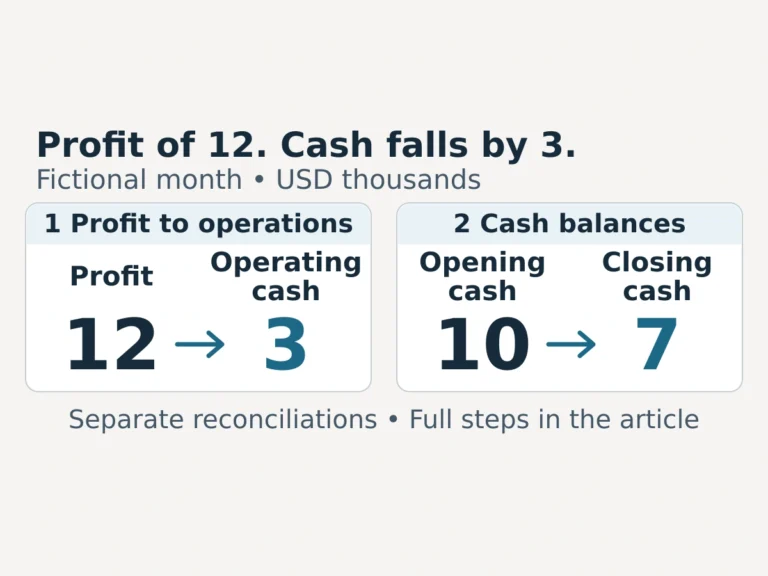
An invented one-month example reconciles net income, customer receipts, supplier payments, equipment, debt and an owner distribution to the closing cash balance.