Invoice Financing vs. Factoring: Compare Cash, Fees and Control
Trace one invoice through two funding arrangements. Compare cash now, later proceeds, fees and remaining risks with examples and an offer worksheet.

“Invoice financing” and “accounts receivable financing” do not always describe a separate alternative to factoring. Some providers use these terms broadly enough to include selling invoices. For example, altLINE’s accounts-receivable explanation describes a receivables sale.
For this guide, compare two specific structures: borrowing with invoices as collateral, and selling invoices to a factor. Ask what the proposed contract actually does before comparing its price. Then separate three questions: how much usable cash arrives now, how much remains later, and which risks stay with the business.
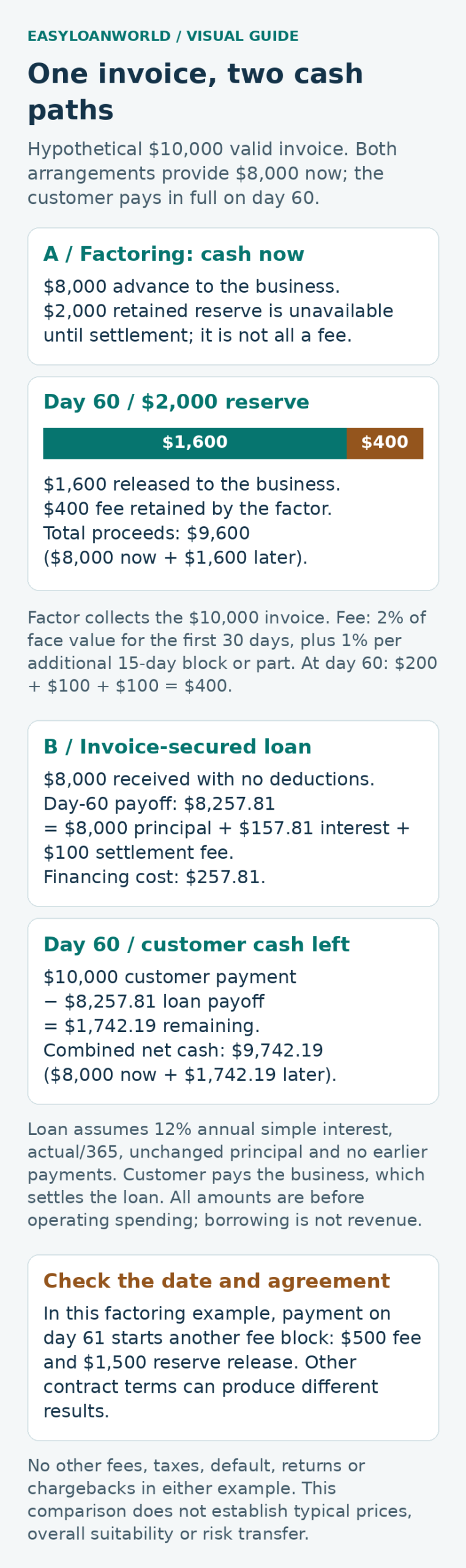
Borrowing against an invoice versus selling it
Invoice-secured borrowing: A loan or credit line uses eligible receivables as collateral. The business has a repayment obligation under its agreement. The OCC describes this collateral-based financing.
Factoring: The business sells unpaid invoices. In the structure described by the Federal Reserve’s small-business credit guide, the factor collects from the customer, retains a fee and returns remaining funds. This concerns existing unpaid invoices, rather than an advance against future sales.
Not every invoice qualifies for the same funding. The OCC’s receivables-financing handbook discusses eligibility rules, overdue accounts, concentration and collateral controls. Payment routing can also vary: a lender may require a controlled account or lockbox. Borrowing against invoices does not guarantee unrestricted access to customer collections.
Start with the invoice, its payment history and the actual cash deadline. If payroll needs $8,000 on Friday, a proposal’s invoice value or headline limit is less useful than the net amount available by Friday.
Compare the same $10,000 invoice in two hypothetical arrangements
Shared assumptions: Work is completed, the $10,000 invoice is valid and undisputed, and the business needs $8,000 now. The customer pays in full exactly 60 days after funding. Neither example includes taxes, defaults, returns, chargebacks, extra services or charges beyond those stated. These constructed offers illustrate mechanics, not typical prices or available terms.
Arrangement A: factoring with an advance and reserve
The factor advances 80% of the invoice, or $8,000, and retains a $2,000 reserve. Assume a fee of 2% of invoice face value for the first 30 days, plus 1% for every additional 15-day block or part of one.
- Cash now: $8,000.
- Fee through day 60: $200 for the first 30 days, plus two $100 blocks, totaling $400.
- Customer payment: The factor receives $10,000.
- Reserve released: $10,000 − $8,000 already advanced − $400 fee = $1,600.
- Total business proceeds: $8,000 now + $1,600 later = $9,600.
The retained $2,000 was not a $2,000 fee. In this example, $400 pays the charge and $1,600 returns to the business. Until settlement, however, that $1,600 is not cash available to spend.
The $400 charge equals 4% of invoice face value but 5% of the $8,000 advance. Both describe the same dollars using different denominators. Neither is an APR, so neither should be compared directly with an annual loan interest rate.
One day’s delay can matter under a tiered fee
If the customer instead pays on day 61, the assumed “block or part of one” rule starts a third extra block. The fee becomes $500, the reserve release becomes $1,500, and total proceeds become $9,500. That extra $100 follows this invented contract’s rounding rule; it is not a rule for every factor.
A higher advance does not by itself lower the charge. If this same example advanced $9,000 with the same $400 fee at day 60, the later release would be $600. Total proceeds would still be $9,600. More cash now and a lower total cost are different outcomes.
Arrangement B: an $8,000 invoice-secured loan
Assume the business receives $8,000 without deductions. Interest is 12% annually, calculated as simple interest using actual days divided by 365. Principal remains unchanged for 60 days, no earlier payments are required, and a separate $100 service fee is due at settlement.
- Cash now: $8,000.
- Interest: $8,000 × 0.12 × 60 ÷ 365 = $157.81.
- Total financing cost: $157.81 interest + $100 fee = $257.81.
- Day-60 loan payoff: $8,000 principal + $157.81 interest + $100 fee = $8,257.81.
- Customer cash remaining: $10,000 − $8,257.81 = $1,742.19.
- Combined net cash: $8,000 at funding + $1,742.19 at settlement = $9,742.19.
This simplified ledger assumes the customer pays the business, which then settles the loan. An actual arrangement may route payment differently. Combined net cash is a measure across these funding and settlement flows, before operating spending. It is not a claim that the borrowing created another $8,000 of revenue or that all the money remains in the bank.
The loan has the lower financing cost under these particular assumptions. Change the fees, collection date, payment requirements, services or risk retained, and the comparison can change. Use equal net funding and the same expected collection date when testing your actual offers.
What happens if the customer does not pay?
Selling an invoice does not always remove nonpayment risk. altLINE describes its small-business factoring as recourse: the business may have to repay the advance if its customer fails to pay.
“Nonrecourse” also needs a contract-specific explanation. Riviera Finance’s discussion distinguishes qualifying credit-related nonpayment from disputes about quality, service or billing that can remain the seller’s responsibility. That provider explanation is not a universal legal definition or assurance that every unpaid invoice is covered.
Ask about five separate events: late payment, insolvency, disputed work, returned goods and payment sent to the wrong account. For each, write who must act, what amount the business could owe, and when. Avoid accepting a single reassuring answer about “bad debt” as the explanation for all five.
Check collection control and existing liens
Riviera’s FAQs illustrate why the security terms matter: it says it requires first position on all accounts receivable while factoring. The invoices selected for funding and the receivables covered by a claim are therefore separate questions to resolve.
Identify any existing lender’s rights before promising invoices to a new provider. Ask the providers and a qualified adviser whether consent or a release is needed. Do not pledge or sell the same invoice twice. Also establish who tells customers where to pay and how a misdirected payment must be handled.
Copy this invoice-offer worksheet
Use one copy per proposal, with written terms attached. Keep cash timing and responsibility visible alongside price.
- Invoice: Face amount, due date, realistic collection date, and any disputed, returned or unpaid portion.
- Cash today: Eligible amount, advance percentage, each deduction, net deposit and any retained reserve. Is the deposit enough for the expense?
- Ownership and contact: Is the invoice being sold or pledged? Who contacts the customer, and what is the approved payment destination?
- Cost calculation: Each fee’s dollar base, rate, day count, billing interval, partial-period rounding and minimum. Recalculate using the expected collection date and 30 days later.
- Cash later: Loan payoff or factoring settlement, deductions from any reserve, and the date remaining money becomes available.
- Remaining risk: For each nonpayment or dispute scenario, record any repayment, repurchase, replacement-invoice or guarantee obligation.
- Other restrictions: Which accounts or assets are covered? Check existing-lender consent, minimum volume, exclusivity, reporting, contract duration and exit charges.
- Operating buffer: Show cash available after the financing flows and ordinary expenses in both the expected and delayed-payment scenarios.
Decision check: Does the offer provide enough usable money when needed? Can the business carry the risk that remains? Are the charges and control of customer payments understood in writing? An unresolved answer deserves clarification before agreement, even if the advertised advance percentage looks attractive.
Primary sources checked October 19, 2026. U.S. general education, not individualized financial, legal, accounting or tax advice. Consult qualified advisers about the contract, existing liens and accounting treatment. No funding speed, approval, risk-transfer or tax outcome is promised.
Featured photo: Photo by Cht Gsml on Unsplash. Used under the Unsplash license. Illustrative stock photograph of accounting paperwork. The pictured records do not represent the hypothetical invoice or financing offers in this guide. Photo by Cht Gsml on Unsplash.

SBA Surety Bonds vs. Working-Capital Loans: Four Contractor Scenarios
Follow Riverton Build through four fictional alternatives at one pre-start review. Identify what remains unresolved and prepare a focused next conversation.

Export Payment Documents: A Two-Packet Review
A worked export-packet review follows an unresolved instruction proposal, an incomplete selected inventory and an unknown carrier arrangement, without inventing the missing evidence.
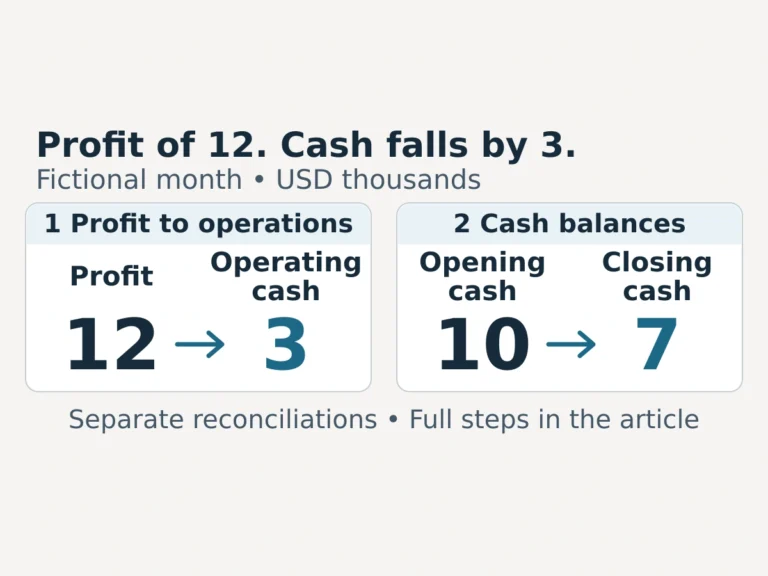
Profitable Business, Falling Cash: Reconcile the Difference
An invented one-month example reconciles net income, customer receipts, supplier payments, equipment, debt and an owner distribution to the closing cash balance.