Business Loan Affordability: Test the Cash Flow Before Borrowing
Test a proposed business loan against customer collections, operating costs, taxes, owner draws and existing debts, then check a slower month.

A business loan payment has to fit the cash your business can use after its other commitments. Start with customer money actually collected, protect the cash uses your plan requires, and test the proposed payment in a weaker month. A healthy sales total alone cannot answer that question.
This guide builds a payment-capacity check for a U.S. business. It does not calculate a lender’s maximum offer or the credit line needed to bridge a particular collection date. The example is fictional and is not a borrowing recommendation.
Start with collections, not booked sales
The SBA’s business-finance guidance distinguishes recording a sale from receiving payment and highlights receivables, payables, available cash, bank reconciliation and payroll. Use those records to check that your forecast agrees with what actually happened.
For this exercise, count an invoice when its usable payment is expected to arrive. Do not count the invoice value at issuance and again at collection. Separate borrowing proceeds, owner contributions and asset-sale receipts from recurring customer collections. Those inflows may cover specific dates; they do not establish that customers will generate the same amount next month.
Exclude or separately reserve money that must be remitted or is otherwise unavailable. A bank balance containing that money is not entirely available for debt. Mark uncertain collections and document the evidence behind their timing rather than filling a gap with an optimistic sales target.
Give each cash use one home
The worksheet below starts directly with receipts and disbursements. It does not start with accounting profit. Use mutually exclusive lines so that the same dollar is never deducted twice:
- Operations: payroll, ordinary supplier and inventory payments, rent and other operating cash paid. Put purchases at their payment dates; do not also subtract a separate inventory or receivables adjustment for that same cash effect.
- Taxes and owner cash: distinguish business tax payments from money distributed to an owner. If the owner’s salary is already in payroll, do not subtract it again as a draw.
- Equipment: show a planned cash purchase separately if it is not in operating payments. Use the cash payment, not depreciation.
- Existing debt: include required principal and interest. Exclude that interest from the operating line so it appears only once.
- Liquidity allocation: show any chosen reserve top-up separately. It remains business-owned cash earmarked for protection; it is neither an expense nor a lender payment.
These are cash-planning labels, not tax rules. Entity structure and owner arrangements vary. If your records start with profit or combine these categories, have an accountant reconcile them to this cash view before using the result.
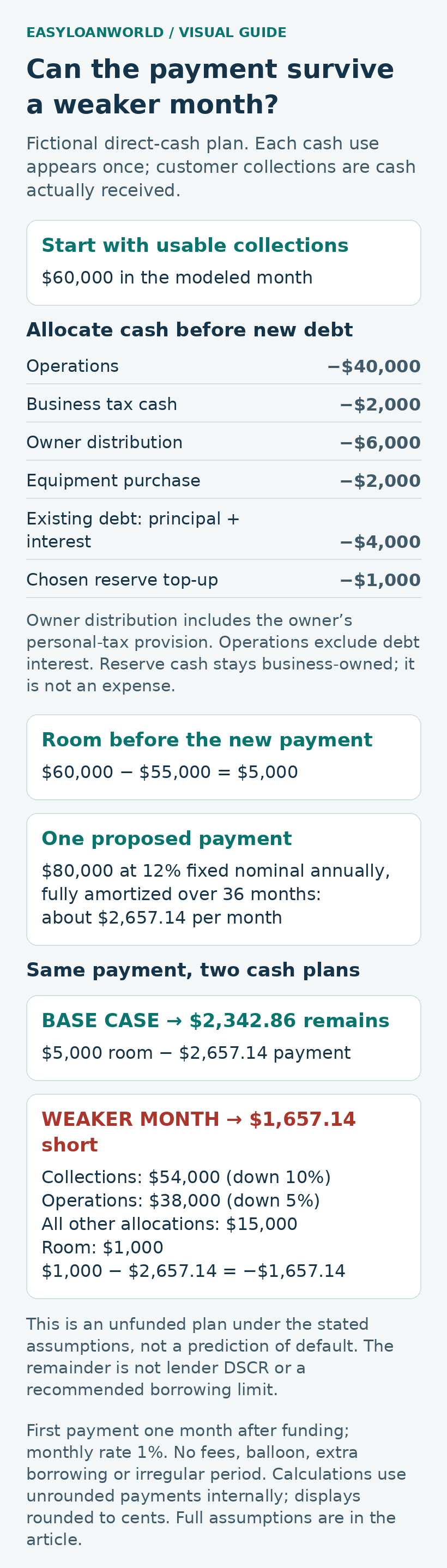
Worked example: one month leaves $5,000
An invented business is considering new debt without assuming the financed project immediately increases collections. Its modeled month has these nonoverlapping allocations; all other flows are excluded:
- Usable customer collections: $60,000.
- Operating cash paid, including ordinary inventory, suppliers and payroll: $40,000.
- Separate planned business tax cash: $2,000.
- Owner distribution: $6,000, including the owner’s personal-tax provision.
- Planned equipment cash purchase: $2,000.
- Existing debt principal and interest: $4,000.
- Chosen liquidity reserve top-up: $1,000.
The $2,000 business-tax line is separate from the owner’s tax provision inside the $6,000 distribution. Owner salary is not duplicated here. Neither the equipment purchase nor the reserve top-up is a universal monthly requirement.
Room before new debt: $60,000 − $40,000 − $2,000 − $6,000 − $2,000 − $4,000 − $1,000 = $5,000.
That $5,000 is what remains after the selected cash needs and reserve allocation. It is not free profit, an accounting-statement subtotal or an amount the business should automatically commit to a lender.
Add the proposed payment
Assume a fictional $80,000 loan, fully amortizing over 36 months, at a constant 12% nominal annual interest rate. Payments start one month after funding; the monthly rate is 1%. There are no fees, balloon, extra borrowing or irregular first period. Calculations use unrounded payments internally.
The modeled monthly principal-and-interest payment is about $2,657.14. Subtracting it from the $5,000 leaves about $2,342.86 after all listed allocations. Real fees, rounding and contract conventions can change a quoted payment.
Now make collections weaker than expected
Change two assumptions: customer collections fall 10%, to $54,000, while operating cash paid falls only 5%, to $38,000. Keep every other cash use unchanged. This tests a situation in which costs cannot shrink as quickly as receipts.
- Room before the new payment falls to $1,000.
- The proposed payment remains about $2,657.14.
- The modeled plan is short about $1,657.14 after that payment.
This is an unfunded plan under the stated assumptions, not a prediction of default. Nor does it make $1,000 the recommended payment: spending all of that leaves no additional room beyond the selected allocations.
Rework the decision using changes you can substantiate, such as a smaller purchase, a delayed project, a different operating plan or an actual lower-cost offer. Do not simply assume taxes can wait, owner cash can disappear, existing payments can be skipped or refinancing will be available.
Keep your cash check separate from lender DSCR
As one program-specific example, the SBA says most 7(a) term loans are repaid through monthly principal and interest from business cash flow. That does not make this fictional loan an SBA offer.
A debt-service coverage ratio, or DSCR, compares a defined earnings or cash measure with included debt service for the same period. Required principal and interest matter. Chase notes there is no universal “good” DSCR standard. Ask the lender for its numerator, adjustments, included debts, testing period and threshold.
Do not divide this worksheet’s $5,000 remainder by the new payment and call it the lender’s DSCR. The worksheet already deducts existing debt and selected allocations; it was designed for a different purpose.
Bank of America’s lending guidance describes evaluating repayment alongside operating needs and a cushion. A lender may request a business debt schedule and current financial statements. Your forecast supports that conversation; it does not replace underwriting or guarantee approval.
Write down the decision before committing
- Evidence: date range, collection records, seasonal patterns, one-off receipts and who owns each forecast assumption.
- Protected uses: operations, tax and owner treatment, equipment, existing debt and chosen reserves, with overlaps removed.
- Actual obligation: amount financed, net proceeds, fees, payment amounts and dates, rate changes, maturity and any final lump sum.
- Result: room before and after the proposed payment, the weakest tested month and assumptions still unverified.
- Open questions: lender definitions, covenant tests, required evidence and any contract language needing professional advice.
Test the expected borrowing period using seasonal records and realistic downside cases. One representative month cannot establish that a multiyear commitment works. Annual averages can hide weaker months, and weekly or daily payments need a dated cash check within the month.
End with a plain conclusion: the tested plan has room, depends on an unverified assumption, or shows a shortfall. The useful result is a documented decision you can revisit when the offer or business assumptions change.
Featured photo: Photo by Denny Müller on Unsplash. Used under the Unsplash license. Illustrative cash register. Photo by Denny Müller on Unsplash.
SBA Surety Bonds vs. Working-Capital Loans: Four Contractor Scenarios
Follow Riverton Build through four fictional alternatives at one pre-start review. Identify what remains unresolved and prepare a focused next conversation.
Export Payment Documents: A Two-Packet Review
A worked export-packet review follows an unresolved instruction proposal, an incomplete selected inventory and an unknown carrier arrangement, without inventing the missing evidence.
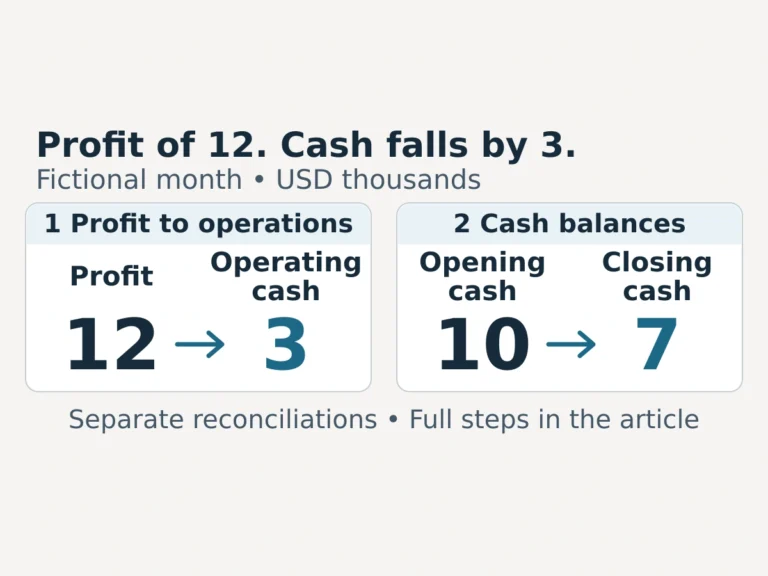
Profitable Business, Falling Cash: Reconcile the Difference
An invented one-month example reconciles net income, customer receipts, supplier payments, equipment, debt and an owner distribution to the closing cash balance.