Working Capital Loan Sizing: Find the Cash Gap Before You Borrow
Size a working capital request from dated cash gaps, a chosen cash floor and loan costs. Test a late customer payment and the source of repayment.

Size a working capital request around the largest dated cash gap, then check the full repayment. The amount needed to pay suppliers before customers pay you is different from annual sales, accounting working capital or the largest credit limit a lender might offer.
The useful output is specific: how much usable cash is needed, when it must arrive, and which later receipts can repay it while keeping the business operating. This U.S. educational example shows that complete loop.
Separate working capital from this week’s usable cash
Net working capital is current assets minus current liabilities at a date. It is a balance-sheet measure that includes assets, such as inventory and receivables, that may not yet be cash. Bank of America’s working-capital guide also discusses forecasting receipts and outflows to identify the widest cash gap.
A shelf of inventory cannot directly fund payroll. A customer invoice needs a realistic collection date. The calculation below therefore follows usable cash through a supplier-and-customer cycle instead of treating a balance-sheet subtotal as the loan request.
The SBA’s finance guidance highlights receivables, payables, available cash and bank reconciliation. Reconcile those records before forecasting; an unexplained opening balance makes every later estimate harder to trust.
Chase’s public cash-flow instructions use deposit and withdrawal dates, amounts and starting cash. That timing distinction matters here: record when usable money arrives or leaves, not simply when an invoice is issued.
Build the cash calendar without counting anything twice
Start with available opening cash after setting aside unavailable amounts and known remittances. If you already removed an obligation from that balance, do not deduct the same obligation again in a later row.
Then enter expected customer collections and each committed payment: supplier and inventory cash, payroll, business taxes, necessary owner distributions and existing debt principal and interest. Salary already included in payroll is not a second owner draw. An inventory payment should not also appear as cost of goods sold and an additional inventory adjustment in this direct-cash forecast.
Keep new financing on separate lines. Its proceeds are borrowing, not revenue. Its costs and repayment must appear on their actual dates, even when the customer who was expected to fund repayment pays late.
An eight-week wholesale cash gap
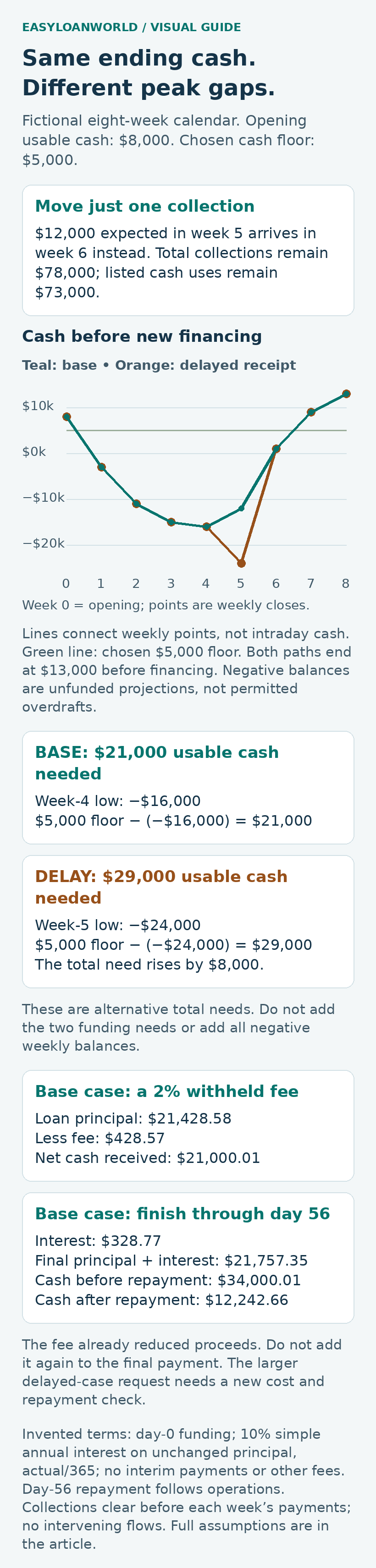
Consider a fictional wholesaler paying suppliers ahead of customer collections. It starts with $8,000 of usable cash and chooses a $5,000 cash floor. The floor is a planning choice, not a lender requirement or industry standard.
Each week’s cash out includes all the operating, tax, owner and existing-debt payments described above. Only the new financing’s proceeds, costs and repayment are excluded initially. No other cash flows are assumed.
Timing assumption: collections clear on days 7, 14, 21, 28, 35, 42, 49 and 56, before that day’s listed payments. There are no intervening transactions. These weekly closing figures therefore capture the operating low points in this invented schedule.
- Week 1: $3,000 in; $14,000 out; projected cash without new funding: −$3,000.
- Week 2: $4,000 in; $12,000 out; projected cash: −$11,000.
- Week 3: $6,000 in; $10,000 out; projected cash: −$15,000.
- Week 4: $8,000 in; $9,000 out; projected cash: −$16,000.
- Week 5: $12,000 in; $8,000 out; projected cash: −$12,000.
- Week 6: $20,000 in; $7,000 out; projected cash: $1,000.
- Week 7: $15,000 in; $7,000 out; projected cash: $9,000.
- Week 8: $10,000 in; $6,000 out; projected cash: $13,000.
Every balance equals the previous balance plus that week’s receipts minus payments. Negative figures describe an unfunded projection; they do not mean a bank will allow the payments to clear.
Total receipts are $78,000 and listed cash uses are $73,000. Opening cash plus the $5,000 net inflow produces the $13,000 ending balance. That positive ending balance does not fund the earlier shortfall.
The peak requirement is $21,000 of usable funding
The lowest projected balance is −$16,000 in week 4. To preserve the selected $5,000 floor, the business needs $5,000 − (−$16,000) = $21,000 of additional usable cash.
Do not add all the negative weekly balances: each already carries the earlier gap forward. Do not add opening cash again, either; the $8,000 is already inside every projected balance.
For a real business, inspect daily transactions when payroll or supplier payments come before the week’s receipts. Weekly closing balances can otherwise conceal a larger shortfall.
Adjust for a withheld fee, then test maturity
A $21,000 cash need does not necessarily mean a $21,000 loan. Assume these entirely fictional terms:
- Funding on day 0, with a 2% origination fee withheld from principal.
- A 56-day loan charging 10% simple annual interest on unchanged principal, using actual days divided by 365.
- No interim principal or interest payments and no other fees.
- Full principal and interest due on day 56, after that day’s operating transactions.
Divide the usable cash needed by the proportion retained: $21,000 ÷ 0.98. Rounding the principal up to $21,428.58 avoids funding below the required cents. The fee rounds to $428.57, leaving $21,000.01 received. The funded operating trough becomes $5,000.01.
Day-56 interest is $21,428.58 × 10% × 56 ÷ 365, or $328.77 rounded to cents. The final payment is $21,757.35: principal plus interest. Do not add the withheld fee again to this payment; it already reduced the proceeds.
Immediately before repayment, cash is $13,000 plus $21,000.01, or $34,000.01. After paying $21,757.35, the business has $12,242.66, above its chosen floor in this scenario.
The difference from the $13,000 no-financing ending balance is the $757.34 financing cost: $428.57 fee plus $328.77 interest. The 10% interest assumption is not a fee-inclusive APR or a current offer. A different disbursement date, payment schedule, fee or rate requires a new calendar calculation.
Stress one late collection, even if total sales are unchanged
Now move only the $12,000 week-5 receipt into week 6. Week 5 receives nothing; week 6 receives $32,000. All other transactions stay unchanged. Eight-week collections still total $78,000, and projected ending cash before financing remains $13,000.
But the week-5 unfunded balance falls to −$24,000. Maintaining the same $5,000 floor now takes $29,000 of usable funding, an $8,000 increase. The increase is smaller than the $12,000 delay because the original lowest balance occurred earlier, in week 4.
The $21,000 and $29,000 are alternative total needs, not amounts to add together. With only the original $21,000.01 proceeds, stressed cash reaches −$2,999.99. That is an unfunded plan, even though the late receipt still arrives before maturity.
A larger request would need its own fee, interest, availability and repayment check. If a real collection slips beyond maturity, test that due date separately and contact the lender early. A later customer payment does not change a signed loan’s due date.
Take six records to the financing decision
For a program-specific example of supporting records, the SBA’s Working Capital Pilot description discusses timely financial statements, receivables and payables aging, and inventory reports. The fictional loan above is not an SBA product or an eligibility test.
- Usable opening cash and exclusions.
- Dated collections, evidence and the least-certain customer payment.
- All nonoverlapping operating, owner, tax and existing-debt cash uses.
- The selected floor and lowest projected balance.
- New-financing proceeds, costs and every repayment date.
- A dated repayment source and at least one credible delay test.
Ask whether borrowing-base, availability, reporting or renewal conditions could prevent access to the requested cash. A calculated need is not an approved credit limit.
Keep temporary collection-cycle needs separate from persistent funding needs. Bank of America’s guidance makes that distinction; a forecast that stays short after realistic receipts calls for a broader operating-plan review.
Finish the calendar through final repayment. If the only way it works is to assume another loan will replace this one, the repayment question remains unresolved.
Featured photo: Photo by Jacques Dillies on Unsplash. Used under the Unsplash license. Illustrative inventory storage. Photo by Jacques Dillies on Unsplash.

SBA Surety Bonds vs. Working-Capital Loans: Four Contractor Scenarios
Follow Riverton Build through four fictional alternatives at one pre-start review. Identify what remains unresolved and prepare a focused next conversation.

Export Payment Documents: A Two-Packet Review
A worked export-packet review follows an unresolved instruction proposal, an incomplete selected inventory and an unknown carrier arrangement, without inventing the missing evidence.
Profitable Business, Falling Cash: Reconcile the Difference
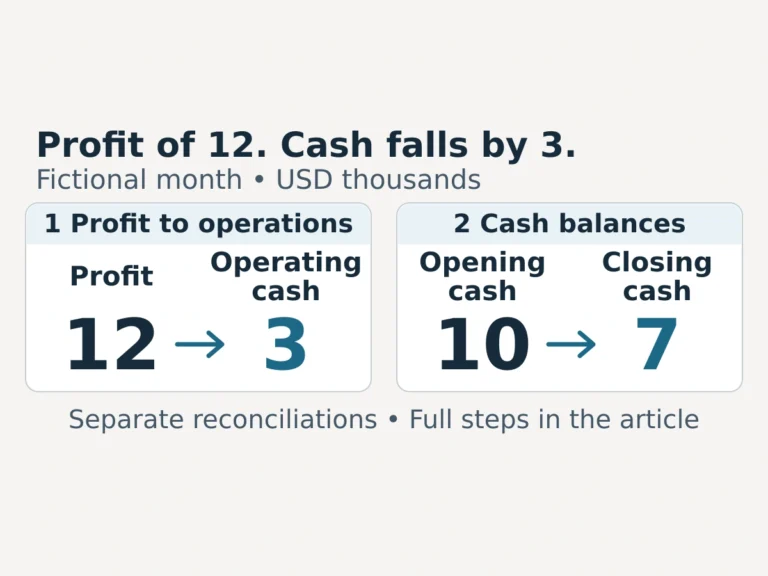
An invented one-month example reconciles net income, customer receipts, supplier payments, equipment, debt and an owner distribution to the closing cash balance.