Business Loan Balloon Payments: Prepare for the Amount Due at Maturity
Check your business loan's maturity date, remaining balance and final payment. Build a cash plan without assuming a refinance or extension will happen.

A manageable monthly business-loan payment can leave a much larger amount due at maturity. Check the final obligation separately: the schedule used to calculate installments may run longer than the contract allows you to keep the debt outstanding.
The practical task is to verify the amount and date, match usable payment sources to that deadline, and identify any gap early. This guide uses a fictional business loan and reserve plan, not a real offer or payoff quote.
Read the maturity date alongside the amortization period
The Office of the Comptroller of the Currency’s commercial refinance-risk guidance discusses loans with principal still outstanding at maturity, including commercial property loans whose installment calculation extends beyond their contractual term. Its guidance is directed to banks; it does not give borrowers an entitlement to renewal or refinancing.
For a specific product example, Chase’s commercial real-estate financing description distinguishes repayment through equal installments from repayment involving a final balloon. Your signed documents determine which structure and obligations apply to you.
Find the signed note and all amendments. Record the actual maturity date, any contractual notice deadlines and the period used to calculate the ordinary payment. A reference to “ten-year amortization” is not enough to establish when the full debt is due.
Ask for a written maturity-date breakdown
Request the lender’s projected amount due on that date, with the components separated. Ask whether the figure includes the last regular installment, remaining principal, accrued interest, fees and any other charges. Recheck the dated amount near payment.
A current principal balance, an old schedule and a model answer different questions from a final payoff quote. If the quoted final amount already contains the ordinary payment, adding that payment again overstates the cash needed.
Also identify rate changes or extra payments that could alter the projected balance. Review relevant prepayment, extension, collateral, guarantee and covenant terms with the lender or a qualified adviser. Do not assume a grace period or a changed due date because an application is pending.
A three-year maturity with a ten-year installment calculation
Assume this entirely fictional business loan:
- Original principal: $120,000.
- Fixed nominal annual interest rate: 9%, or 0.75% monthly.
- Ordinary payment calculated over 120 months.
- Actual maturity after 36 months.
- First installment one month after funding; remaining principal due immediately after installment 36 on the same date.
The calculation excludes fees, extra principal payments, arrears, rate changes and irregular periods. It uses unrounded payments internally; actual cents-rounded lender schedules may differ slightly.
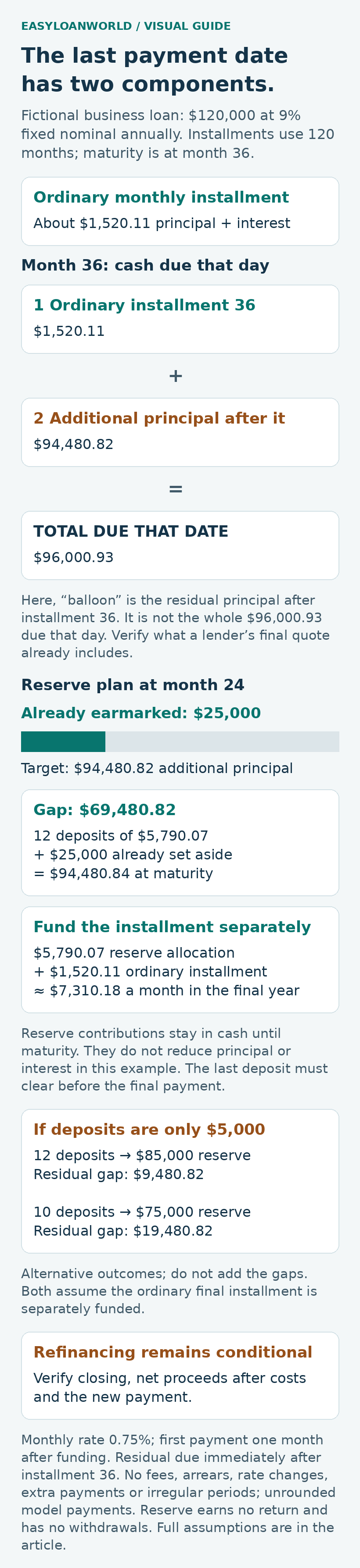
The regular principal-and-interest installment is about $1,520.11. After 36 installments, the business has repaid about $25,519.18 of principal. It still owes about $94,480.82.
Two components are due on the month-36 date
- Ordinary installment 36: about $1,520.11.
- Additional principal immediately after that installment: about $94,480.82.
- Total cash due that day: about $96,000.93.
Here, “balloon” means the additional residual principal after the last regular installment. A lender may use that word for its entire final payment, so confirm the definition. The two components above are separate only because the fictional contract explicitly makes them separate.
The residual is still-borrowed principal, not a financing fee. This borrower cannot continue making the illustrated payment for another seven years simply because the original installment calculation used 120 months.
At month 24, test a reserve for the residual
Now assume the borrower reaches the end of month 24 with $25,000 genuinely available and earmarked for the additional maturity principal. This money is separate from operations, payroll, tax remittances and cash needed for future ordinary installments.
Twelve saving opportunities remain, at the ends of months 25 through 36. The final deposit must be available before the maturity payment. Assume no investment return, withdrawals, fees or additional contributions.
- Expected additional principal at maturity: about $94,480.82.
- Already set aside: $25,000.
- Remaining reserve gap: about $69,480.82.
- Equal monthly allocation over twelve months: $5,790.07, rounded upward to cents.
Twelve allocations of $5,790.07 plus the existing $25,000 produce $94,480.84, two cents above the rounded residual target. The ordinary installment still needs its own funding. Together, the installment and reserve allocation use about $7,310.18 per month during that final year, in addition to the business’s other cash needs.
This reserve allocation is cash retained for a future obligation. It is not another lender charge, an accounting expense or an extra principal payment today. In this model, moving money into the reserve does not reduce the debt balance or interest.
What if the business can set aside only $5,000?
With twelve $5,000 deposits, the reserve reaches $85,000. The additional residual remains short by about $9,480.82. If two of those deposits are missed, the reserve reaches $75,000 and the shortfall becomes about $19,480.82.
Those are alternative outcomes, not gaps to add together. Both assume the month-36 ordinary installment is funded separately. If it is not, include it in the due-date cash plan once. Add real charges only from the lender’s actual breakdown.
The reserve test does not justify diverting payroll or tax cash. If operations cannot support it, the result is an early warning that the maturity plan needs another evidenced source.
Give each proposed payment source a status
The OCC describes refinance risk as being unable to replace debt on reasonable terms when needed. Borrower finances, interest rates, collateral values and market conditions can change the outcome. A good history of ordinary payments does not establish that a replacement loan will be available.
For every proposed source, record an amount, ready date, supporting evidence and unresolved condition:
- Existing cash: confirm it is unrestricted and not already assigned to operations, taxes or another maturity.
- Future retained cash: use a forecast after ordinary debts and owner needs; test weaker collections and missed reserve deposits.
- Refinancing: distinguish discussion from an offer, then record remaining conditions, closing timing, net proceeds after costs and the new payment. Replacement financing creates another debt obligation.
- Asset sale or owner contribution: record usable net proceeds and the completion date. Review restrictions and consequences before relying on a sale or contribution; expected proceeds are not available cash.
- Extension or changed payment arrangement: ask early and document any agreed terms. Record costs and conditions. A request or informal conversation is not proof the existing obligation changed.
Keep a six-field maturity record
- Exact maturity date and any contractual notice deadlines.
- Amortization period compared with the actual remaining term.
- Ordinary payment, rate type and any scheduled change.
- Dated lender breakdown of the final amount, including what is already included.
- Relevant contract conditions and unresolved questions for an adviser.
- Payment sources, ready dates and the remaining unsupported gap.
The example starts reserving twelve months ahead as a planning choice, not a legal or lender deadline. Your starting date depends on the contract and how long each funding condition takes to resolve.
If maturity is close and the payment source is unresolved, seek prompt lender and qualified financial or legal advice. Keep the due-date gap visible while exploring options; neither refinancing nor an extension is guaranteed.
Featured photo: Photo by Zulfa Nazer on Unsplash. Used under the Unsplash license. Illustrative clock; no loan deadline is shown. Photo by Zulfa Nazer on Unsplash.

SBA Surety Bonds vs. Working-Capital Loans: Four Contractor Scenarios
Follow Riverton Build through four fictional alternatives at one pre-start review. Identify what remains unresolved and prepare a focused next conversation.
Export Payment Documents: A Two-Packet Review
A worked export-packet review follows an unresolved instruction proposal, an incomplete selected inventory and an unknown carrier arrangement, without inventing the missing evidence.
Profitable Business, Falling Cash: Reconcile the Difference
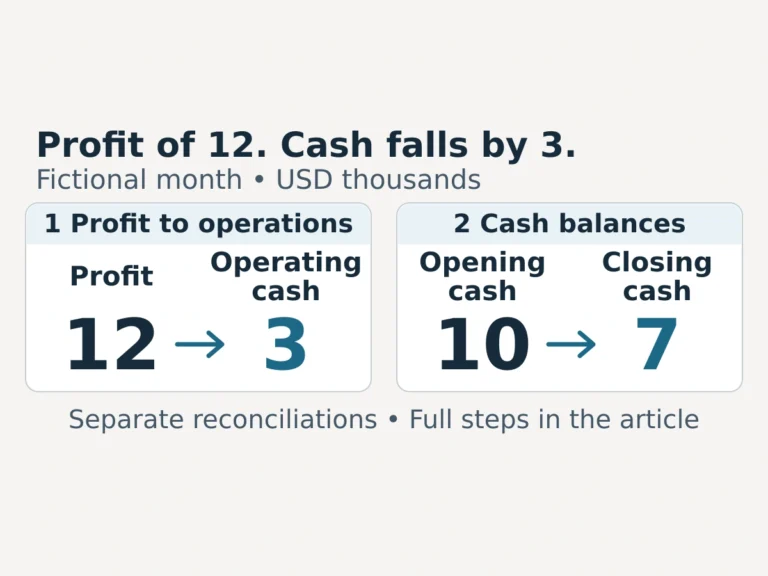
An invented one-month example reconciles net income, customer receipts, supplier payments, equipment, debt and an owner distribution to the closing cash balance.