Business Credit Line Renewal: Prepare for the Review
Prepare an evidence-based credit line review packet, track separate deadlines, explain business changes and compare any proposed renewal terms.

A business credit review, renewal decision, draw cutoff and repayment deadline are different events. Before preparing a renewal packet, establish which events apply to your existing line and what each date means. A meeting on the calendar is not evidence that borrowing access continues afterward.
This U.S. guide helps an existing borrower explain what has changed since the last review. The goal is a consistent record of dates, business changes and unanswered questions, without treating preparation as a promise of renewal.
Check your facility’s review arrangement
Bank of America’s unsecured-line disclosure describes availability generally lasting one year, with renewal at the bank’s discretion.
By comparison, Wells Fargo’s BusinessLine product page advertises no annual review. There is no single annual-review assumption to apply to every business line.
That does not mean permanent, unconditional access. The published BusinessLine agreement, sections 12–13, permits closing or reducing a line, subject to applicable law, even without default; payment responsibility continues. It also permits credit reevaluation and requests for current financial information. The bank’s agreement hub identifies its published documents as new-account agreements. Existing borrowers should obtain their own applicable terms.
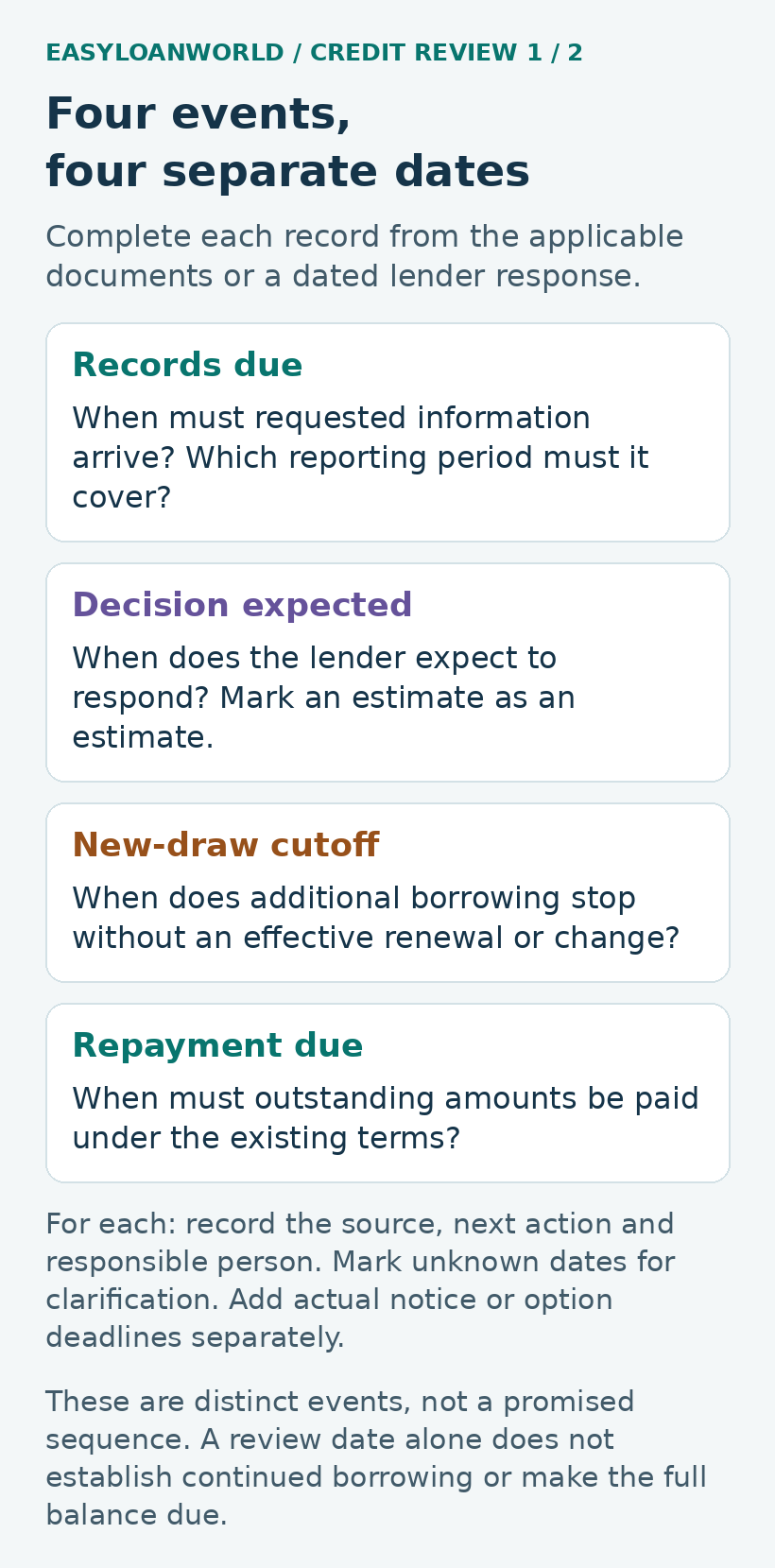
Make four separate date cards
Use the current agreement and any lender notice to complete these cards. If a date is unavailable, record who will clarify it rather than selecting an assumed deadline.
- Records due: when requested information must arrive and which reporting period it must cover.
- Decision expected: when the lender expects to communicate a review or renewal decision, if known.
- New-draw cutoff: when additional borrowing stops without an effective renewal or change.
- Repayment due: when outstanding amounts must be paid under the existing terms.
For each card, record the document and page, or a dated lender response, plus the next action and responsible person. Add any actual notice or option deadline separately. Keep an estimated decision date visibly different from a contractual deadline.
Work backward from the earliest verified date and the time your accountant needs. If the expected decision follows a draw cutoff, ask how that gap will be handled. The sequence alone does not establish an extension or change an existing payment obligation.
Explain what changed, using comparable periods
The OCC’s 2026 lending handbook describes monitoring required financial statements, covenant testing and periodic commercial reviews. It is supervisory guidance for OCC-regulated institutions, not a uniform borrower checklist or a right to renewal. Confirm what your agreement and lender require.
Prepare a short cover note using the following structure. This is an organizational aid, not an official bank form. Keep supporting records private and submit only through the bank’s verified requested channel.
State the requested outcome
Write down whether you want the existing facility continued, a different size or another specific change. Explain its intended use and repayment source briefly. Label this as the business’s request, keeping it separate from anything the bank has approved.
Choose a fair comparison
Identify the last reviewed period and the current comparable period, with exact dates and the accounting basis used. Put a forecast in its own section. Nine months of completed results and twelve months of results need an explicit explanation before comparison.
For a seasonal business, identify whether the periods cover the same part of its cycle. A strong month is not an explanation for a full-year assumption. If the reporting basis changed, ask the accountant to explain how that affects the comparison.
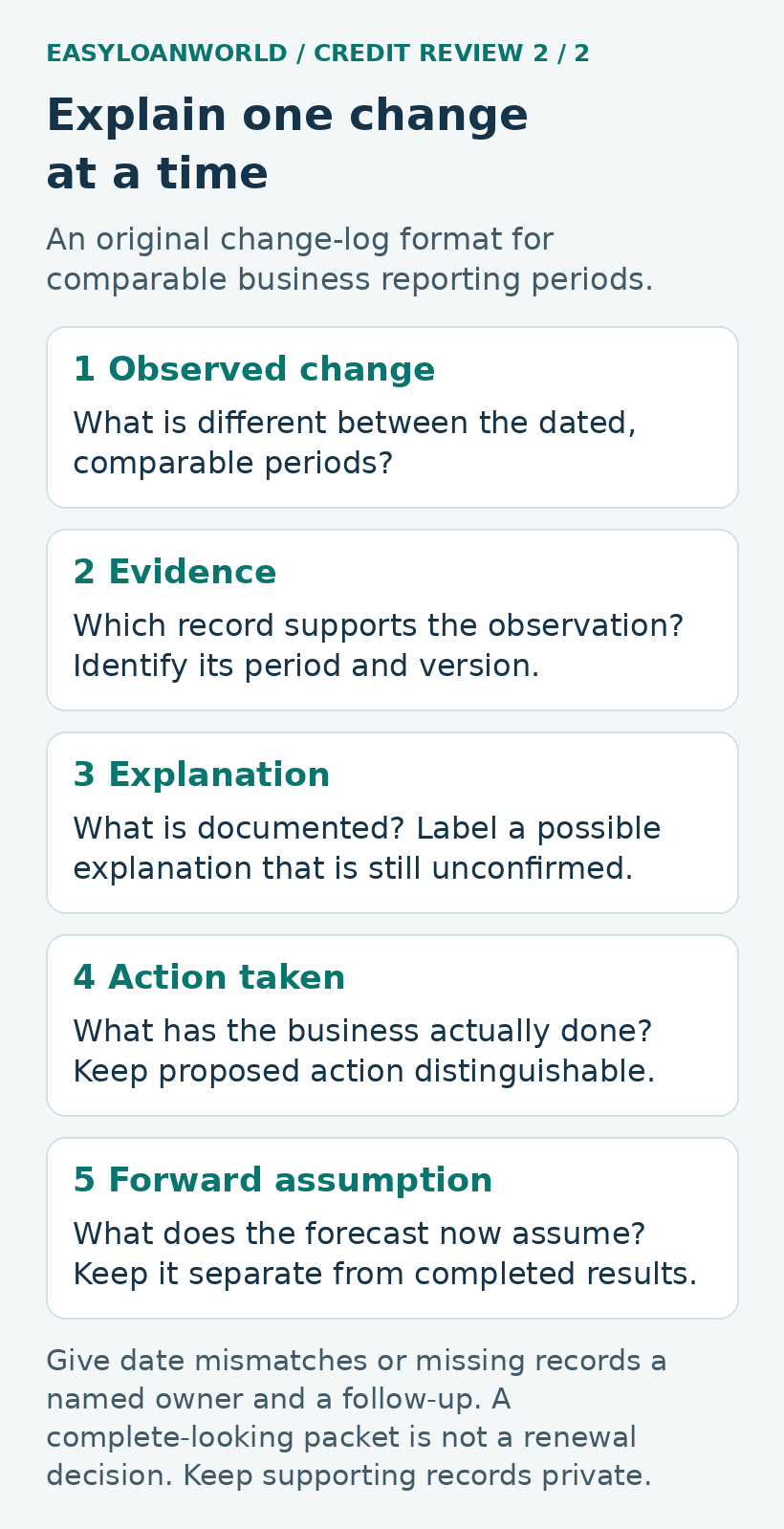
Write one entry per material change
Use five short fields: observed change, evidence, explanation, action taken and forward assumption. For example, a customer paying later may warrant an entry. Attach the supporting record and distinguish a documented reason from a possible explanation you have not confirmed.
Other entries might concern changed supplier terms, a one-off asset sale or a new recurring debt. Keep unusual events visible rather than presenting them as ordinary repeatable performance. Financing proceeds should not be presented as customer sales, and outstanding obligations should remain visible.
Track the actual information request
Confirm whether the lender needs financial statements, tax information, debt details or applicable receivable, inventory or covenant records. The required documents, dates and frequency depend on the facility; this list does not prescribe them.
For each requested item, record its period, format, preparer, ready date, submission date and acknowledgement. Give a late item its own follow-up. Sending the available files is not a reason to mark an incomplete request complete.
A fictional packet with three different dates
A fictional wholesaler has September 30 financial statements, an August 31 customer-aging report and a forecast relying on a large October collection. The dates differ. That alone does not prove the figures are false, the customer will pay or a lender test has failed.
The preparation work is to make the relationship between those records understandable:
- Align the report dates, or label why a different cutoff is being used.
- Trace the expected October collection to supporting evidence and identify the uncertainty.
- Keep the completed September period separate from projected October activity.
- Tell the lender which corrected schedules are outstanding and when they will be available.
For each mismatch, name the person who will resolve it and retain the corrected version. Ask the accountant about genuine reporting differences; ask the lender which definitions govern its requested test. Do not alter evidence simply to make a result look acceptable.
Compare any proposal with the current documents
Use a vertical card for each relevant term, with three fields: current documented term, proposed term and operating consequence or question. Inspect what is actually offered:
- Limit and period for new draws
- Maturity and payment structure
- Rate method and fees
- Reporting or covenant requirements
- Any collateral or guarantee changes
These are review prompts, not claims that every offer contains every feature. Mark an unanswered item “unconfirmed” rather than carrying an old term into the proposal by assumption. Obtain qualified legal or financial advice on a change you do not understand.
Track the decision while preserving the current plan
Keep separate statuses for information requested, packet acknowledged, decision communicated, conditions resolved and effective written terms verified. These are your tracking labels, not a required bank sequence. A receipt acknowledgement or willingness to review does not establish renewed availability.
While waiting, test a contingency plan with no new draws after the actual cutoff and existing repayment duties unchanged. This does not assume the whole balance becomes due at review. If the test reveals an urgent gap, discuss it promptly with the lender and qualified advisers.
Finish by recording what was decided, what remains conditional and which documents establish the effective terms. If renewal is refused or the facility changes, identify the actual written consequences before revising the operating plan.
Sources checked October 19, 2026. Product examples illustrate differing arrangements; your applicable agreement and lender communications need their own review.
Featured photo: Photo by Swello on Unsplash. Used under the Unsplash license. Illustrative calendar; it does not show a loan deadline. Photo by Swello on Unsplash.

SBA Surety Bonds vs. Working-Capital Loans: Four Contractor Scenarios
Follow Riverton Build through four fictional alternatives at one pre-start review. Identify what remains unresolved and prepare a focused next conversation.
Export Payment Documents: A Two-Packet Review
A worked export-packet review follows an unresolved instruction proposal, an incomplete selected inventory and an unknown carrier arrangement, without inventing the missing evidence.
Profitable Business, Falling Cash: Reconcile the Difference
An invented one-month example reconciles net income, customer receipts, supplier payments, equipment, debt and an owner distribution to the closing cash balance.