Equipment Financing: Cash Needed Before the Machine Is Ready
Reconcile the equipment invoice, financing and cash still needed, then check delivery, installation and acceptance before relying on productive use.
A financed machine can arrive before it is installed, tested or producing anything. Before relying on it, reconcile the acquisition cash still due and the facts any acceptance document asks you to confirm.
These are related checks, but they answer different questions. Funding tells you who pays which invoice items. Readiness tells you whether the equipment can do its intended job. The fictional example below keeps them separate.
Start with uses of money, not the financing headline
U.S. Bank describes direct vendor funding and possible inclusion of installation, tax and freight within product limits. That named example is a reason to confirm eligible invoice lines and the payment destination; an approved amount is not necessarily unrestricted cash sent to your business.
For your purchase, list the exact machine, accessories and services in the quote. Beside each item, identify the payee, total cost, amount financed, cash already paid and amount still due. Keep a deposit credit connected to the invoice it reduces.
Consider this invented acquisition, not a lender quote or tax calculation:
- Machine: $50,000.
- Freight: $1,800.
- Installation: $4,200.
- Assumed quoted tax: $3,000.
- Training: $1,500.
- Separately paid financing fee: $500.
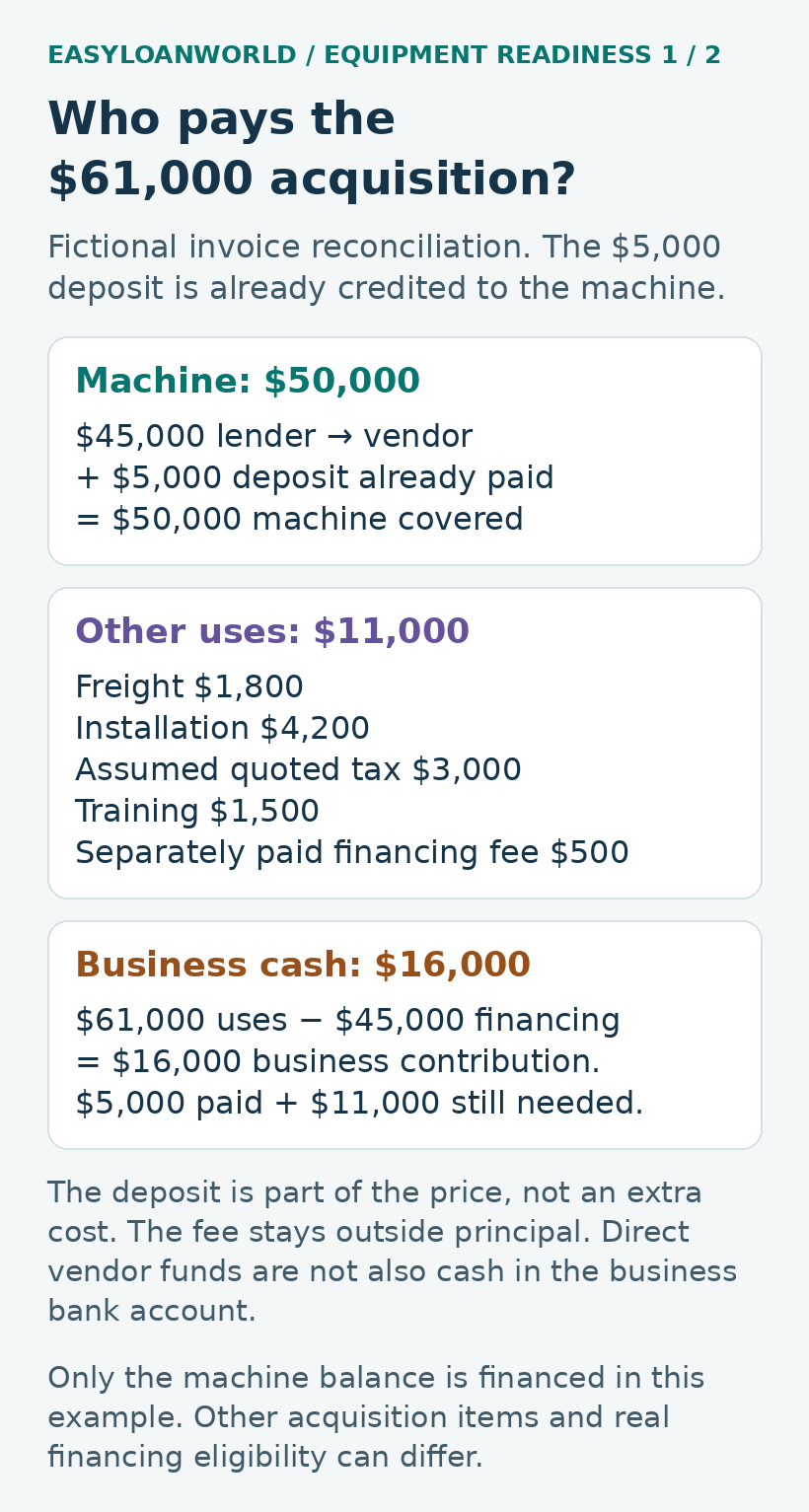
Total acquisition-related uses are $61,000. The $3,000 tax is simply a stipulated invoice item; it does not establish any jurisdiction’s tax rate, exemption or credit. In an actual project, add missing quote items and applicable connection, permit, insurance or service costs. These six lines are not an exhaustive checklist for every machine.
Credit the deposit exactly once
In this arrangement, the lender commits $45,000 directly to the vendor against the machine balance only. Every other item is excluded from financing. Funding conditions are assumed satisfied solely for the arithmetic.
The business already paid that vendor a $5,000 deposit, with evidence that it is credited toward the $50,000 machine price. There is no reimbursement or refund in this example.
The machine is therefore covered by $45,000 of lender funds plus the $5,000 credited deposit. Freight, installation, tax, training and the financing fee total $11,000, which the business still needs to pay.
- Total business acquisition cash: $61,000 − $45,000 = $16,000.
- Cash already paid toward that amount: $5,000.
- Acquisition cash still needed: $16,000 − $5,000 = $11,000.
Adding the deposit to the $61,000 again would count part of the machine price twice. Deducting it twice would conceal a cash shortage. The $500 financing fee remains outside the loan principal, and money paid by the lender to the vendor is not also available in the business’s bank account.
Before relying on this reconciliation, obtain matching invoice and deposit records. If financing eligibility or reimbursement is only proposed, label it unresolved rather than subtracting it as if the money had arrived.
Give arrival, installation and acceptance separate entries
Record what happened and when, rather than using one “delivered” box for the whole acquisition. Arrival could be evidenced by a delivery record; completed installation and technical testing need their own appropriate evidence. Assign responsibility for site preparation, setup and testing before scheduling productive use.
As a provider-specific documentation example, DLL’s Retail Finance best-practices resource emphasizes matching equipment serial numbers to the contract. Record each delivered asset’s identifier so discrepancies can be resolved against the actual order.
A 2017 Wells Fargo/Plug Power master lease filed with the SEC provides a historical illustration. Its acceptance certificate covers delivery, inspection, installation and operational readiness, and section 24 connects acceptance with noncancelability under that agreement. This is not a current standard form or a rule for every equipment transaction.
Before signing your document, read each factual statement and check whether it is true. Note missing accessories, damage or unfinished installation and testing. Seek corrected documentation or advice about unresolved statements instead of certifying something inaccurate. Qualified technical personnel should assess mechanical readiness; contractual questions belong with the parties and a qualified legal adviser.
Keep signed records and confidential identifiers private. This guide is not a substitute acceptance form and does not determine the legal effect of a signature.
Test payments before productive use
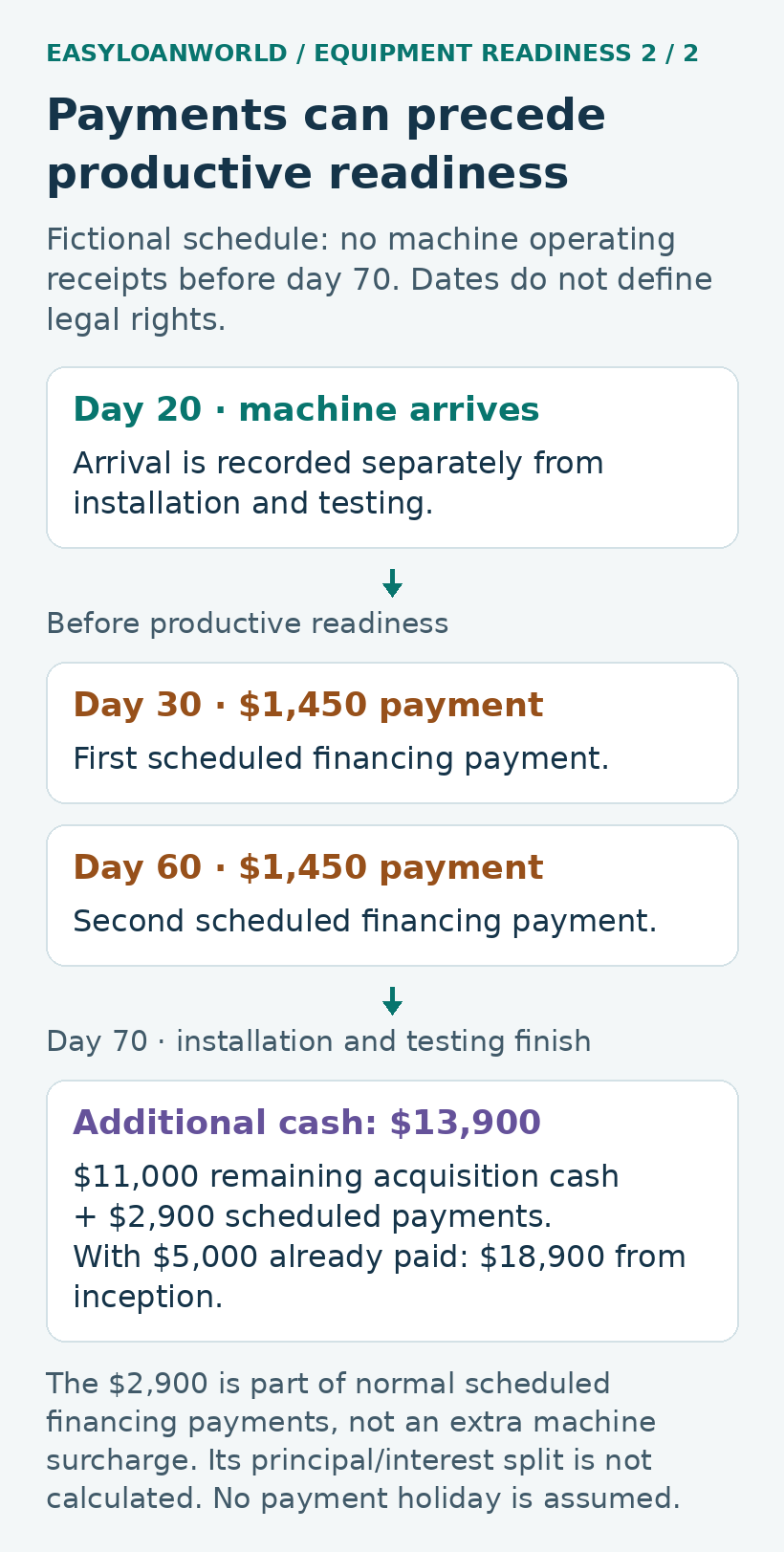
Now add a separate timing assumption to the $11,000 still needed. In the fictional project, the machine arrives on day 20, but installation and testing finish on day 70. The agreed financing schedule requires $1,450 on day 30 and another $1,450 on day 60. No operating receipts from the machine arrive before day 70.
Those dates and installments are supplied assumptions, not a calculation of the $45,000 financing rate or term. They are also independent of the historical SEC agreement.
- Two scheduled payments before readiness: 2 × $1,450 = $2,900.
- Additional cash through readiness: $11,000 remaining acquisition cash + $2,900 = $13,900.
- Total business cash from inception through readiness: $5,000 already paid + $13,900 = $18,900.
The $2,900 is part of the normal financing payment schedule, not an extra surcharge added to the machine’s price. Its principal and interest components are not calculated here. Once spent, it cannot also be counted as an operating reserve available after installation.
For the real transaction, ask which dated event triggers vendor funding, any financing charges and the first payment, and how an installation delay affects the agreed schedule. Do not assume those events share a trigger. The example creates no payment holiday or right to cancel payments.
Close the unresolved-items list
Before depending on production, reconcile the vendor’s receipt, the credited deposit, your remaining payments, the first financing debit and the actual readiness date. Give each unresolved item an owner and the evidence needed to close it: a corrected invoice, funding confirmation, missing-part delivery or completed technical test.
A balanced invoice alone does not prove readiness, and a ready machine does not prove every cash obligation is covered. Keeping both records makes the remaining work visible before the business relies on the equipment.
Featured photo: Workshop tools illustrate equipment setup and maintenance. Photo: Markus Spiske / Unsplash. Used under the Unsplash license.
SBA Surety Bonds vs. Working-Capital Loans: Four Contractor Scenarios
Follow Riverton Build through four fictional alternatives at one pre-start review. Identify what remains unresolved and prepare a focused next conversation.
Export Payment Documents: A Two-Packet Review
A worked export-packet review follows an unresolved instruction proposal, an incomplete selected inventory and an unknown carrier arrangement, without inventing the missing evidence.
Profitable Business, Falling Cash: Reconcile the Difference
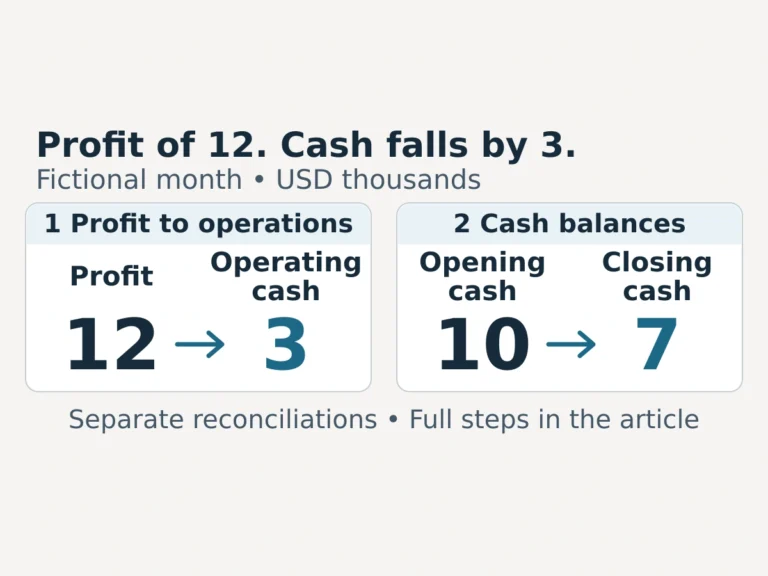
An invented one-month example reconciles net income, customer receipts, supplier payments, equipment, debt and an owner distribution to the closing cash balance.