Small Business Credit Survey: What Financing Percentages Mean
Use a fictional 100-firm exercise to check who a percentage describes and whether the stated outcome matches the arithmetic.

A headline can hide two different counting mistakes. This guide separates a short real-report reference from an invented counting exercise. The exercise’s numbers must never be presented as survey findings.
The report reference
The Federal Reserve’s 2026 report surveyed 6,525 employer firms (1–499 employees), September 3–November 14, 2025. For the prior 12 months, 60% applied for new financing. Applicants’ financing received (N=3,654): all sought 42%, most 15%, some 21%, none 22%. These are weighted outcomes, not approval/denial rates; pending applications and declined offers can explain incomplete funding. See PDF pages 10 and 14 (printed).
Methodology: nonrandom convenience sample; weighting does not guarantee unbiased results. Branching/responses change denominators. Weighted percentages are not raw counts. Nonemployers are excluded. These findings do not predict individual outcomes.
A separate, fictional group of 100 firms
Everything in the following exercise is invented, unweighted and based on complete responses. It is not Federal Reserve data. Define one financing category and one observation period. Count each firm once, including firms that made no application.
- 100 firms in the whole group.
- 40 applied; 60 did not apply.
- Of the 40 applicants, 16 received all they requested, 12 received part and 12 received none.
Check the branches first: 40 + 60 = 100, and 16 + 12 + 12 = 40. The outcomes are stipulated as observed in this invented dataset, but the reasons for receiving none are unspecified.
Keep the top number and change the group
Among applicants, full funding is 16 ÷ 40 × 100 = 40%. Among all firms, it is 16 ÷ 100 × 100 = 16%. Both answers are correct. They describe the same 16 firms against different comparison groups.
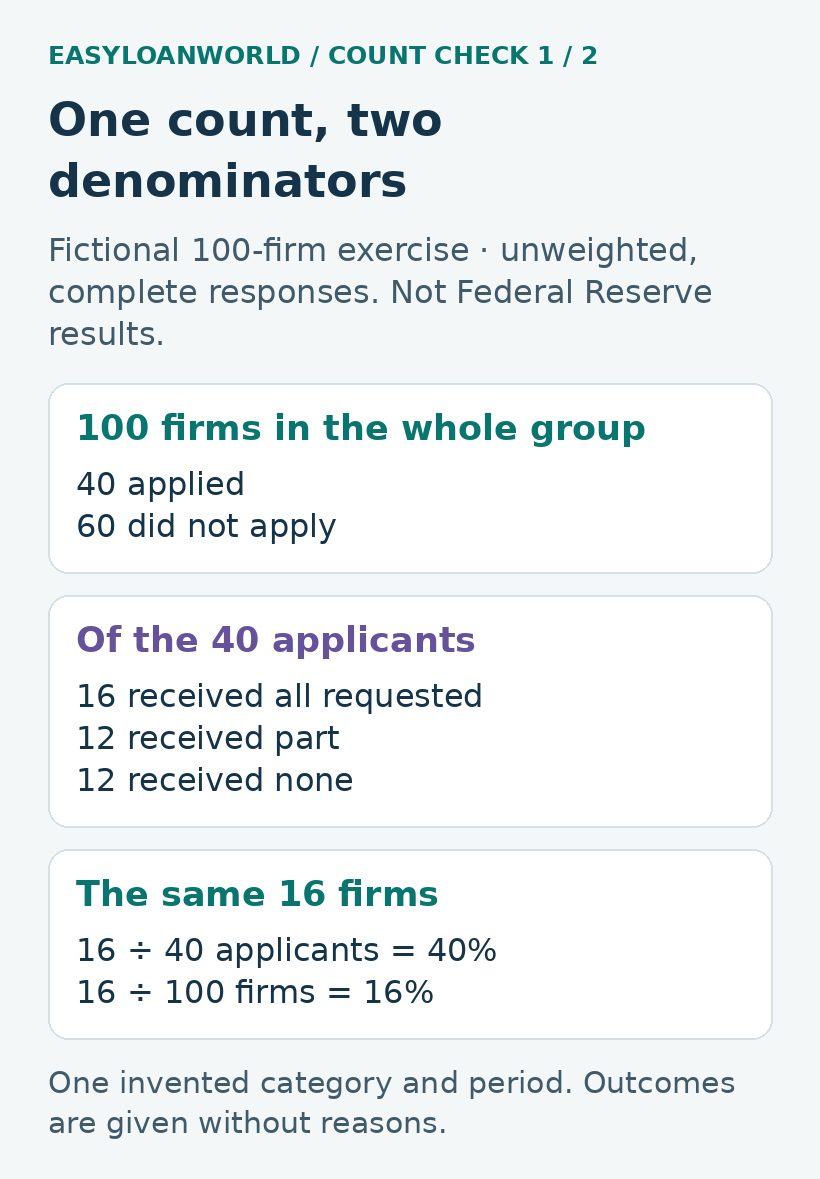
The fictional sentence “40% received full funding” is incomplete without “of applicants.” Changing the wording to “40% of all firms” would imply 40 fully funded firms, when the exercise contains only 16.
Partial funding is 12 ÷ 40 = 30% of applicants, or 12% of all firms. The 12 applicants receiving none are also 30% of applicants and 12% of all firms. The remaining 60% of all firms are nonapplicants; they cannot be counted as rejected applications.
Change the outcome and recalculate
For “any financing,” combine the fictional full and partial groups: 16 + 12 = 28. That is 28 ÷ 40 = 70% of applicants, or 28 ÷ 100 = 28% of all firms. Receiving some money is a different outcome from receiving the entire requested amount.
Suppose an invented headline says “70% of all businesses received everything requested.” It fails twice against this exercise. A correct sentence is: “In this fictional group, 70% of the 40 applicants received at least some financing; 40% received all they requested.” The correction changes both the denominator and the outcome.
Receiving none does not establish why no money arrived. The exercise gives no decision records, so it cannot support a count of denials. Do not fill that missing fact with a plausible story.
Check whether answer groups overlap
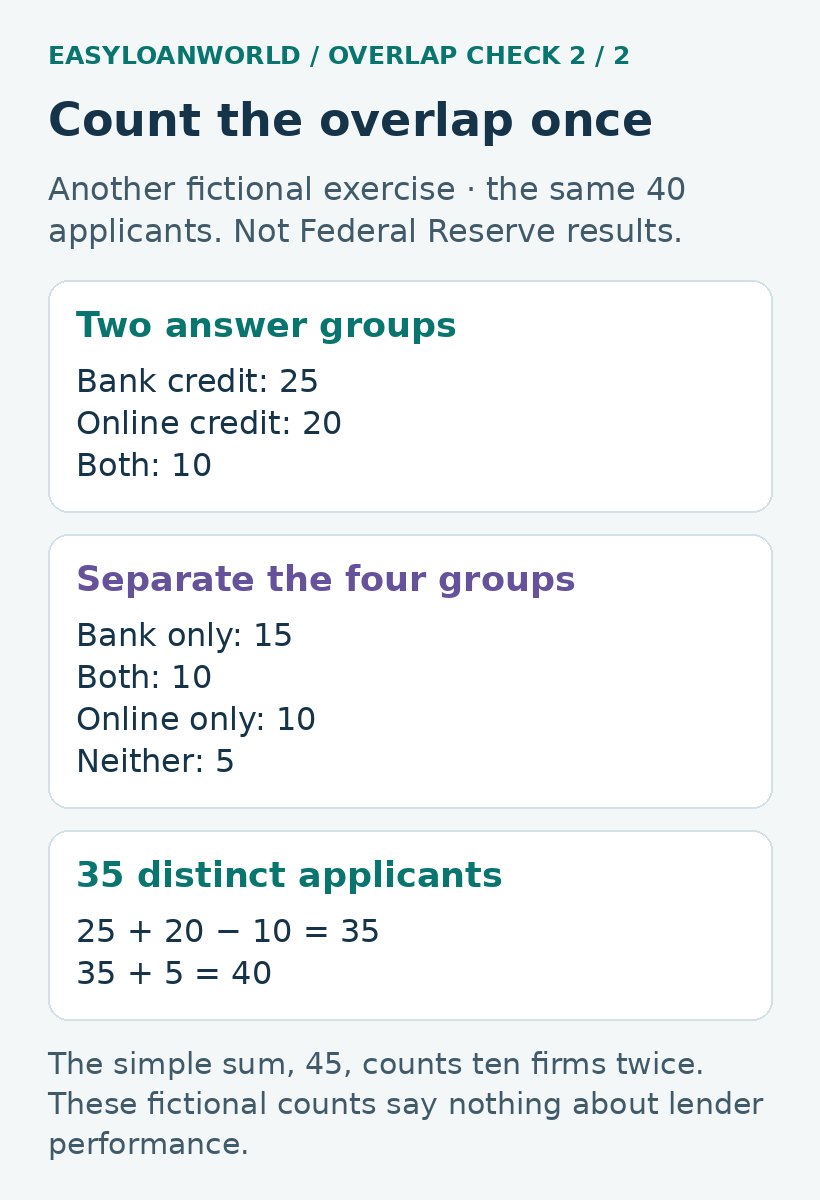
Here is another fictional exercise using the same 40 applicants. Suppose 25 sought bank credit and 20 sought online credit, with 10 seeking both. Then 25 + 20 − 10 = 35 distinct applicants sought at least one of those two categories. Five sought neither category.
Adding 25 and 20 produces 45 selections, not 45 distinct firms. An applicant appearing in both groups was counted twice in the simple sum. This exercise makes no comparison of lender performance; it only shows why multiple-selection answers need a different counting check.
Save a one-sentence interpretation with its evidence
Private card: claim, chart, release/observation dates, unit, denominator, product, outcome, sampling/weighting caveat, missing details, corrected sentence.
For the fictional headline, write the two corrected percentages beside the original claim. Underline “of applicants” and circle “at least some.” Those two edits identify precisely what went wrong, instead of merely replacing one headline number with another.
Sources checked October 19, 2026. General research-reading education. The 100-firm and overlapping-response exercises are original hypothetical examples, not market estimates or borrowing recommendations.
Featured photo: A blank notebook and pencil, shown for illustration. Photo: Kelly Sikkema / Unsplash. Used under the Unsplash license.

SBA Surety Bonds vs. Working-Capital Loans: Four Contractor Scenarios
Follow Riverton Build through four fictional alternatives at one pre-start review. Identify what remains unresolved and prepare a focused next conversation.

Export Payment Documents: A Two-Packet Review
A worked export-packet review follows an unresolved instruction proposal, an incomplete selected inventory and an unknown carrier arrangement, without inventing the missing evidence.
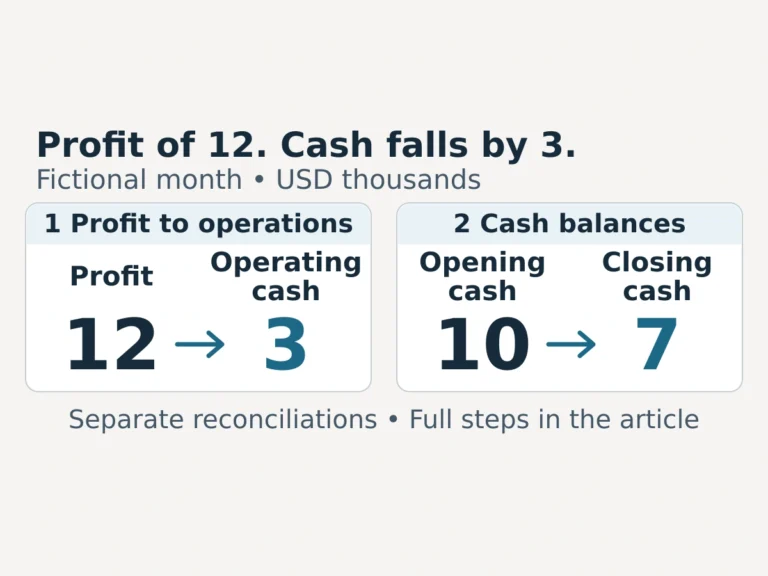
Profitable Business, Falling Cash: Reconcile the Difference
An invented one-month example reconciles net income, customer receipts, supplier payments, equipment, debt and an owner distribution to the closing cash balance.