Dealer Financing Changed? Compare Both Versions
Track a fictional callback with a version-by-version comparison worksheet.

Use two questions to organize a financing callback: what changed, and what remains unresolved? A new payment amount alone cannot explain a changed transaction or determine your legal position.
Check whether financing is final before leaving. Review proposed changes before deciding. See car-financing guidance.
Open a version register
Date and label complete existing documents “A” and revised documents “B.” Keep attachments with their own version. Avoid combining a price page from A with a payment page from B, even if the vehicle identification is unchanged.
On a separate call log, record the caller, date, explanation and requested next step in neutral language. “Dealer says approval was not completed” records what you were told. It does not establish that a contract was invalid or that anyone broke the law.
Read the fictional change across all columns
This original exercise compares two proposals before repayment begins. It is not an actual rescission case. The fully itemized vehicle transaction is $26,000 in both versions, with no trade-in, add-ons, rebate, separate finance charge or fees beyond that total. There are no prior repayments or other debts.
| Input or result | A: first proposal | B: changed proposal |
|---|---|---|
| Total cash contribution | $2,000 | $3,000 |
| Principal | $24,000 | $23,000 |
| Annual nominal rate | 7% | 10% |
| Monthly payments | 60 | 72 |
| Payment amount | $475.23 | $426.09 |
| Scheduled repayments | $28,513.73 | $30,678.79 |
| Cash plus repayments | $30,513.73 | $33,678.79 |
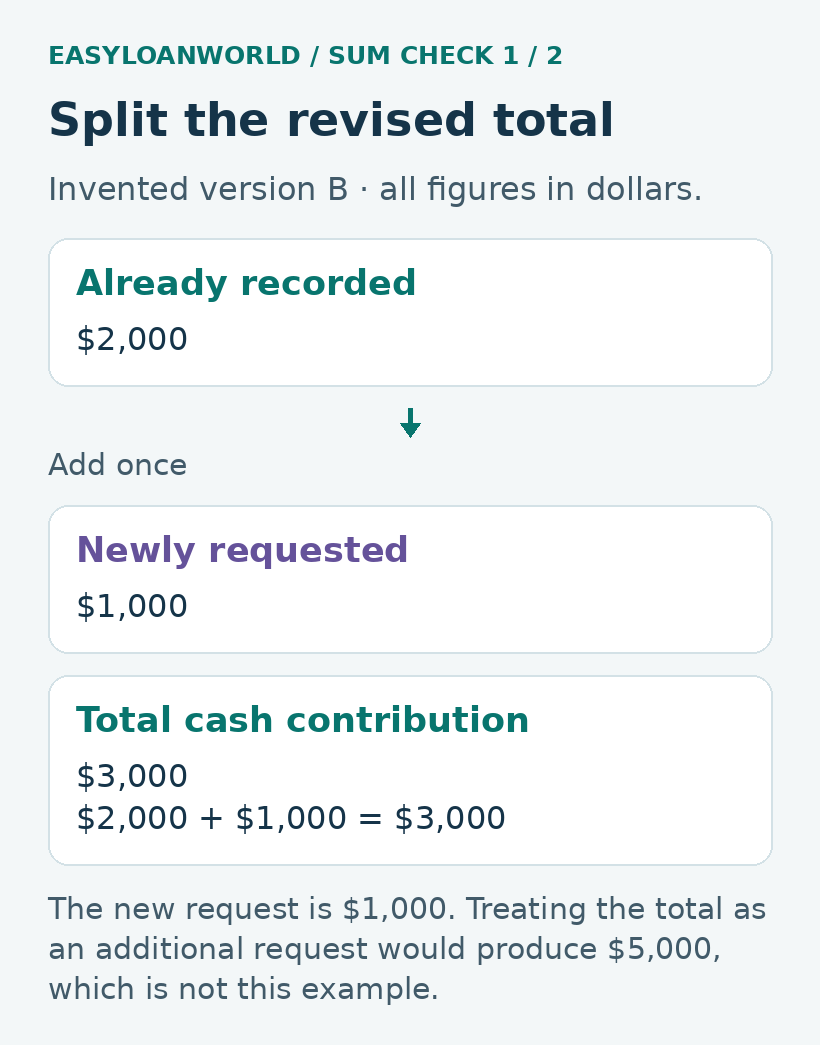
For B, the $3,000 cash total consists of $2,000 already on record plus $1,000 newly requested. Count the existing contribution once. The new request is $1,000, not another $3,000.
B lowers the monthly payment by about $49, but requires that extra $1,000 now and 12 additional monthly payments. Its modeled cash-plus-repayments total is $3,165.06 higher. Do not add the $26,000 vehicle transaction to either final total: purchase principal is already represented in cash and repayments.
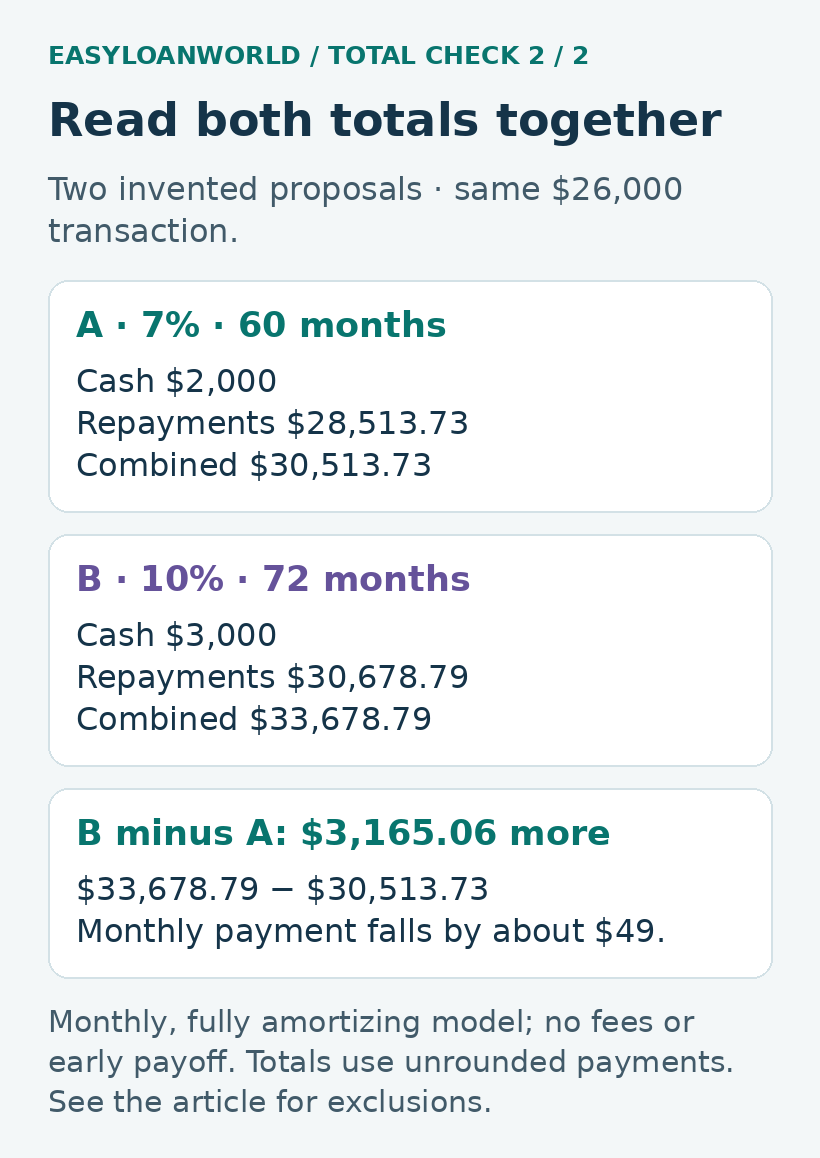
Both schedules assume fully amortizing monthly loans with end-of-month payments, no irregular first period and no early payoff. Rates are invented and equal APR in this fee-free model. The calculation uses monthly rate = annual rate ÷ 12 and payment = principal × monthly rate ÷ [1 − (1 + monthly rate) raised to the negative payment count]. Totals use unrounded payments; displayed cents can create small subtraction differences. Real schedules can differ. This model excludes maintenance, insurance, depreciation and the value of cash used today.
Make each unresolved change visible
Create a row for price, total cash, cash already received, newly requested cash, principal, rate, term, scheduled repayments and stated financing status. Give every row these five fields:
- Value in A and its document/page.
- Value in B and its document/page.
- Dollar, percentage-point or date difference.
- Your unanswered question.
- The response, date and supporting document.
For the example’s cash row, a useful question is: “Does the revised $3,000 include my recorded $2,000?” For an unchanged price with changed principal, ask which cash or itemization entry explains the difference. Mark a missing page as missing rather than assuming it matches A.
Record the decision and the response
If rejecting the new proposal, ask about cancellation and return of your down payment or trade-in. Ask the dealer and finance company for written confirmation of any agreed cancellation. These requests are not a universal right to unwind every contract or a guaranteed return. Take disputed obligations or return arrangements to a state consumer-protection agency or qualified legal adviser.
Use USA.gov’s state consumer-protection office directory to select your state or territory and find its official contact route for a business complaint.
For this callback, ask which office handles dealer-financing complaints and what to do about the specific return demand or payment deadline you received. Have both document versions and the dealer’s request available.
If considering B, resolve its unexplained entries and keep the complete version you actually accept. Do not assume A remains available or enforceable. Avoid treating silence, vehicle abandonment or stopped payments as a resolution; address obligations and any notice promptly. This worksheet organizes evidence and questions, not legal advice or a finding of wrongdoing.
Featured photo: A showroom scene, shown for illustration. Photo: Patrick Langwallner / Unsplash. Used under the Unsplash license.
College Withdrawal Bill: Reconcile the School Account
Use three school records and a fictional $1,340 example to trace each adjustment, check a changed balance and organize questions for the right office.

Student Aid Credit Balance: Separate the School Ledger From Spendable Cash
Use two fictional aid snapshots and a private payment record to organize the amounts, permissions and dates behind a college-account credit.

Solar Loan Quotes: Compare the Cash Price Before the Low Rate
Match the installation scope, reconcile a fictional $6,000 financed-price uplift, and test the later payment if a planned savings payment never arrives.