Totaled Car, Open Loan: Reconcile Posted and Pending Credits
Trace a fictional total-loss loan through insurer and provider credits. Separate posted amounts, pending assumptions and the records still needed.

When you review an auto loan after a total loss, give each insurance or provider amount its own record. Start with one dated lender balance, identify the credits it already includes, and keep unposted amounts in a separate scenario. This lets you see which part of the old account is reconciled and which party still needs to supply evidence.
The fictional case below has a $3,780 recorded book-account balance as of October 6, 2026. Two separate pending credits would reduce that figure to $380 if both later posted unchanged and nothing else happened. The smaller number is a conditional result, not a payment instruction or replacement-car budget.
Check the account record alongside the claim record
The Consumer Financial Protection Bureau describes GAP as an optional product promising to cover some or all of the difference between a vehicle’s cash value and the remaining loan or lease balance after theft or total loss. That general description does not establish what your own contract will pay. See CFPB’s insurance guidance.
As one lender’s example, Wells Fargo tells borrowers whose vehicle was damaged to keep making regular monthly payments until the loan is paid off. Its FAQ also describes GAP claims and eligible product refunds, including a different refund route for non-GAP products on loans originated in Nevada. These are Wells Fargo’s processes. Ask your own lender for written payment and account instructions. See Wells Fargo’s auto-loan FAQ.
For this reconciliation, use a lender posting record to answer whether an amount has changed the account. Keep a provider’s confirmation or estimate as evidence of that item’s separate status. A provider record alone does not meet the example’s definition of a posted loan credit.
Fix the date and balance basis first
Fictional figures. As of October 6, 2026. Book-account balance, not payoff. All amounts are U.S. dollars. The cutoff is October 6 at 23:59:59 UTC, inclusive. Every date and record in the example is invented.
The calculation uses one hypothetical total book-account balance. Each plus or minus amount shows a recorded change to that same total. The $400 borrower credit is not an assumption that a real $400 cash payment reduces principal by $400. The example assumes no other transactions or additional accrued amounts.
Two snapshots describe the same account at different times. Choose one as your starting point; do not add the snapshots together.
| Snapshot | Through end of day, UTC | Book-account balance | Events already included |
|---|---|---|---|
| S0: opening record | October 1, 2026 | $24,600 | None of E1–E5 |
| S1: newer record | October 4, 2026 | $3,780 | E1, E2 and E3 |
Trace each post-loss amount to its destination
The event IDs keep the records separate. E1–E3 were recorded and posted on their listed dates. E4 and E5 were recorded on their listed dates but have no posting date by the October 6 cutoff. All dates use UTC. A minus sign means a reduction in this account balance.
| Event and date, 2026 | Origin, destination and evidence | Signed net change | Status at October 6 | Already in S1? |
|---|---|---|---|---|
| E1 · October 2 | New posted account charge from lender record to old loan balance. Evidence: record E1. | +$80 | Posted | Yes |
| E2 · October 3 | Borrower payment credited to old loan balance. Evidence: record E2. | −$400 | Posted | Yes |
| E3 · October 4 | Primary-insurance settlement credited from insurer to old loan balance. Evidence: record E3. | −$20,500 | Posted | Yes |
| E4 · October 5 | Separate conditional provider credit to old loan balance if posted. Evidence: provider record E4. | −$3,000 assumed | Confirmed but unposted | No |
| E5 · October 6 | Separate estimated product credit to old loan balance if posted. Evidence: product-provider record E5. | −$400 estimated | Estimated, unposted | No |
E4 and E5 are invented credits with separate fictional supporting records. Each would add its own further reduction to the same account balance. Neither amount includes, replaces or offsets the other. This is a modeling assumption, not a GAP-benefit or refund formula. Before combining real quoted amounts, ask each provider to identify any overlap and confirm the intended recipient.
If a real amount is disputed or its destination is unclear, label that uncertainty. Do not enter it as a posted loan reduction merely because a settlement letter or another document mentions the amount.
Reconcile the posted balance, then show the separate scenario
Starting from S0, apply the three posted events once:
$24,600 + $80 − $400 − $20,500 = $3,780.
Starting from S1, E1, E2 and E3 are already included. There are no additional posted events through October 6 in this example, so the result remains $3,780. The two paths agree.
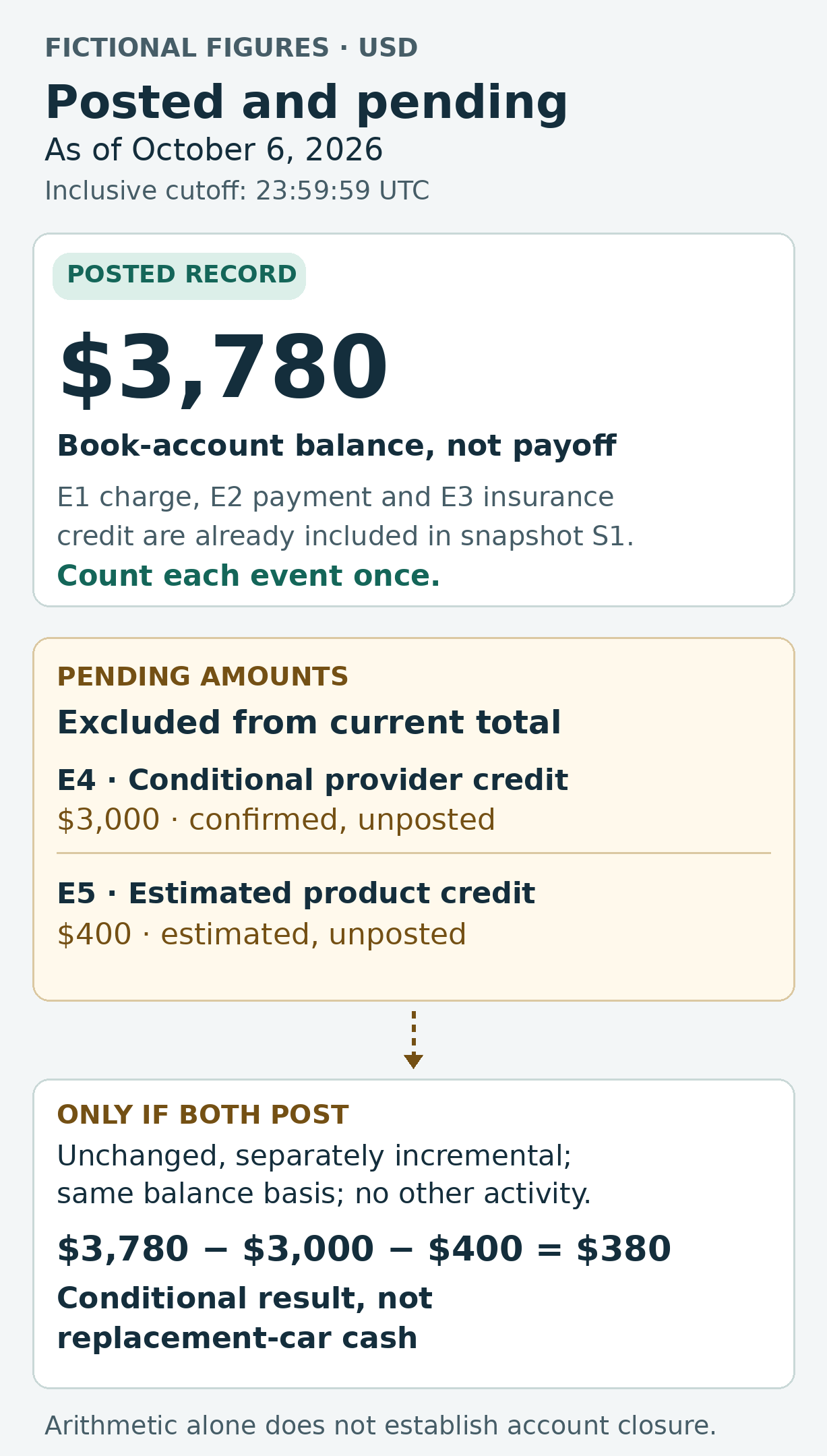
Now calculate the separate conditional case:
$3,780 − $3,000 − $400 = $380, only if E4 and E5 actually post unchanged with no other activity.
Conditional result, not replacement-car cash. Both pending entries are directed to the old loan in this invented case. The calculation establishes neither a lender payoff amount nor funds available to buy another car. Account closure remains unverified.
Avoid counting the $400 borrower payment twice
E2 and E5 happen to have the same amount. E2 is an already-posted borrower credit; E5 is a separate estimated product credit. Match records by event, origin, date and evidence, rather than by amount alone.
- Wrong duplicate only: $3,780 − $400 = $3,380. This incorrectly subtracts E2 a second time from a balance that already includes it.
- Pending assumptions plus the wrong duplicate: $3,780 − $3,000 − $400 − $400 = negative $20. The first two deductions assume E4 and E5; the last $400 repeats E2.
Negative $20 does not follow from duplicating E2 alone. It requires that duplicate deduction on top of both pending assumptions. Also, $3,380 can be a valid conditional result in a different case below. An amount by itself cannot tell you whether the underlying records were handled correctly.
Update the status when the evidence changes
These are separate alternatives, each starting from the October 6 base case. They do not revise that historical cutoff or all happen together.
- E4 is revised to $2,500 while still unposted: the recorded balance stays $3,780. If revised E4 and unchanged E5 later post with no other activity, the conditional result is $880.
- E4 is denied: the recorded balance stays $3,780. With only E5 still assumed, the conditional result is $3,380. Unlike the duplicate-payment mistake above, this calculation does not subtract E2 again.
-
One posting sequence: E4 posts on October 7. At that later cutoff, the recorded balance becomes $780, assuming no other activity. Remove E4 from the pending scenario; E5 alone would reduce $780 to $380 if it later posts unchanged.
In this same sequence, E5 then posts on October 8. The later recorded balance becomes $380 under those same assumptions. Neither E4 nor E5 remains pending. This still does not establish payoff or account closure.
- A separate October 7 alternative reverses $500 of E3: retain E3 and add a new +$500 event linked to it. The later recorded balance is $4,280 if nothing else posts. A reversal is its own dated event; do not silently erase or rewrite the original credit.
A new lender snapshot should identify which events it already covers. Use it as the new starting balance and add only later posted changes to the same account total. If an older posted event seems missing from the snapshot, ask the lender to reconcile the mismatch before adding or subtracting it yourself.
Keep principal-only amounts, payoff quotes and total account balances clearly labeled. If records use different bases, request comparable records rather than forcing them into one sum. Any later charge or other posted activity also needs its own dated entry; it is outside the fixed October 6 result.
Ask for the record that resolves the gap
Use the ledger to make each follow-up specific:
- Lender: What balance basis and cutoff does this record use? Which borrower payments and insurer or provider credits does it already include? For any missing item, can you provide the posting reference or explain its current status?
- Primary insurer: What amount was issued, to whom, on what date and with which payment reference? Ask the lender to match that evidence to the credit on the old loan.
- Relevant provider: Is this amount an estimate, a conditional confirmation or an issued payment? What conditions remain? Does it already account for another quoted credit, and where is it intended to go?
- Lender before a payoff decision: What current payoff instructions apply to the intended payment date, and what separate record will confirm the account has been settled or closed?
Save the answer beside the matching event and note the next unresolved question. A provider’s revised estimate changes the pending scenario; a lender’s new posting changes the recorded balance. Even a zero or negative arithmetic result does not, by itself, prove account closure or a right to receive cash.
The useful stopping point for this reconciliation is a dated balance supported by identified postings, plus a short list of unresolved credits and the party responsible for each answer. Keep any replacement-car funding decision separate until its actual funding and old-account obligations have been verified.
Educational account-reconciliation example. No coverage, refund eligibility, title procedure or payment change is determined here. Official source pages checked October 20, 2026.

College Withdrawal Bill: Reconcile the School Account
Use three school records and a fictional $1,340 example to trace each adjustment, check a changed balance and organize questions for the right office.

Student Aid Credit Balance: Separate the School Ledger From Spendable Cash
Use two fictional aid snapshots and a private payment record to organize the amounts, permissions and dates behind a college-account credit.

Solar Loan Quotes: Compare the Cash Price Before the Low Rate
Match the installation scope, reconcile a fictional $6,000 financed-price uplift, and test the later payment if a planned savings payment never arrives.