Simple or Precomputed Auto-Loan Interest? What Early Payments Change
Identify your auto loan’s interest method before paying early. See why a $30 allocation difference becomes $1.32 at a matched date in one fictional example.

Before paying an auto loan early, find the interest-calculation clause in your agreement. Start with a precise question: are you moving one installment forward, paying extra while continuing installments, or clearing the entire loan? Identify the action before comparing dollar amounts.
With simple interest, charges follow the outstanding balance on a daily or monthly basis. With precomputed interest, the interest charge is calculated when the loan begins. Changing repayment therefore requires a different analysis for each method. The CFPB’s explanation of the two methods supplies this starting distinction.
Read the calculation clause before the payment screen
For a balance-based calculation, identify the contract rate, calculation frequency, day-count basis and date used to credit payment. A daily calculation needs the elapsed days; sending money and having it credited are separate events to confirm.
Regulation Z’s disclosure rule requires a finance-charge dollar amount. Our inference: that box alone cannot identify precomputed interest. Read the operative terms rather than diagnosing the method from a fixed installment or a single prepayment checkbox. The rule separately addresses prepayment penalties and rebates, and different charge types can coexist. Precomputed interest, prepaid finance charges and prepayment penalties are not interchangeable.
Use the contractual accrual rate. APR reflects applicable fees as well as interest, so substituting a fee-inclusive APR can distort the calculation. See the CFPB’s rate-versus-APR explanation.
A later due date does not establish stopped interest. Wells Fargo’s current auto-loan FAQ, for example, describes extra money reducing principal while also advancing the next payment due. That is one lender’s policy; verify your own allocation and remaining obligations.
Daily-interest example: compare both paths on October 21
Suppose you want to move the same $500 installment ten days earlier. The following fictional experiment changes only the payment’s timing. It does not add a second payment or compare two loan offers. All dollar amounts are U.S. dollars.
For the daily method illustrated, interest equals unpaid principal × annual contract rate ÷ year basis × elapsed days. Confirm the actual agreement’s inputs.
The assumptions that make the comparison work
- Immediately after September 21, 2026, principal is $10,000 and unpaid interest is $0.
- The fixed annual contract rate is 10.95%, with a 365-day basis and daily simple interest. The daily rate is 0.1095 ÷ 365 = 0.0003.
- One $500 payment is received and credited on October 11 or October 21, 2026. Each interval excludes its starting date and includes its ending date.
- Interest is rounded to cents once per completed interval, with half cents rounded up. There is no daily rounding. Each payment covers accrued interest first, then principal.
- The early payment satisfies the same October 21 installment, with no further payment before that checkpoint. This is an assumption, not a lender billing rule.
- There are no fees, penalties, late payments, rate changes, capitalization, add-on credits or separate principal adjustments. Later accrued interest in the early path stays unpaid and separate from principal.
If the $500 arrives October 11
Twenty days have elapsed. Interest is $10,000 × 0.0003 × 20 = $60. The payment therefore reduces principal by $500 − $60 = $440, leaving $9,560. Another ten days then accrue $9,560 × 0.0003 × 10 = $28.68 of interest by October 21.
If the $500 arrives October 21
Thirty days have elapsed. Interest is $10,000 × 0.0003 × 30 = $90. The payment reduces principal by $410, leaving $9,590. Immediately after that payment, this path has no unpaid modeled interest.
On a small screen, scroll the table sideways to see both payment paths.
| Measure | Paid October 11 | Paid October 21 |
|---|---|---|
| Interest paid within the $500 | $60.00 | $90.00 |
| Interest still accrued and unpaid | $28.68 | $0.00 |
| Total interest paid or accrued | $88.68 | $90.00 |
| Remaining principal | $9,560.00 | $9,590.00 |
| Principal plus unpaid interest | $9,588.68 | $9,590.00 |
The two payment receipts allocate $30 differently, but they cover different numbers of days. At the common checkpoint, the early path has incurred $1.32 less interest: $90 − ($60 + $28.68). Its remaining modeled obligation is also $1.32 lower. Omitting the unpaid $28.68 would exaggerate the difference.
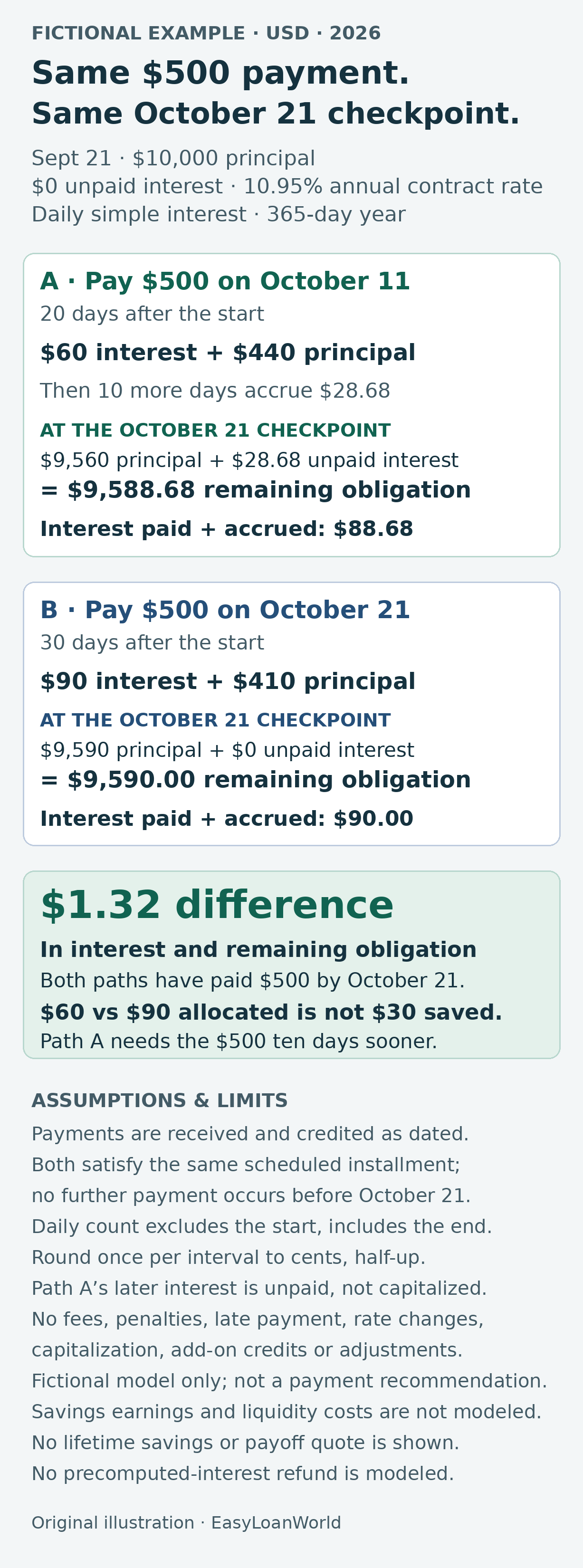
A second calculation confirms it: reducing principal by $440 ten days sooner avoids $440 × 0.0003 × 10 = $1.32. The $60 paid on October 11 has already left the borrower’s cash; do not add it to the remaining obligation again.
This result requires $500 available ten days sooner. It measures loan interest through October 21 only, without savings earnings or the value of retaining accessible cash. It establishes neither lifetime savings nor an overall financial recommendation. The table is not a payoff quote, and its assumed installment treatment does not change a real account’s next required payment.
For precomputed interest, identify the specific prepayment event
A precomputed charge does not automatically shrink using the daily-balance arithmetic above. An early full payoff may involve a rebate of unearned interest. The CFPB’s precomputed-interest guidance does not establish your rebate amount or promise one for every partial extra payment.
Ask which provision governs your intended action: an early installment, a partial extra payment or full payoff. For a partial payment, ask whether and how the finance charge changes. For full payoff, request a dated calculation showing any applicable rebate and charges. A rebate disclosure alone does not supply the amount; ask for the contractual calculation behind it. See the prepayment disclosure provisions.
The example fixes a daily rate, two intervals and a rule for applying $500. If your agreement supplies a different calculation, those inputs no longer describe your loan. Reusing the $1.32 result would answer the fictional question again, leaving your actual question unresolved.
Early-payoff treatment depends on the contract and applicable law. Check potential charges before acting; this guide determines no state-law entitlement. The CFPB’s early-payoff guidance explains that limitation.
Leave with a calculation you can trace
Ask the servicer to identify the clause and calculation it used for your chosen amount and date, and to confirm what remains due afterward. Keep required payments current while clarifying the answer. The useful endpoint is a method tied to your agreement and intended payment, with any unexplained difference still visible.
U.S. consumer education, not individualized financial or legal advice. Primary sources checked October 20, 2026. All worked amounts and dates are fictional.
College Withdrawal Bill: Reconcile the School Account
Use three school records and a fictional $1,340 example to trace each adjustment, check a changed balance and organize questions for the right office.

Student Aid Credit Balance: Separate the School Ledger From Spendable Cash
Use two fictional aid snapshots and a private payment record to organize the amounts, permissions and dates behind a college-account credit.

Solar Loan Quotes: Compare the Cash Price Before the Low Rate
Match the installation scope, reconcile a fictional $6,000 financed-price uplift, and test the later payment if a planned savings payment never arrives.