Lease Mileage: When Does a Higher Allowance Pay Off?
Compare two fictional lease mileage quotes before signing. Calculate the break-even mileage, see why savings level off, and adjust for upfront costs and taxes.

A higher mileage allowance can be worth paying for before you sign a car lease. The useful question is how much extra driving would recover the higher price. Compare two matching written quotes, then test several realistic mileage totals.
The Consumer Financial Protection Bureau identifies mileage limits as negotiable lease terms and explains that exceeding the allowance can trigger charges.
Timing can matter: Toyota Financial Services says extra miles may be arranged before signing, but the allowance becomes fixed after signing and taking possession. That is Toyota’s process; check the rules for your own lessor.
Start with two fictional, matching quotes
This U.S. consumer example compares a scheduled return after the full 36-month term. Both quotes cover the same vehicle and have identical non-mileage costs. All figures are invented, exclude tax and are not advertised offers from Toyota or any other provider.
- Lower allowance: 36,000 total miles; $0.25 for each mile above that limit.
- Higher allowance: 45,000 total miles; $25 more on each of 36 payments, plus $0.25 for each mile above its own limit.
- Extra premium: 36 × $25 = $900 for 9,000 additional allowed miles.
There are no unused-mile refunds, credits, bonuses or waivers in this exercise. This assumption does not describe any provider’s refund policy. We compare undiscounted extra dollars, not the full lease price or the value of paying money earlier versus later. Early termination, buyout and extensions are outside this comparison.
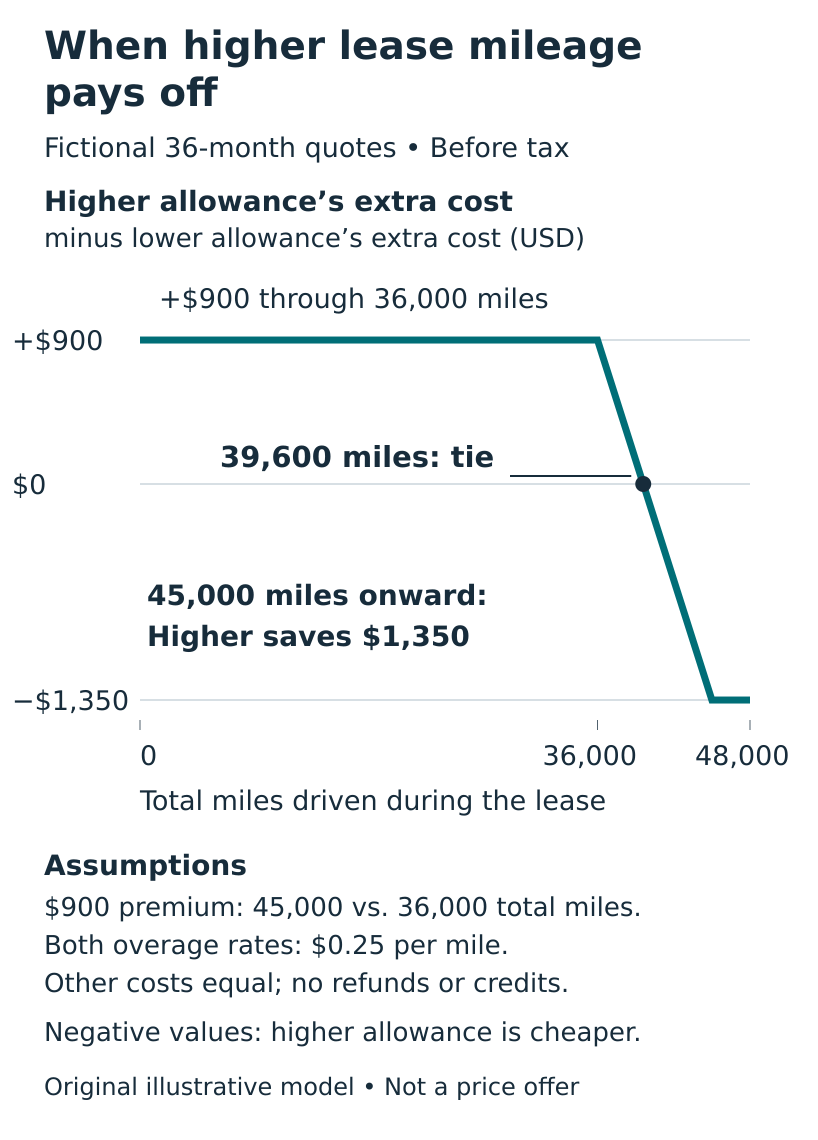
The tie is 39,600 total miles
Let M mean the miles you drive during the entire lease. It is not necessarily the ending odometer reading: check the starting odometer and the contract’s allowance basis.
- Lower extra cost: $0.25 × the miles above 36,000, or zero if you stay within that allowance.
- Higher extra cost: $900 + $0.25 × the miles above 45,000, with no overage charge below that allowance.
While driving remains between the two limits, the higher quote avoids $0.25 of overage for each mile beyond 36,000. Recovering the $900 premium takes $900 ÷ $0.25 = 3,600 miles above the lower allowance. Add those to 36,000: the offers tie at 39,600 total miles.
That is not 3,600 total miles or 3,600 extra miles each year. Over three years, the tie averages 13,200 miles annually; this conversion does not create an annual allowance reset.
Test your likely driving against both quotes
| Total miles driven | Lower allowance: extra cost | Higher allowance: extra cost | Cheaper option |
|---|---|---|---|
| 33,000 | $0 | $900 | Lower by $900 |
| 39,000 | $750 | $900 | Lower by $150 |
| 39,600 | $900 | $900 | Tie |
| 42,000 | $1,500 | $900 | Higher by $600 |
| 45,000 | $2,250 | $900 | Higher by $1,350 |
| 48,000 | $3,000 | $1,650 | Higher by $1,350 |
For example, at 48,000 miles the lower quote adds (48,000 − 36,000) × $0.25 = $3,000. The higher quote adds $900 + (48,000 − 45,000) × $0.25 = $1,650. Neither number is the full cost of the lease.
Why the saving stops growing
Subtract the lower quote’s extra cost from the higher quote’s extra cost:
- Up to 36,000 miles: the higher quote costs $900 more.
- Above 36,000 through 45,000 miles: the difference is $900 − $0.25 × (M − 36,000).
- Above 45,000 miles: the higher quote costs $1,350 less, because both quotes now charge the same rate for every further mile.
Under these assumptions, lower wins below 39,600 total miles, the quotes tie there, and higher wins above it. The higher allowance’s saving reaches its $1,350 ceiling at 45,000 miles and stays there. Driving beyond 45,000 still costs money.
Adjust the calculation for your actual quote
Upfront differences: If the higher quote also requires a genuine extra $300 nonrefundable charge, its premium becomes $1,200. The tie becomes 36,000 + ($1,200 ÷ $0.25) = 40,800 total miles, before tax. Count the first installment once: if it is already in the signing amount, include only 35 later installments for this 36-payment example. Keep refundable deposits separate from nonrefundable costs and consider when that cash is returned.
A premium too large to recover: The extra 9,000 allowed miles avoid at most 9,000 × $0.25 = $2,250 in lower-tier overage. With equal overage rates, a premium above $2,250 never pays for itself through mileage alone. At exactly $2,250, the quotes tie at and beyond 45,000 miles. Dividing any premium by $0.25 without checking the allowance gap can give a misleading answer.
Different overage rates: The flat $1,350 saving depends on equal rates. With different rates, recalculate each quote at every mileage scenario, including above both limits; the difference can keep changing.
Refunds or credits: Use only a documented provision that applies to your quote and scenario. Subtract a qualifying credit once from the relevant option. Do not assume an allowance tier works like a separately purchased prepaid-mile product.
Taxes: Toyota’s lease-end FAQ says invoice items may be taxable. Obtain the applicable tax treatment for your actual quotes rather than assuming the pre-tax example gives your final result.
Make a low, middle and high mileage estimate
Build each full-term estimate from commute round trips × expected workdays, errands and planned travel. Add likely changes such as moving farther from work. Use three plausible totals rather than treating today’s commute as certain for three years.
- Record each quote’s full-term allowance, overage rate and installment count.
- Itemize cash due at signing, nonrefundable extras, refundable deposits, taxes, return charges and any written credits.
- Calculate each option at your low, middle and high mileage totals using its own allowance and rate.
- Compare both the dollar difference and the payment timing. A higher monthly commitment must fit your budget even if it wins in a high-mileage scenario.
Ask the lessor to clarify any missing term in writing before deciding. If your realistic mileage range straddles the tie, the calculation shows the cost of each outcome; it cannot tell you which future driving pattern will occur.

College Withdrawal Bill: Reconcile the School Account
Use three school records and a fictional $1,340 example to trace each adjustment, check a changed balance and organize questions for the right office.

Student Aid Credit Balance: Separate the School Ledger From Spendable Cash
Use two fictional aid snapshots and a private payment record to organize the amounts, permissions and dates behind a college-account credit.

Solar Loan Quotes: Compare the Cash Price Before the Low Rate
Match the installation scope, reconcile a fictional $6,000 financed-price uplift, and test the later payment if a planned savings payment never arrives.