Title Insurance Quotes: Compare Policies, Services and Payers
Compare fictional $2,150 and $2,275 title packages using matched coverage, complete service charges and a separate payer worksheet.
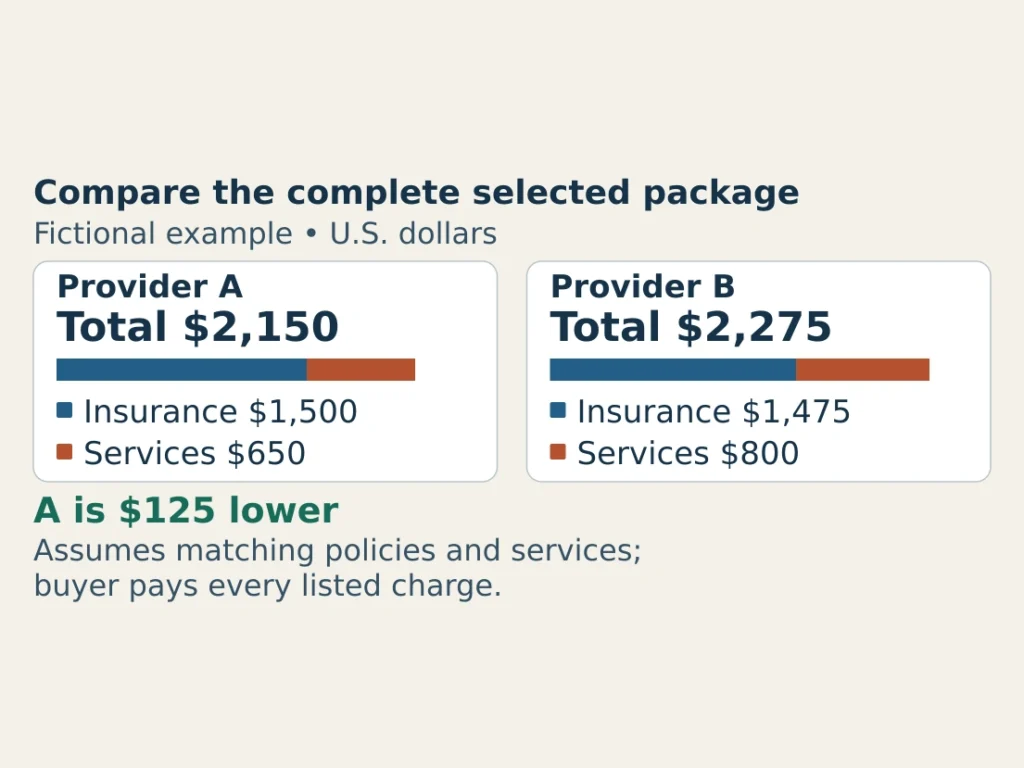
Two title-insurance quotes can point to different winners depending on which line you compare. In the fictional example below, Provider B has the lower owner-policy premium and the lower insurance subtotal. Provider A still has the lower combined insurance-and-service package: $2,150 versus $2,275.
The useful question is whether those prices buy the same policies and services, with the same payment responsibilities. Start by matching the scope. Then compare the complete selected package and check the figures against the paperwork for your transaction.
Start with the policies you are comparing
An owner’s policy can protect the homeowner’s investment against covered claims arising from earlier title problems. The actual policy determines protection. The CFPB’s owner-policy overview explains the purpose.
The lender’s policy insures the lender’s interest. Paying its premium does not give you owner-policy protection. See the CFPB’s lender-policy overview.
Before asking which quote is cheaper, send both providers the same comparison checklist. Keep a copy of each dated response. If a provider cannot confirm a field, leave it unresolved rather than assuming it matches.
| Check | Record from each provider | Your review |
|---|---|---|
| Transaction | Property, purchase price, loan amount, transaction type and expected closing date | Same inputs, or ask for a revision |
| Policy identity | Exact policy forms and versions, insured amounts, named insureds, covered risks, exclusions and endorsements | Attach the documents; flag differences |
| Pre-issuance documents | Commitment, listed exceptions and unresolved issuance requirements | Ask the provider to explain open items |
| Price scope | Each quoted charge, services included in another charge, and services billed separately | Mark included, extra or unresolved |
| Payment responsibility | Who pays each charge and any documented contribution from someone else | Separate package price from your share |
| Practical checks | Insurer and agent, quote date, expiration, open pricing assumptions and lender acceptance | Get confirmation before relying on the quote |
A commitment precedes the policy and sets out terms, conditions and exceptions. An exception identifies a matter outside coverage. The NAIC glossary explains these terms. A commitment alone does not establish that issuance conditions are satisfied.
Policy terms govern covered and excluded risks, as the California insurance regulator explains. Ask your title professional about your actual documents and local rules.
Compare the selected package, including services
Example assumptions: All amounts are invented U.S. dollars. Assume a home-purchase mortgage using a Loan Estimate and Closing Disclosure, in a jurisdiction permitting the illustrated pricing. Each issues basic owner and lender policies together. The lender requires its policy, but does not require owner coverage in this example. Assume matching coverage and services, valid quotes accepted by the lender, and no unresolved requirements. The buyer pays every listed charge, with no contributions or earlier payments.
The example also assumes the providers may charge these different premiums. It is not a state rate schedule, current offer or estimate of what you will pay.
| Item | Provider A | Provider B |
|---|---|---|
| Full owner-policy premium | $1,300 | $1,200 |
| Lender premium with both policies issued together | $200 | $275 |
| Insurance subtotal | $1,500 | $1,475 |
| Separately billed services | $650 | $800 |
| Selected package total | $2,150 | $2,275 |
A’s owner premium is $100 higher, while its lender premium is $75 lower. That leaves A’s insurance $25 higher. Its services are $150 lower, more than offsetting the insurance difference: A’s selected package is $125 lower overall.
This comparison stops at the listed package. Other transaction charges are outside the model, so neither package total tells you the full closing costs or the cash needed to complete a purchase.
Reconcile A’s $1,500 insurance total
Now stipulate A’s full lender-only premium is $900. Here, the Loan Estimate and Closing Disclosure use $900 for the lender policy; the owner amount is $1,300 + $200 − $900 = $600. See the CFPB explanation and current Loan Estimate and Closing Disclosure commentary.
| Allocation | Owner | Lender | Total |
|---|---|---|---|
| Quoted | $1,300 | $200 | $1,500 |
| Disclosed | $600 | $900 | $1,500 |
The $700 shift leaves the total unchanged. The $650 services stay separate. Mixing allocations gives false totals: $1,300 + $900 = $2,200, or $600 + $200 = $800. This allocation does not decide who pays or change coverage.
A missing service can erase the apparent saving
Go back to the original quotes. Suppose A’s $650 service bundle left out a required $125 item that B’s $800 bundle already includes. Add that item once to A: $2,150 + $125 = $2,275. The packages now tie.
If the missing item instead costs $150, A becomes $2,300, which is $25 higher than B. These are separate variations on the original example. Do not add both adjustments.
Ask for an itemized description of what the service bundle includes. A different label does not prove a different service, and a blank price does not prove the service is free. Get the provider’s written clarification before counting an extra or treating an item as included.
Keep your payment share separate from the price comparison
In another separate variation, keep the original package prices and suppose another payer covers $300 of B’s package. The buyer’s share of B becomes $1,975, while A’s stays $2,150. A still has the lower gross package price; B now requires $175 less from this buyer for these selected items.
That subtraction assumes the contribution is available and applies to this package. It does not establish whether any particular credit is permitted or where it belongs on a closing document. Verify the arrangement with the people handling your transaction.
| Entry | What to record |
|---|---|
| Selected package | Total the agreed items once, before contributions |
| Other payer’s amount | Record the amount, payer, applicable items and written confirmation |
| Buyer’s share | Subtract only the confirmed contribution applying to these items |
| Earlier payments | Record separately to avoid paying the same item twice |
| Unresolved difference | Record the amount, question, contact and response date |
Ask for a matched, dated reconciliation
Send the two worksheets to the title or closing professional and ask for a revised quote addressing every mismatch. Request the documents behind the numbers, the complete list of included services, and confirmation of each payer’s responsibility.
Ask how the quoted insurance total reconciles to the disclosure.
Keep the reply with the quote version it explains. If an item remains unresolved, record that gap and who will resolve it. A neat total is useful only when you can trace the scope and the payment assumptions behind it.
Educational comparison using fictional figures; not a coverage determination or individual legal advice. Review your transaction with the appropriate title, closing or legal professional. Sources checked October 21, 2026.
California Supplemental Property Tax: Check the Bill, Payment and Cash
Organize one California supplemental property tax bill, its payment evidence and the cash earmarked for it. A fictional example shows why a funding gap…

Flood Insurance Quote: Test Two Deductibles Against Your Cash Reserve
Test fictional flood quotes against a $6,000 reserve: $180 in annual savings comes with $3,000 more building deductible exposure.

Condo Special Assessment: Lump Sum or Payment Plan?
Compare a fictional condo assessment using cash after closing, monthly surplus and the unpaid balance. A planned reserve draw changes the result.