VA Down Payment: Compare the Fee Savings and Cash Left
A worked three-case illustration that separates changes in the fee, opening debt and cash left, using an invented purchase and buyer-chosen cash floor.
Estimated reading time: 8 minutes
A VA down payment comparison should separate lower borrowing from any change in the financed fee. Check both effects against the cash you want to keep available.
More cash toward the same home can reduce both borrowing and the fee added to it. Those are two different effects. This fictional comparison separates them, then checks what each choice leaves in cash.
This example assumes an eligible, non-exempt Veteran making a first VA-loan use for a purchase. Confirm exemption status and classification with your lender. Prior use solely for a manufactured home can still receive first-use treatment.
This is a closing-day illustration, not a loan offer, eligibility decision or recommendation. It excludes refinancing, assumptions and other loan types.
VA down payment: three choices, one home
The invented home price is $400,000. The buyer starts with $60,000 and assigns $8,000 to other closing outlays in every case. They want at least $15,000 left afterward. That cash floor is the buyer’s chosen constraint, not a lender requirement.
Assume approval and a supporting valuation, with no appraisal shortfall. The $8,000 is a deliberately equal modeling input, not a quote or estimate. No seller credit, prior deposit, additional loan or closing adjustment is included.
All three rows finance the funding fee. On this purchase, other fees and charges are payable at closing.
Down payments are percentages of price; the fee uses the loan amount before the financed fee.
| Measure | A: 4% down | B: 5% down | C: 10% down |
|---|---|---|---|
| Contribution toward price | $16,000 | $20,000 | $40,000 |
| Base loan | $384,000 | $380,000 | $360,000 |
| Funding fee rate | 2.15% | 1.5% | 1.25% |
| Fee added | $8,256 | $5,700 | $4,500 |
| Opening debt | $392,256 | $385,700 | $364,500 |
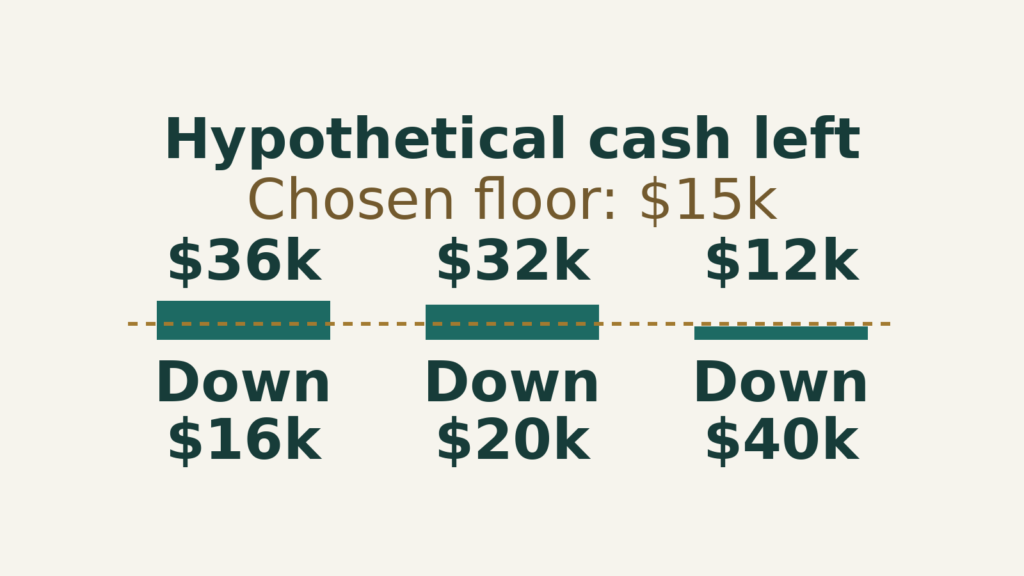
| Cash left | $36,000 | $32,000 | $12,000 |
| Meets the chosen cash floor? | Yes | Yes | No |
Check one row before comparing
For A, subtract the $16,000 contribution from $400,000 to get $384,000. Applying its listed rate produces $8,256. Adding that amount gives $392,256 of opening debt. Separately, $60,000 minus $8,000 minus $16,000 leaves $36,000 in cash.
Repeat those operations for B and C. The financed fee belongs in opening debt; don’t also subtract it from cash in this model. If you instead choose a cash-paid fee, that’s a different scenario requiring both columns to be recalculated.
What a larger VA down payment changes
Moving from A to B uses $4,000 more cash. The fee falls by $2,556, while opening debt falls by $6,556. The larger debt reduction is the $4,000 extra contribution plus the $2,556 fee reduction. Calling all $6,556 a fee saving would overstate the benefit.
Moving from B to C commits another $20,000. It reduces the fee by $1,200 and opening debt by $21,200. That smaller fee reduction doesn’t make the extra contribution worthless, but it buys a different mix of lower debt and less cash.
VA down payment: change how the same fee is paid
Keep B’s $20,000 contribution, $380,000 base loan and $5,700 fee. For an independent variation, pay that fee from cash at closing instead of adding it to the loan. All other invented inputs remain unchanged.
Opening debt is then $380,000. Cash left is $60,000 minus $8,000 minus $20,000 minus $5,700, or $26,300. It still exceeds the chosen $15,000 floor by $11,300.
Compared with B’s financed-fee row, cash and debt both fall by $5,700. The fee itself hasn’t become smaller: the same charge is funded differently. Calling this a $5,700 fee saving would confuse repayment funding with the price of the fee.
For C’s independent cash-paid variation, subtract its $4,500 fee from the original $12,000 cash remaining. That leaves $7,500, which is $7,500 below the chosen floor. Opening debt would be the $360,000 base amount.
Neither variation changes the assumed non-exempt status or fee bracket. Calculate a new scenario from the beginning if classification changes. These cash-paid alternatives aren’t extra amounts to subtract from the original financed-fee table.
VA down payment: test the exact cash boundary
The original maximum contribution of $37,000 equals 9.25% of the $400,000 price. It’s above 5% but below 10%. Under the stipulated first-use, non-exempt purchase assumptions, use the 1.5% bracket for this additional point.
Subtract $37,000 from the price to get a $363,000 base loan. The financed fee is $363,000 times 0.015, or $5,445. Opening debt becomes $368,445. Cash left is exactly $15,000 after the same $8,000 other outlay.
Relative to C, this point keeps $3,000 more cash and has $3,945 more opening debt. The difference is the $3,000 smaller contribution plus a $945 larger fee. Reversing the comparison gives C’s extra debt reduction and cash use.
Even though C reaches the lower 1.25% fee bracket, it still misses the cash constraint. A threshold discount doesn’t supply the additional $3,000 of closing cash needed to keep the chosen floor.
The $37,000 point is a boundary for this particular cash plan. It isn’t a recommendation to contribute every available dollar up to the floor, nor proof of the best choice among all possible amounts.
A buyer can compare additional points, but each needs the correct bracket and a new base loan. Applying a fee percentage to the full purchase price would give the wrong fee for these down-payment examples.
Change other closing outlays in a separate stress test
Now keep the original financed-fee choices but independently raise the fictional other closing outlay from $8,000 to $12,000. This $4,000 change is a modeling stress, not a prediction of a lender’s actual charges.
B then leaves $60,000 minus $12,000 minus $20,000, or $28,000. C leaves $8,000 and misses the chosen floor by $7,000. Their original base loans and financed fees stay the same because neither contribution nor price changed.
The maximum contribution consistent with the floor becomes $33,000: starting cash minus the revised outlay minus $15,000. Don’t continue using the old $37,000 boundary after changing the closing-cost input.
If actual quotes show different charges across options, enter each complete set separately. The equal-outlay assumption makes the original comparison easy to inspect, but it doesn’t establish equality between real offers.
Keep an auditable closing worksheet
Use separate lines for purchase price, contribution toward price, base loan, confirmed fee classification, fee rate, fee dollars, payment method, opening debt, other cash outlay and cash remaining. One combined “cost” cell hides the relationships being tested.
Show the cash-floor test after completing those lines. A difference from the chosen floor is a planning result, not a lender reserve determination. Don’t describe the buyer’s invented $15,000 preference as an official VA requirement.
If a prior deposit or credit appears in the actual closing documents, reconcile where it enters the complete cash calculation. This exercise assumes neither, so adding one without tracing its treatment would create a different model.
Retain the dated fee guidance and lender documents supporting classification and actual amounts. An unresolved exemption question should remain unresolved until confirmed; selecting a cheaper rate merely to balance the worksheet would undermine the comparison.
The final record should distinguish three effects: cash committed toward price, the charge itself and the amount borrowed to pay that charge. It should also state that this exercise stops at closing. Later interest or ownership costs require their own complete assumptions and comparison.
Check both sides of each fee-payment variation: base loan plus a financed fee must reconcile to opening debt, while starting cash less actual closing outflows must reconcile to cash left. A fee paid from cash belongs in the second check; a financed fee belongs in the first. Labeling its payment method explicitly prevents it from appearing in both places or disappearing from both.
Apply the cash constraint

C leaves $12,000, missing the chosen $15,000 floor by $3,000. A and B both pass. B has the lower fee and debt among those two; A preserves $4,000 more cash. This doesn’t identify the best possible contribution among every amount the buyer could choose.
The maximum contribution consistent with these invented inputs is $37,000: $60,000 minus $8,000 minus $15,000. That’s a limit from this buyer’s cash plan, not a mortgage qualification limit. Change any input and recompute the result.
This exercise stops at closing. It doesn’t calculate future interest, payments, tax effects, investment returns or total ownership costs. Lower starting debt isn’t itself a lifetime-cost comparison. Actual unequal charges or loan terms require a new comparison.
Use your confirmed classification and complete quotes before choosing a contribution.
For eligibility records, see preparing a VA COE request. If you have a previous VA loan, review entitlement restoration after payoff separately from the new purchase’s cash calculation.

One Mortgage Form, Two Borrowers
Match each person’s share.