See how balances and credit limits affect a utilization ratio, without predicting a credit score.
The interactive form requires JavaScript. The worked example, formulas and source links below remain available.
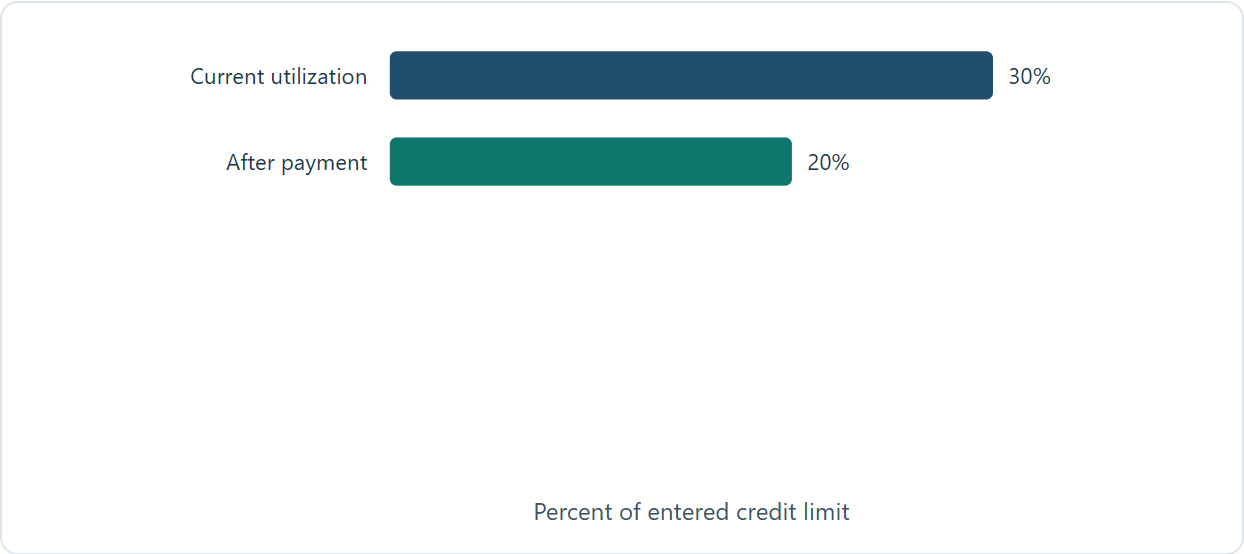
Credit utilization calculator: default example chart
On this page
Credit utilization: measure the share of available credit you’re using
This calculator divides a revolving balance by its credit limit and shows the result as a percentage. It also estimates the ratio after a planned payment, assuming the limit stays unchanged and no new charges or fees are added. Use it for one credit card or for combined balances and limits, with the same scope on both sides of the calculation.
For example, a $3,000 balance against a $10,000 limit represents 30% utilization. A planned $1,000 payment reduces the modeled balance to $2,000 and the ratio to 20%. The tool measures that arithmetic change. It doesn’t predict a credit score, promise a particular increase, or determine whether a lender will approve an application.
The CFPB explains the basic ratio in its discussion of credit-score misconceptions. Utilization is useful context, but it’s only part of a broader credit profile and shouldn’t replace an affordable repayment plan.
Choose balances and limits that belong together
Balance: enter the revolving balance you want to evaluate. Use the reported balance if you’re reviewing a credit report. If you’re planning a payment today, use the current balance and recognize that the credit report may update at a different time.
Credit limit: enter the limit associated with that balance. For a single card, don’t divide its balance by the combined limits of several cards and describe the result as the card’s individual utilization. For an aggregate estimate, add the balances of all included cards and divide by the limits of those same accounts.
Planned payment: enter the amount you intend to apply to the modeled balance. The after-payment estimate can’t fall below zero. A payment larger than the entered balance doesn’t create negative utilization in this model. Additional purchases, interest, or fees may change the balance before the payment is reported.
A positive credit limit is required. If an account doesn’t report a conventional limit or has unusual reporting treatment, this simple calculation may not describe how a scoring model evaluates it. Check the account information instead of inventing a limit for the field.
How the percentage is calculated
Current utilization equals balance ÷ credit limit × 100. After-payment utilization equals the greater of zero or balance minus planned payment, divided by the same limit, multiplied by 100. The change between these percentages is measured in percentage points.
In the default example, utilization moves from 30% to 20%, a decrease of ten percentage points. The balance itself falls by one-third, from $3,000 to $2,000. Those are two different descriptions of the same change. Calling it a ten-percent reduction in the balance would be inaccurate.
A balance above the limit can produce utilization above 100%. The mathematical ratio shouldn’t be artificially capped at 100%, because doing so would conceal the entered over-limit amount. The calculator doesn’t determine the issuer’s fees or account actions associated with that situation.
Credit utilization example: a $1,000 payment on a $3,000 balance
Assume a hypothetical card has a $10,000 credit limit and a $3,000 balance. The borrower plans to pay $1,000, with no new spending or interest added before the next measured balance.
| Measure | Before payment | After payment |
|---|---|---|
| Balance | $3,000 | $2,000 |
| Credit limit | $10,000 | $10,000 |
| Utilization | 30% | 20% |
| Unused credit | $7,000 | $8,000 |
Unused credit isn’t cash savings. It’s borrowing capacity under an account’s terms and can change. The payment reduces the debt by $1,000 in the model; a credit-limit increase of $1,000 wouldn’t have the same effect on the dollars owed.
If the borrower instead wanted a mathematical ratio of 10% on this unchanged $10,000 limit, the target balance would be $1,000. Reducing the current $3,000 balance to that amount would require a $2,000 payment before additional charges. This is a target illustration, not a guarantee about the resulting score.
Individual and aggregate utilization can tell different stories
Suppose Card A has a $2,000 balance and $2,500 limit, while Card B has a $1,000 balance and $7,500 limit. Card A is at 80% utilization and Card B is at approximately 13.33%. Combined balances are $3,000 and combined limits are $10,000, so aggregate utilization is 30%.
Don’t average 80% and 13.33% to obtain the aggregate ratio. The cards have different limits, so a simple average gives the wrong result. Add dollars first, then divide. FICO’s explanation of individual and aggregate utilization describes both views.
A $1,000 payment toward Card A would bring its balance to $1,000 and its ratio to 40%. Paying the same $1,000 toward Card B would clear that card while leaving Card A at 80%. Both scenarios produce the same 20% aggregate utilization, but the individual account positions differ. This calculator doesn’t convert those differences into score-point predictions.
The reported balance may differ from today’s balance
The number visible in your banking app may not be the number most recently reported to a credit bureau. Purchases, payments, and interest can occur after the reporting snapshot. Experian’s utilization guide explains that the ratio used in credit reporting is based on balances appearing in the credit report.
Record which date and source you used. A comparison of a current balance with an older credit limit can also be misleading if the limit recently changed. Use the values from the same reported account record if you’re checking a reported ratio.
Paying before a particular reporting date may affect a future snapshot, but the calculator can’t confirm when an issuer will report or when a bureau will update. Keep required payments on time and verify the actual account and report rather than relying on an assumed update date.
A percentage isn’t a credit-score guarantee
Don’t treat 30% as a universal cliff at which a score automatically changes by a known amount. FICO explicitly cautions against that interpretation in its utilization discussion. Different credit profiles and scoring models can respond differently.
The tool therefore reports the percentage and the payment effect without assigning an invented score gain, approval probability, or universal good/bad label. A lower balance also reduces dollars owed, which can matter to the household budget independently of any credit-score effect.
There’s no reason to pay interest solely to make a calculator show a particular ratio. A reported balance and carrying an interest-bearing balance aren’t the same thing. Review your statement, due date, and grace-period terms when deciding how to pay the account.
Keep utilization separate from debt-to-income ratio
Utilization compares a revolving balance with a credit limit. Debt-to-income ratio compares monthly payment obligations with gross monthly income. A $10,000 card limit is relevant to utilization but isn’t income, and a $3,000 balance isn’t automatically a $3,000 required monthly payment.
Use the debt-to-income calculator for the payment-to-income comparison. Use the credit card payoff calculator to estimate how a fixed payment affects payoff time and interest. Each answers a different question, so combining their labels into one general financial-health score would hide useful distinctions.
When planning a payment, preserve enough cash for required bills and upcoming expenses. Reducing a ratio by making a payment that immediately forces new borrowing may not create a sustainable improvement in the underlying balance.
Understand the effect of a changing limit
If the balance remains $3,000 but the limit changes from $10,000 to $15,000, the ratio falls from 30% to 20% without reducing the debt. If the limit falls to $7,500, the same balance represents 40%. The denominator matters as much as the numerator to the arithmetic.
This isn’t a recommendation to request new credit. Account applications, issuer decisions, fees, and the risk of additional spending need separate consideration. The calculator doesn’t assess those factors. Use an actual approved limit rather than an amount you hope an issuer will grant.
Recalculate after an account or limit change
Consider the two-card example after Card B’s $1,000 balance has been paid off. Total remaining debt is $2,000 and combined limits are $10,000, so aggregate utilization is 20%. If Card B’s $7,500 limit is no longer included, the same $2,000 balance divided by Card A’s $2,500 limit is 80%.
The debt did not increase; the available-limit total changed. This is a mathematical scenario, not a recommendation to keep or close a particular account. Fees, security concerns, spending habits, and issuer rules may also matter. Whenever an account changes, update the included balances and limits together before comparing the new ratio with an older result.
Credit utilization questions
Can the calculator predict my new credit score?
No. It calculates a ratio from balances and limits. Credit scores depend on a wider report and a specific scoring model. A payment can change several aspects of an account, and no fixed number of score points follows from the percentage alone.
Should I include my mortgage balance?
This tool is intended for revolving credit utilization, such as conventional credit-card balances and limits. A mortgage is an installment loan with different characteristics. Don’t add its outstanding principal to card balances while leaving the denominator as card limits.
What if I pay more than the balance?
The modeled remaining balance stops at zero. A real account may show a credit balance depending on transactions, but that isn’t negative utilization in this illustration. Check the actual balance before sending a payment larger than the amount owed.
Why does my overall ratio look low when one card is nearly full?
Other cards with larger unused limits can lower the aggregate ratio. Review individual accounts as well as the combined total. The two-card example above demonstrates how an 80% individual ratio can coexist with a 30% aggregate ratio.
Questions or corrections?
Send a question or report an issue with a published page.