Calculate cash received after deducted origination fees and the payment on the full loan.
The interactive form requires JavaScript. The worked example, formulas and source links below remain available.
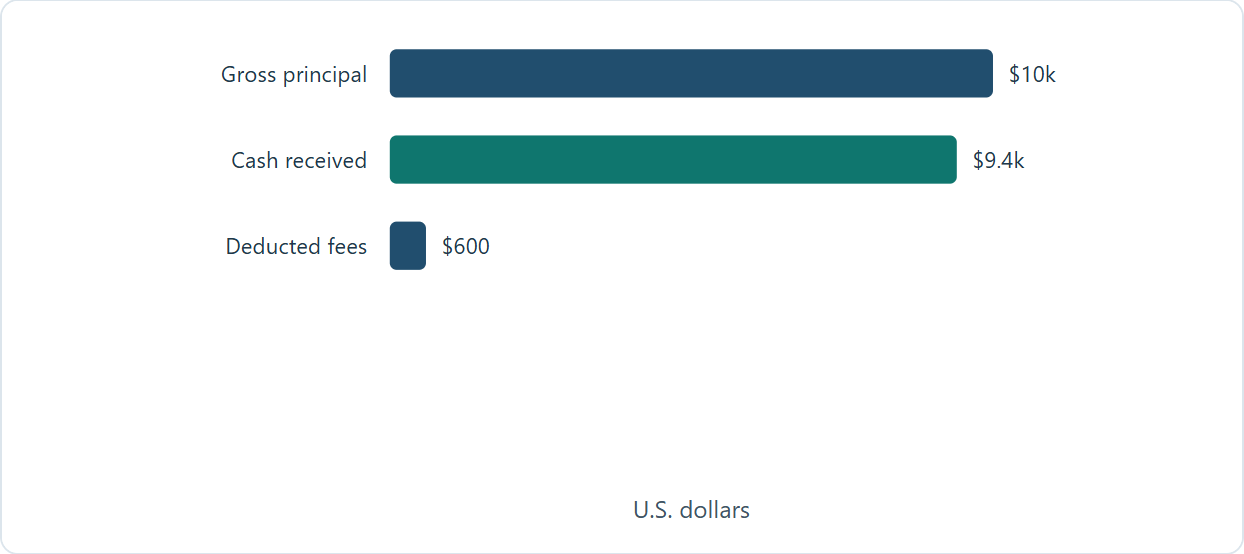
Loan net proceeds calculator: default example chart
On this page
Loan net proceeds: find the cash left after a deducted loan fee
This calculator estimates how much cash remains when a percentage fee and a flat fee are deducted from a loan before it’s paid out. It also calculates a fixed monthly principal-and-interest payment and compares total repayments with the cash received. The result makes a common borrowing distinction visible: the contract principal can be larger than the amount deposited into your account.
The model assumes fees are withheld from proceeds, the contract principal remains repayable, and the interest rate is fixed for the term. It doesn’t assume the fee is refunded, waived, or included in the quoted interest rate. All example rates and fees are hypothetical rather than current offers.
The CFPB advises borrowers to review lender disclosures for personal installment loan fees. Use the written quote to identify whether each fee is deducted, financed on top of another amount, or paid separately. Those structures shouldn’t be mixed in one calculation.
Enter principal and fees using the lender’s definitions
Gross contract principal: enter the starting balance on which this fixed-rate payment calculation is based. In the example, that amount is $10,000. Don’t enter the smaller net deposit as principal if the lender requires repayment of the larger balance.
Percentage fee: enter the fee assessed on the gross principal, such as 5%. Confirm the lender’s actual fee basis. A percentage applied to another amount requires a different formula. Flat fee: enter any additional dollar amount deducted from proceeds in this model.
Contract interest rate: enter the annual interest rate used to calculate the installment payment. This is different from a fee-inclusive APR. The CFPB’s interest-rate and APR explanation describes why APR can incorporate charges beyond the interest rate.
Term: enter the number of monthly payments. The tool assumes equal scheduled monthly payments and no missed payments, rate changes, or additional borrowing. Fees paid outside the loan and costs that arise only after a particular event require separate treatment.
How net proceeds and borrowing cost are calculated
Total deducted fees equal gross principal multiplied by the percentage fee, plus the flat fee. Net proceeds equal gross principal minus total deducted fees. If fees equal or exceed principal, there’s no positive cash disbursement under the entered assumptions; the calculator should flag that rather than describe the result as a usable loan.
The monthly payment uses the standard fixed-rate amortization formula: P × r ÷ [1 − (1 + r)−n]. P is gross principal, r is the annual contract rate divided by 12 as a decimal, and n is the number of monthly payments. At a zero rate, the payment is principal divided by months.
Scheduled interest equals total principal-and-interest payments minus gross principal. Borrowing cost relative to cash received equals total scheduled payments minus net proceeds. Under this deducted-fee model, that’s the same as scheduled interest plus deducted fees. This dollar cost isn’t an APR calculation.
Loan net proceeds example: a $10,000 loan with $600 deducted
Suppose a hypothetical loan has $10,000 of gross principal, a 5% deducted fee, an additional $100 deducted fee, a 12% annual contract interest rate, and 36 monthly payments. The percentage fee is $500, making total deducted fees $600. The borrower receives $9,400.
| Item | Amount |
|---|---|
| Gross contract principal | $10,000.00 |
| Percentage fee plus flat fee | $600.00 |
| Net cash received | $9,400.00 |
| Monthly principal and interest | $332.14 |
| Scheduled interest | $1,957.15 |
| Total scheduled payments | $11,957.15 |
| Payments minus cash received | $2,557.15 |
The repayment schedule still begins at $10,000 even though the deposit is only $9,400. The $2,557.15 cost relative to proceeds contains both $1,957.15 of interest and $600 of deducted fees. Treating the loan as though it supplied $10,000 in usable cash would miss the funding shortfall.
Money is displayed to cents, while the underlying amortization calculation retains additional precision. A lender’s rounding or daily-interest convention may produce a slightly different final payment. Use the signed schedule and disclosures for the actual obligation.
What if you need a specific cash amount?
If you need $10,000 to complete a purchase or repay another debt, the example’s $9,400 deposit is $600 short. Don’t assume that choosing a loan labeled $10,000 automatically funds a $10,000 need. Check the net disbursement before relying on the proceeds.
Under this precise fee structure, the gross principal required for a target cash amount is (target cash + flat fee) ÷ (1 − percentage fee). With a $10,000 cash target, a $100 flat fee, and a 5% percentage fee, the mathematical gross amount is approximately $10,631.58. That larger principal would also increase payments and interest at the same rate and term.
This calculation assumes the fee percentage remains unchanged and the lender permits that loan amount. Real offers may use tiers, minimums, maximums, or different pricing. Request an updated written quote instead of treating the algebraic result as an available offer or approval amount.
Why the dollar cost isn’t APR
APR is an annualized borrowing-cost measure with rules about included charges and payment timing. Adding a 12% interest rate to a 6% upfront fee doesn’t produce a valid 18% APR for a three-year amortizing loan. The principal declines over time, while a deducted fee reduces cash received at the start.
Similarly, dividing total dollar cost by net proceeds gives a cumulative ratio over the whole term, not an annual percentage rate. Labeling it APR would mislead a reader comparing offers. This calculator deliberately shows dollars and the contract-rate payment rather than inventing an annualized figure from an oversimplified formula.
Use the lender’s APR disclosure alongside net proceeds, payment, fees, and term. If a quoted APR seems inconsistent with the fee structure, ask the lender for an explanation. The tool can reveal inputs worth checking without replacing the formal disclosure calculation.
Compare offers that provide the same usable cash
For each offer, record the gross principal, net cash, payment, term, interest, and fees. A no-fee offer and a deducted-fee offer should be compared on the cash needed for the same purpose. Otherwise, the lower-cost-looking offer may simply provide less money.
Keep the repayment period visible too. A longer term can reduce the monthly payment while increasing total interest. The loan payment calculator helps explore that tradeoff. If the new borrowing replaces existing debt, compare the old obligation with the actual new obligation rather than adding both permanently to the budget.
For a debt-to-income estimate, use required monthly payments rather than the net deposit. The DTI calculator separates housing and other payment obligations. Neither tool establishes lender approval or determines whether the purpose of borrowing is worthwhile.
Distinguish deducted, financed, and separately paid fees
A deducted fee reduces the cash disbursed while leaving the modeled principal unchanged. A separately paid fee requires additional cash from the borrower. A fee financed on top of a requested cash amount can increase the contract principal. Each structure affects timing and affordability differently.
Don’t deduct a fee from proceeds if the lender already included it in a net-cash number that you entered. That would count the fee twice. Likewise, don’t label the gross contract balance as the exact statutory “amount financed” without checking the lender’s disclosure definitions.
Optional insurance, late charges, and prepayment charges aren’t automatically included. Some are contingent on future events and should be shown as separate scenarios. The calculator models the specified upfront deductions and scheduled interest, not every possible cost of the agreement.
Check the first month’s cash position
Before committing the expected proceeds, identify when the lender will disburse funds and when the first payment is due. A transaction may also involve cash costs outside the loan. The apparent deposit can be less useful if it must immediately cover fees or an obligation that was omitted from the plan.
Keep a reserve for necessary expenses and avoid treating borrowed cash as income. Borrowing increases available cash at the start but creates a repayment liability. The emergency fund calculator can help describe cash reserves separately from financing.
Check which balance earns interest
In the worked example, the first month’s modeled interest is $100: the $10,000 contract principal multiplied by 1%. Calculating interest on the $9,400 deposit instead would give $94 and understate the modeled charge. The deducted fee changes cash received; it doesn’t automatically reduce the interest-bearing principal.
Use this check when reading an offer with several similar dollar amounts. Identify the starting contract balance, the disclosed amount financed, and the net disbursement using the lender’s definitions. If the relationship is unclear, ask for an itemization before comparing the quote with another loan. Accurate labels prevent an apparently precise calculation from answering the wrong question.
Loan net proceeds questions
Why do I repay more principal than I receive?
In a deducted-fee arrangement, part of the contract principal is retained as a fee before disbursement. The model assumes you still repay the full principal. Confirm the exact structure in the lender’s written documents rather than assuming every loan works this way.
Does the tool calculate a lender’s official APR?
No. It calculates net cash, scheduled interest, payments, and dollar cost relative to proceeds. Official APR calculations require the applicable charge classifications and cash-flow timing. Use the disclosure supplied for the actual offer.
Can a 0% loan still cost money?
Yes. A zero contract interest rate doesn’t remove a deducted fee. If $600 is withheld from a $10,000 principal and $10,000 is repaid, the cost relative to the $9,400 received is still $600 before other charges.
What if the fee is paid separately?
This tool’s deducted-fee assumptions wouldn’t describe the disbursement correctly. Track the separate cash payment and compare the complete cash flows. Don’t enter a separately paid fee as withheld unless you deliberately label the result as a different scenario.
Questions or corrections?
Send a question or report an issue with a published page.