Mortgage File: An IRS Nonfiling Letter Is Not Zero Income
Check the document title, tax year and dates before drawing conclusions from a missing-record response.
Estimated reading time: 5 minutes
An IRS verification of non-filing letter in a mortgage file can prompt the wrong shortcut: “No return means no income.” Before changing an application or making that statement to a lender, identify exactly which record you received, the tax period it concerns and the date of its information.
This guide helps a U.S. borrower organize a tax-document question. It doesn’t decide whether you were required to file, calculate taxable or qualifying income, or tell a lender which evidence it must accept for your particular loan.
Read the letter’s limited finding
The IRS description of transcript types says a verification of non-filing letter reports that the agency has no record of a processed Form 1040-series return as of the request date. It doesn’t determine whether a return was required for that year.
The letter isn’t an income calculation or a filing exemption. A missing processed-return record also doesn’t establish that other documents are false. Investigate those separate questions.
Check the heading before interpreting a message
The IRS transcript FAQ separately explains that a current-tax-year wage and income transcript displaying “No record of return filed” can mean information hasn’t populated yet. That explanation is attached to that transcript and situation; it shouldn’t be generalized to every missing-record message.
Write down the document title before paraphrasing it. A verification letter, a tax return transcript and a wage and income transcript aren’t interchangeable simply because each came from the IRS.
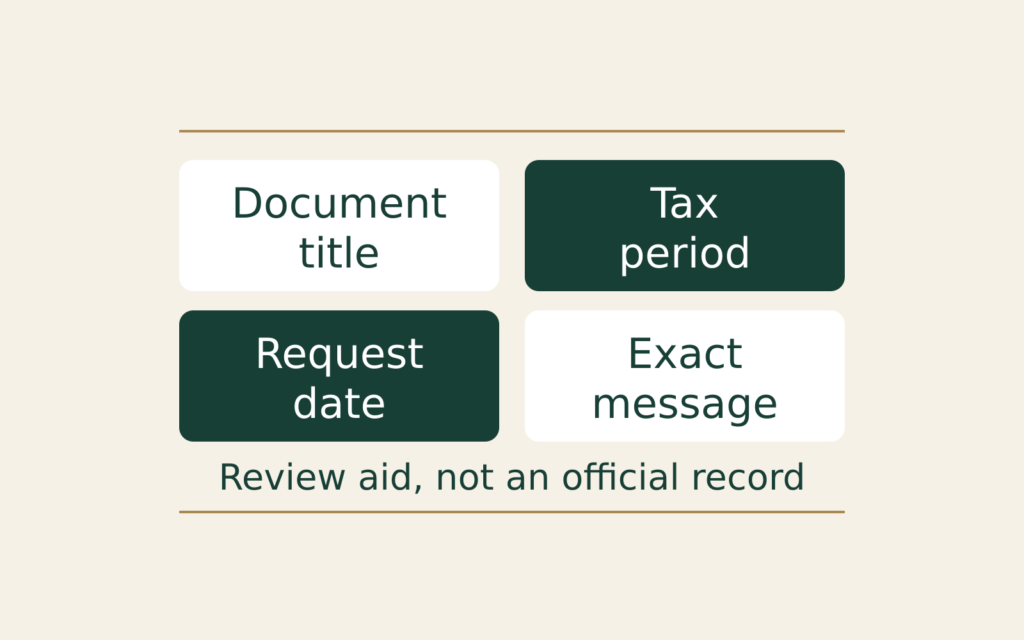
| Field | Question to answer |
|---|---|
| Document title | Which exact record or response is this? |
| Tax period | Does it match the lender’s request? |
| Request or issue date | When was this information produced? |
| Exact message | What does it say, without added conclusions? |
Compare two incomplete fictional files
In File A, Casey’s lender asks about the 2025 tax year. Casey opens a saved verification letter for 2024. The first problem is a period mismatch. Even if the letter is genuine and clearly readable, it doesn’t answer a question about 2025.
Casey can identify the mismatch without deciding anything about income: “The saved letter concerns 2024, while your request identifies 2025. Please confirm the document you need for the requested year.” Don’t rename the old file to 2025 or crop away the period to make it appear responsive.
In File B, Riley has a 2025 verification letter and a separate confirmation concerning an electronically submitted 2025 return. Riley keeps both. The next task is to compare the taxpayer, period and dates, then ask about the unresolved record status—not to erase either document or assume one proves the other fraudulent.
Make a timeline from the actual evidence: date shown on the submission confirmation, date of the transcript request and date on the response. A date sequence helps explain the question. It doesn’t, by itself, prove successful processing, identify a tax-account problem or promise that a new transcript will appear tomorrow.
Don’t turn a general timetable into a diagnosis
The IRS transcript-availability table gives general timing for current-year Form 1040 returns filed by the April due date. Its rows distinguish electronic from paper filing and refund or balance-due circumstances. Those scope conditions matter; the table isn’t a universal deadline for every late, amended or unresolved return.
For Riley, note the filing method and whether the available guidance actually covers the situation. If it doesn’t, leave the timing question open for the IRS or a qualified tax professional. Avoid repeatedly changing the explanation from “not processed” to “lost” to “no income” without new evidence.
Ask the lender what remains necessary
For loans subject to Fannie Mae’s rules, its June 2026 tax-documentation guidance permits applicable transcripts in certain income-documentation situations, but requires actual returns, schedules or forms when transcripts lack necessary detail. It also requires retaining explanations of discrepancies in the loan file. This is program-specific guidance, not a promise that any particular substitute will work.
Give the lender a focused description of the mismatch and ask which issue remains: the requested year, document type, missing detail or an unresolved inconsistency. Ask whether additional evidence is acceptable, which evidence, and how it should be provided. Don’t upload an entire tax archive “just in case.”
Keep tax-account follow-up separate from the lender’s review. An answer from one doesn’t automatically resolve the other’s requirements. Record who is handling each question and any deadline actually given; ask promptly about a deadline you may not meet rather than assuming it moved.
Close the evidence gap without inventing an answer
If a new record becomes available, preserve it alongside the earlier response and explain which question it addresses. Ask whether the lender has finished reviewing that item. Receipt of a file isn’t the same as loan approval.
Use verified IRS and lender channels, keep identifiers private, and never send tax records to EasyLoanWorld. Seek qualified tax advice about filing obligations and account discrepancies. The useful result is an accurately described document and a specific next question.

One Mortgage Form, Two Borrowers
Match each person’s share.