Bank Privacy Notice: Which Sharing Can You Limit?
Read the notice row and keep a clear record of your choice and its coverage.
Estimated reading time: 5 minutes
A bank’s privacy notice asks a narrower question than “Do you want privacy?” It describes particular information-sharing practices and choices. Read across the relevant row before choosing a response, then check which people and accounts your instruction covers.
This guide concerns U.S. consumer financial privacy notices, with a bank example. It isn’t a business-account privacy guide, a request to erase data or a promise that all advertising will stop. No account preferences are changed through this article.
Read the sharing answer and the choice answer separately
The CFPB’s model privacy-form instructions distinguish the institution’s sharing practice from your ability to limit it. The middle column answers whether the institution shares for that reason. The final column identifies an available opt-out, no opt-out, or a practice the institution doesn’t undertake. A choice may be required or voluntary.
The form also separates affiliate creditworthiness information from affiliate transaction-and-experience information. Affiliate marketing may appear in the table or have a separate notice. Don’t treat every reference to an affiliated company as the same permission.
Start with the institution’s name and notice revision date. Save the complete notice, including its definitions and additional-information section, rather than cropping one attractive-looking answer. A screenshot that omits the column heading can turn a useful record into an ambiguous one.
A real notice shows why “yes” needs context
In Chase’s U.S. Consumer Privacy Notice, updated December 2025, sharing for its own marketing and joint marketing is listed without a limit option. Affiliate creditworthiness sharing, affiliate marketing and nonaffiliate marketing have limit options. Its joint-account answer says choices apply to everyone on that account. The notice also identifies state-specific provisions.
That’s one institution’s notice, not a rule that every bank uses identical choices. Check the current notice covering your relationship and any separate state notice.
For example, suppose a fictional reader saves a screenshot showing “Yes” but leaves out the headings. The reader can’t later tell whether the image recorded a sharing practice or an available choice. The repair isn’t to guess from memory: reopen the complete notice, identify the exact row, and attach the relevant instructions to the record.
Keep three different purposes separate
The affiliate-marketing rule addresses using eligibility information received from an affiliate to make marketing solicitations, subject to exceptions. That’s distinct from simply asking whether information moves between related companies. Record the choice’s actual purpose rather than labeling everything “stop sharing.”
Regulation P also has transaction-processing and servicing exceptions. Necessary disclosures for administering requested transactions or maintaining an account aren’t covered by the ordinary opt-out requirement described there. A privacy election is therefore not an instruction to stop servicing a loan or to cancel its payments.
Prescreened-offer lists are a separate task. If that’s your goal, use our prescreened credit-offer guide, rather than substituting a bank privacy-choice record for that process.
Document the choice, not just the button press
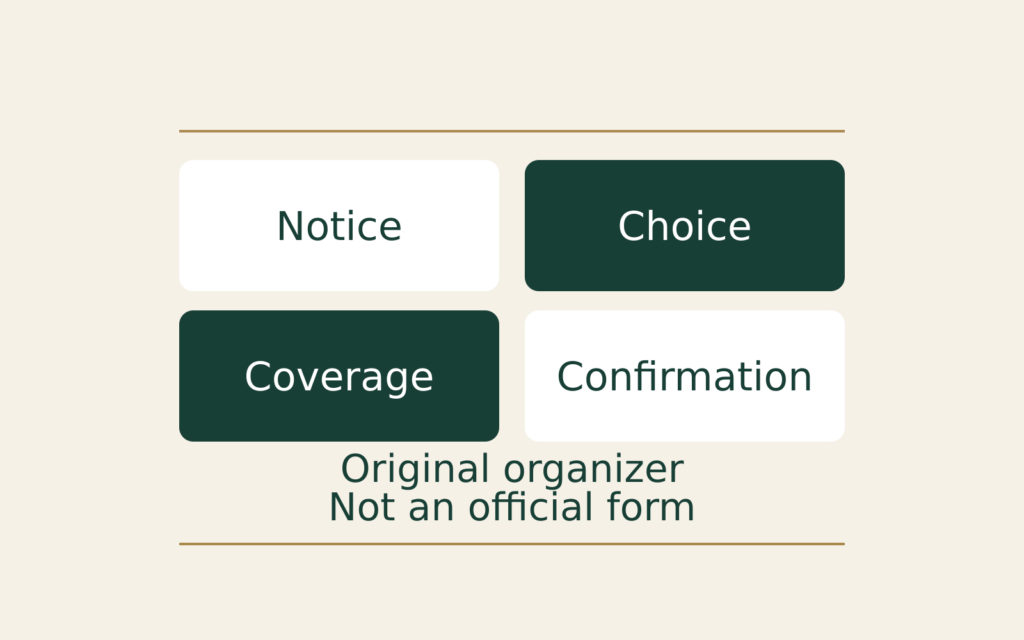
Use this original organizer privately. It isn’t an official form and doesn’t need account numbers, Social Security numbers or copies of identity documents.
| Record | Useful detail |
|---|---|
| Notice | Institution, revision date and a saved complete copy |
| Choice | The exact row and the instruction you selected |
| Coverage | The people and relationships confirmed by the instructions |
| Submission | Date, official route, confirmation and unresolved questions |
Keep “not yet confirmed” as a valid entry. If your record says only “done,” you can’t distinguish an intended choice from a submitted instruction or an unanswered coverage question. Save the response alongside the request so a later review doesn’t depend on recollection.
Check joint coverage and later relationships
For banks covered by Regulation P’s joint-relationship provision, the notice must explain how a joint consumer’s opt-out is treated. A bank can apply it to all joint consumers or allow separate choices; if separate choices are allowed, one joint consumer must be able to opt out for all. The bank can’t require everyone to opt out before implementing any direction.
Under this section, an opt-out can be made at any time and must be implemented as soon as reasonably practicable. It continues until revoked in writing or, with agreement, electronically. It survives termination for information from that relationship, but doesn’t automatically apply to a subsequently established new relationship.
Imagine two fictional household members with a joint bank account and separate accounts elsewhere. Their shared address isn’t a useful substitute for checking coverage. Write down the relationship addressed by each notice and ask about anything left unclear. Don’t copy “everyone covered” into the other institution’s record merely because the household already made one choice.
Use the method in the verified institution’s current instructions. If an unexpected message asks for sensitive information, confirm the route independently first. Keep ordinary payment reminders and statements in your existing workflow while resolving privacy questions.
U.S. financial education. Sources checked October 29, 2026. Rights and procedures depend on the institution, relationship, applicable law and notice; this guide doesn’t determine whether a particular disclosure violated the law.


