Current Ratio vs. Quick Ratio: Read the Asset Mix
Compare two liquidity measures without treating inventory, prepaids or customer balances as cash already available.
Estimated reading time: 5 minutes
A balance-sheet ratio answers a question about a particular reporting date. It doesn’t list the days when customers will pay or suppliers must be paid. That distinction matters when a business financing discussion moves from “What do the accounts show?” to “Can the next payment be made?”
The SEC’s financial-statement guide distinguishes the balance sheet’s snapshot from statements showing activity over a period. Read the statement date before interpreting a ratio. A recent bank balance attached to an older balance sheet doesn’t automatically update all the other accounts.
Keep each calculation with its underlying statement. For a comparison across dates, identify the reporting entity, accounting basis and period consistently. If those change, ask the preparer to explain the difference before describing the movement as improved performance. This article illustrates a U.S. business-finance reading exercise, not an accounting certification or a lender’s approval test.
Identify the denominator before calculating
The SEC’s small-business glossary describes current liabilities as obligations due within twelve months, including payables, salaries and the current portion of long-term debt. Current assets include cash, receivables and inventory. Receivables are customer amounts owed, not collected cash.
Have the preparer identify the current debt portion rather than classifying the entire loan by its final maturity. Keep the debt schedule supporting that classification with the statement.
Same liabilities, different asset totals
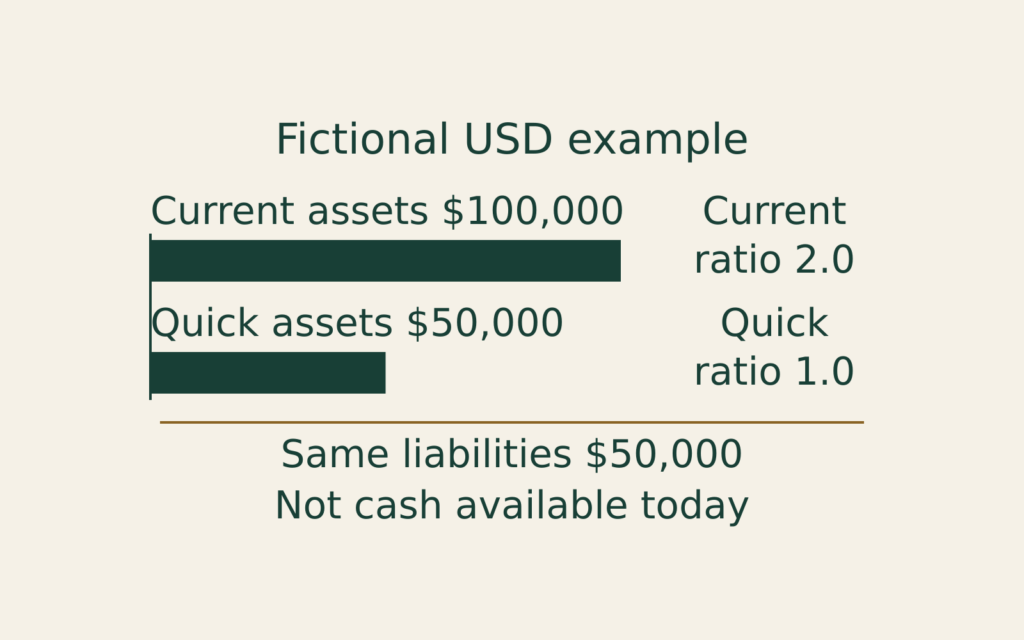
Using Chase’s published formulas, current ratio divides current assets by current liabilities; quick ratio first excludes inventory and prepaid expenses. Assume these are the complete classified inputs, with unrestricted cash and no other current assets.
| Item | Amount |
|---|---|
| Cash | $20,000 |
| Net receivables | $30,000 |
| Inventory | $40,000 |
| Prepaid expenses | $10,000 |
| Total current assets | $100,000 |
| Current liabilities | $50,000 |
Current ratio: $100,000 ÷ $50,000 = 2.0. Quick ratio: ($100,000 − $40,000 − $10,000) ÷ $50,000 = 1.0. The difference comes from numerator composition, not a changed debt balance or new cash receipt. These are invented accounting inputs, not suggested targets.
A prepaid benefit isn’t another cash balance
Intuit’s prepaid-expense guidance explains that advance payments for future goods or services can remain current assets under accrual accounting while the benefit is unconsumed. Examples include insurance and subscriptions. Their balances become expenses as benefits are used, rather than remaining cash available in a bank.
Ask which coverage period and remaining-benefit schedule support the balance. Intuit distinguishes refundable deposits from prepaids; don’t classify every advance payment alike. This guide doesn’t instruct you to post entries.
A quick ratio still doesn’t promise prompt collections
Xero’s liquidity-ratio guide highlights two limitations: receivables may not be collected on time, and the ratio doesn’t capture the actual due dates of liabilities. Removing inventory from a calculation therefore doesn’t turn every remaining asset into spendable cash today.
Review the collection evidence behind receivables separately from the ratio. Ask which customer payments are expected before the obligations being considered, and which expectations remain uncertain. Check the timing of bills against that evidence rather than assuming a balance-date relationship will persist throughout the month.
For repeated comparisons, consider where each date falls in the billing and collection cycle. A result just after collections and another just before major payments can reflect different timing positions. Neither a larger ratio nor an industry comparison alone establishes that a proposed borrowing is affordable. Use the ratio as a starting question, not a substitute for dated cash planning.
Prepare a reproducible explanation
Before discussing the result, make a compact review note with four fields: statement version, included account references, calculation checked, and unresolved questions. Keep corrections visible instead of overwriting an earlier result without explanation. Identify who supplied each explanation and whether a replacement statement is still outstanding.
Separate a confirmed bookkeeping correction from a proposed business action. A corrected classification isn’t itself a new collection, a debt extension or permission to spend. Ask the lender which definitions its own request uses; this educational comparison doesn’t establish contractual compliance. Share actual business records only through a verified private channel.
Try a version-control check before sending the file
Consider an invented review packet with a statement labeled “final C,” a calculation workbook labeled “review B,” and an email discussing “the earlier draft.” The filenames don’t establish which figures the reviewer actually used. Ask the preparer to identify the source statement inside the workbook, not merely confirm that a final file exists.
A useful reply names the statement version, workbook tab and referenced rows. Record that reply beside the open question. If the preparer sends a replacement workbook, keep the original and mark it superseded; don’t silently substitute the attachment while leaving the earlier explanation attached.
Before closing the question, check that another reader can follow the stated references without guessing which file is intended. If the references still point to different versions, leave the review unresolved. This exercise tests the explanation’s reproducibility, not the correctness of an account classification.


