Prepaid Card Fees: Read Beyond the Short Form
Match the product, fee conditions and available features.
Estimated reading time: 5 minutes
Start with one card package and the documents that accompany it. Keep a separate working page for each product instead of merging everything into a single set of notes. This guide addresses U.S. general-purpose reloadable prepaid accounts, not choosing a provider, changing payroll instructions, or registering a card. Keep gift cards and specialized benefit arrangements outside this comparison.
Confirm the product before comparing the price
The CFPB distinguishes a reloadable prepaid card from a gift card, a checking-account debit card and a credit card. Generally, prepaid spending uses money loaded beforehand; credit-card spending involves borrowing. A familiar payment-network logo doesn’t establish which product you’re holding.
A reloadable card allows additional money to be added; a nonreloadable one doesn’t. Identify the exact product description rather than assuming that every card displayed beside it has the same features.
Write down the product and issuer names, then match them across the package and agreement. If a page describes a different product version, leave the comparison unfinished until the issuer explains which terms apply.
The short form is a starting point
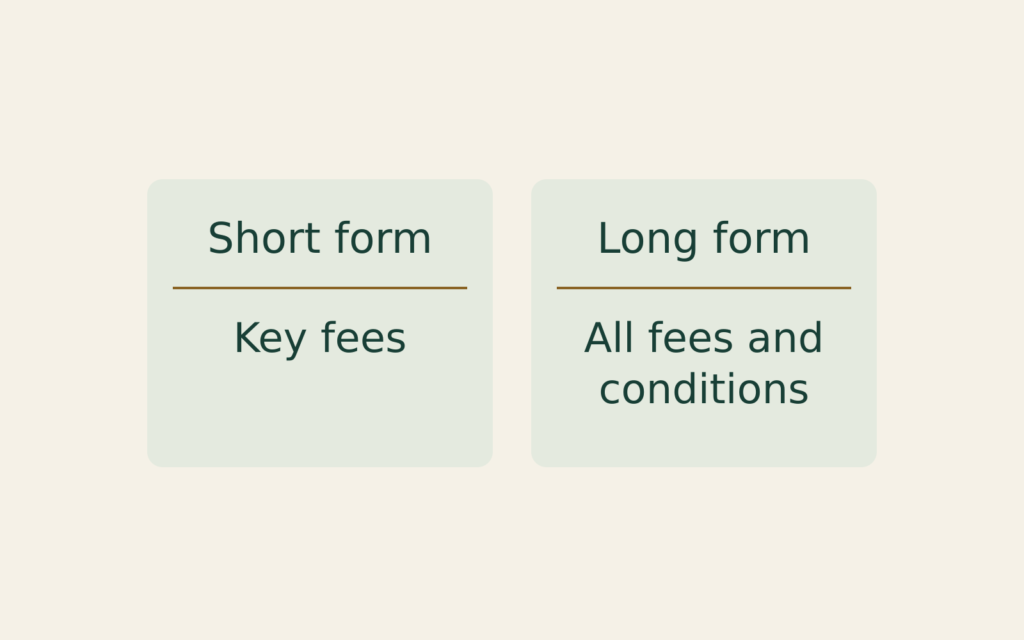
Regulation E requires short and long disclosures, with specific timing exceptions for retail and telephone acquisition. The short form points to the fuller information. The long form identifies fees and their conditions, including when charges may be imposed, reduced or waived.
Third-party charges also need attention: the long form discloses known amounts and warns when an unknown third-party fee may apply. A missing exact amount isn’t a promise of zero cost. Ask which party charges it before adding a guessed figure.
Regulation E prepaid disclosures.
Read the condition beside the displayed fee
The CFPB’s disclosure guide explains that displayed amounts can be the highest applicable fees, with lower charges depending on how or where the card is used. An asterisk can therefore be important, not decorative.
Follow its explanation to the actual condition. Check the transaction channel, network and qualifying activity rather than copying the smallest advertised number. The short form’s count of other fees isn’t a monthly bill: some may concern services you never use. Read the relevant charges, not just the count.
Fictional condition: a $5 monthly charge is waived after a specified qualifying deposit. Without confirmation that the deposit qualifies, $0 is an unsupported assumption. This illustration supplies no real provider’s fee or qualification rule.
Separate buying the card from using it
The CFPB notes that a retail card’s “price” may be an activation fee. Monthly charges, transaction charges and cash-reload fees answer different cost questions. Not every card charges each fee.
Also check occasional events: requesting a replacement card, transferring money to another prepaid card, or obtaining a check for the remaining balance can involve different charges. Don’t turn a list of possible fees into a claim that all will apply. Match the described event to the service you actually need before building a cost comparison.
Activation and registration can be separate
The CFPB explains that activation and registration may be different steps. Registration involves identifying the customer to the provider; successful identity verification can affect access to reloading, online purchases or ATM use. Being able to make one purchase doesn’t by itself answer whether every feature is available.
Ask what the provider means by “activated,” “registered” and “verified” in its own records. This is a document-reading distinction, not an instruction to send identity information here or to an unsolicited caller.
A verification question may involve sensitive information. Identify the provider through existing official documents before discussing it, and ask how to handle an unclear request without putting personal details in public.
CFPB registration explanation.
Use the agreement database without overreading it
The CFPB’s prepaid agreement database permits searches by issuer, product and other criteria. It displays agreements submitted by issuers. The Bureau cautions that these are general terms, not an individual customer’s account information, and directs agreement questions to the issuer.
Match the entry to your product. Preserve conflicting documents separately and identify their titles and differing lines when asking the issuer to clarify.
Finish with a matched comparison
| Record | Question to preserve |
|---|---|
| Product version | Do the names match? |
| Unclear phrase | Which written explanation answers it? |
| Provider reply | What remains unresolved? |
Number your unanswered questions before contacting the provider. Beside each number, leave separate spaces for the reply and your next question. If one reply addresses only part of a question, retain the unanswered part rather than marking the whole item complete.
Preserve complete pages rather than cropped prices. Keep your own notes separate from issuer wording so a working assumption can’t later look like a promise. Use a verified private contact route for account-specific questions, and keep card numbers and identity records out of public comments.


Roth Conversion and Account Clocks
Separate five-year tests.

ABLE Distributions Across Month-End
Separate retained purposes.