Used-Car Documents: Warranty, History and Inspection
Prepare a separate folder for each vehicle you’re considering. Keep the complete documents rather than a collection of favorable screenshots. This U.S.…
Estimated reading time: 5 minutes
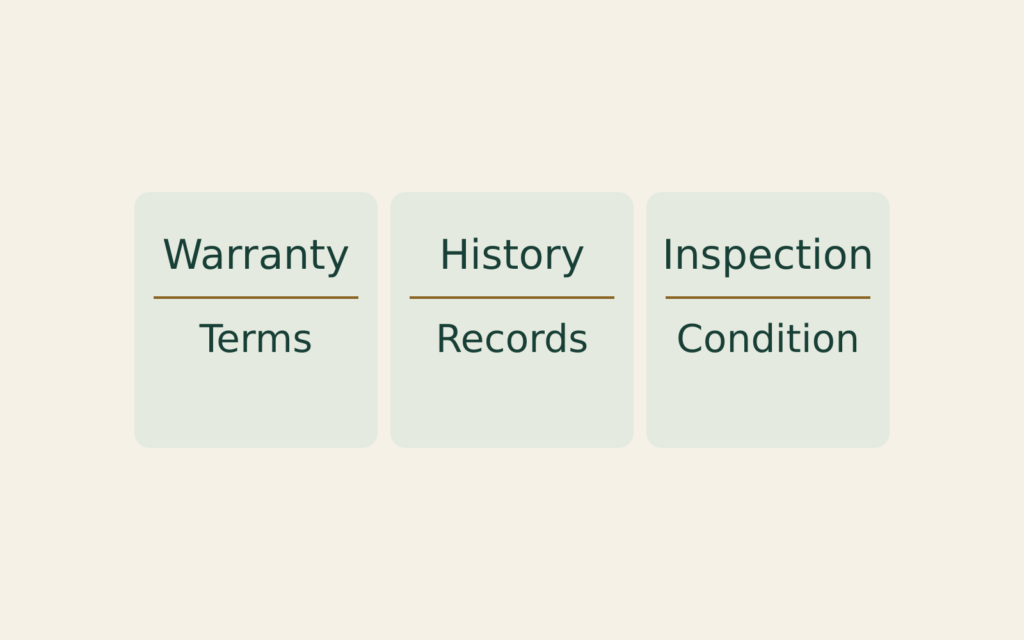
Prepare a separate folder for each vehicle you’re considering. Keep the complete documents rather than a collection of favorable screenshots. This U.S. guide explains a reading process for dealer transactions; it doesn’t recommend a purchase, determine a repair claim, or assess a vehicle’s safety.
Start with the final Buyers Guide
The FTC’s dealer guidance explains that most used-car dealers must display a Buyers Guide. Exceptions apply; Maine and Wisconsin use their own disclosure systems. This isn’t a rule for every private vehicle sale.
On the Guide, locate the vehicle identification and dealer details, warranty status, covered systems, duration, and the dealer’s share of parts and labor costs. State law affects whether and how implied warranties can be excluded; an “as is” label isn’t a substitute for checking those rules.
Negotiated warranty changes must appear on the Guide, and the buyer receives the final version at the sale. The Guide isn’t enough to satisfy the separate written-warranty disclosure requirements. Obtain that warranty document too rather than expecting the window form to contain every term.
Ask what an inspection actually examined
The FTC recommends an independent mechanical inspection even for a vehicle certified and inspected by the dealer. A mechanical inspection differs from a safety inspection, which usually concentrates on conditions that make a car unsafe to drive.
Ask for a written inspection report and an estimate for necessary repairs, with the vehicle’s make, model and VIN identified. A repair estimate is a planning input, not proof that the work was completed.
If an inspection can’t be arranged off the lot, the FTC describes alternatives such as a mobile inspector or asking the dealer to take the car to a chosen facility. Clarify the inspection arrangement before treating a seller’s reassurance as the independent report you intended to obtain.
Read the limits of the history report
The official NMVTIS disclaimer describes title and brand information, the latest odometer reading in the state title record, and reports from insurers and junk or salvage businesses. It doesn’t provide a detailed repair history.
Significant damage may be absent if it never resulted in a reportable total-loss determination or title brand. Conversely, an insurer’s total-loss report and a state’s title classification need not match. Don’t turn a blank field into a finding that nothing happened.
Approved providers can include additional condition information from sources outside NMVTIS. Identify which source supplies the particular entry you’re reading. Keep the provider’s explanation beside an unfamiliar label; the same report may combine information with different origins rather than one uniform inspection finding.
Keep recall searches specific
NHTSA distinguishes a VIN or license-plate search for a particular vehicle from a year, make and model search that returns general information. These are different questions.
| Search | Result scope |
|---|---|
| VIN or plate | Unrepaired recalls for that vehicle |
| Year, make, model | General recalls, investigations, complaints and communications |
The vehicle-specific lookup has limits: it omits completed recall repairs, some newly announced recalls before VINs are identified, certain manufacturers, and non-safety service campaigns. Recalls more than fifteen years old can also be outside its coverage, unless a manufacturer provides longer coverage.
Therefore, a zero-unrepaired-recall result isn’t a complete repair history or a general mechanical inspection. Preserve the search date and exact vehicle identifier. For a recall notice, follow the manufacturer’s interim safety guidance and contact the dealer rather than inferring safety from this comparison.
Read the borrowing document separately
The CFPB explains that Truth-in-Lending disclosures describe auto-loan costs and terms before signing. The form must be completed, not blank. Compare it with the proposed financing rather than treating a monthly payment quotation as the whole agreement.
APR expresses the cost of credit as a yearly rate and can differ from the interest rate. The finance charge includes interest and certain fees under the scheduled-payment assumptions. Total of payments describes the scheduled payments over the loan term. Also locate the number of payments, late fees and prepayment terms.
Keep those labels intact when copying figures. If two amounts differ, first check whether they describe the same measure. Ask the lender or dealer to explain an unexplained entry and retain copies of the final documents.
Close one question at a time
Give each document a short filename and record the page you consulted. Beside your question, write either the exact answer location or “not answered.” Keep your own interpretation in a separate column so it can’t be mistaken for the document’s wording.
When a replacement page arrives, retain the earlier page and mark the new one as a revision. Compare the changed passage before closing the question. A folder marked “complete” should mean you have checked your list, not that you have reached a legal or purchasing conclusion.


Roth Conversion and Account Clocks
Separate five-year tests.

ABLE Distributions Across Month-End
Separate retained purposes.