W-2 Wages Versus Pay-Stub Totals
This U.S. document-reading guide explains W-2 comparisons, not tax-return preparation or a lender’s qualifying-income decision.
Estimated reading time: 5 minutes
This U.S. document-reading guide explains W-2 comparisons, not tax-return preparation or a lender’s qualifying-income decision.
Compare wage bases, not just totals
Michigan’s payroll explanation distinguishes federal income-tax wages in box 1 from Social Security wages in box 3 and Medicare wages in box 5. Traditional retirement deferrals can reduce the first without reducing the others.
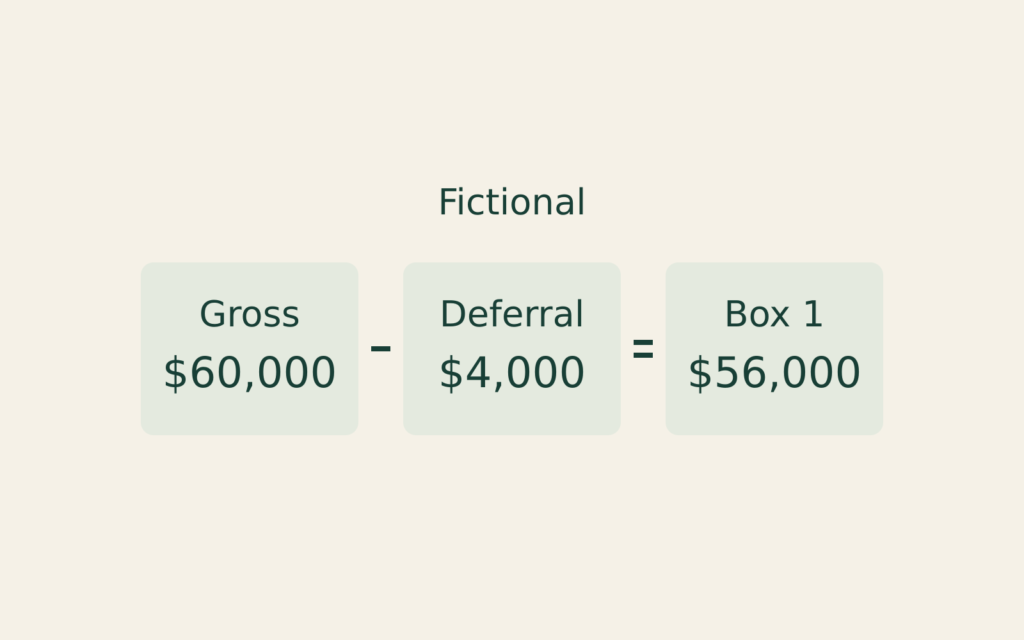
Fictional example: $60,000 gross wages and $4,000 traditional 401(k) deferrals. Assume all wages are subject to Social Security and Medicare, below the applicable Social Security wage cap, with no other adjustments.
| Field | Amount |
|---|---|
| Box 1 | $56,000 |
| Box 3 | $60,000 |
| Box 5 | $60,000 |
The subtraction is $60,000 minus $4,000. The repeated amounts are different tax bases, not three payments to add together. None is a take-home-pay calculation.
Keep the calendar labels attached
GSA’s 2025 payroll calendar separately identifies pay-period endings, electronic-funds-transfer dates, official pay dates and a W-2 cutoff. Its December entries include EFT dates of December 5 and 19, official pay dates of December 10 and 24, and a W-2 cutoff of December 19.
This is one federal agency’s published schedule, not a calendar for every employer. It demonstrates why a date copied without its label can answer the wrong question. “December payroll” doesn’t identify which calendar entry somebody means.
For your records, ask payroll which payment schedule and year-end reconciliation apply. Keep the period covered separate from the payment date. Don’t infer a universal tax-year rule from GSA’s administrative cutoff, or substitute this schedule for your employer’s actual records.
A benefit-cost entry isn’t another paycheck
IRS health-coverage reporting guidance explains that box 12, code DD reports employer-sponsored coverage costs for information. Reporting that cost doesn’t make the coverage taxable. In general, the figure includes both employer-paid and employee-paid portions.
Therefore, don’t interpret the DD amount as an extra cash payment you received, or as only the premiums deducted from your own paychecks. A comparison with your deductions needs the employer’s explanation of what coverage and cost components it reported.
The IRS also describes reporting relief and different treatment for particular coverage categories. A missing DD entry isn’t, by itself, proof that you had no health coverage. Keep the exact letter code with the amount.
Read the retirement checkbox separately
IRS retirement-reporting guidance explains that the retirement-plan indicator in box 13 concerns active participation. It isn’t an account-balance field. For defined-contribution plans, contributions or forfeitures credited to an account can matter; defined-benefit participation uses a different test.
A checked box doesn’t identify how much cash is currently available to withdraw. Nor should the absence of your own voluntary contribution automatically settle whether the checkbox is correct. Ask payroll about the plan and participation information underlying it.
The IRS notes that this indicator can affect traditional IRA deduction eligibility depending on filing status and modified adjusted gross income. That’s a separate tax question, not a deduction calculated here.
A transcript isn’t a complete replacement image
IRS Topic 159 distinguishes wage-and-income transcript data from an actual W-2 copy. The transcript contains information reported to the IRS, but its W-2 information excludes state and local details. Information for the tax year currently being processed may also be incomplete until reported.
If you’re comparing a state wage or withholding entry, don’t assume a blank space on that transcript contradicts your employer’s form. First ask whether the document contains that category at all.
The IRS retains actual W-2 copies only when attached to paper returns. A request for a transcript and a request for an actual return copy are therefore different requests. Confirm the needed document before choosing a retrieval route.
Separate an explanation from a correction
IRS Topic 154 directs recipients of incorrect forms to the employer or payer first. It also describes IRS assistance when a missing or corrected form remains unavailable and explains the substitute-form process.
A focused payroll question can identify the exact field, the reported amount and the supporting record that appears inconsistent. Ask whether payroll is explaining an existing entry or issuing a corrected document. Those responses aren’t interchangeable, and a conversation doesn’t itself replace the form.
If tax filing is affected, use the applicable year’s IRS instructions and qualified assistance. Topic 154 addresses amended returns when a later missing or corrected form differs from estimates already filed. This article doesn’t prepare a substitute form or amend a return.
Protect the record while resolving the question
Minnesota Revenue’s W-2 scam warning describes messages impersonating executives to obtain employees’ forms from payroll or human resources. A plausible sender name isn’t enough to authenticate a request for sensitive records.
The agency recommends connecting with the requester by telephone or in person rather than replying to the questionable email to verify it. Apply that separation when a supposed payroll follow-up unexpectedly asks for forms: establish the request through a genuine contact route before disclosing information.
Keep complete tax records private. Don’t post your W-2, pay statement or tax identifiers in public comments or send them to EasyLoanWorld.


Roth Conversion and Account Clocks
Separate five-year tests.

ABLE Distributions Across Month-End
Separate retained purposes.