Disability Payments: Read Each Adjustment
Disability paperwork can describe different calculations. Read the payer and purpose before combining amounts.
Estimated reading time: 5 minutes
Disability paperwork can describe different calculations. Read the payer and purpose before combining amounts.
Start with the plan’s calculation
The 2026 Savannah River Nuclear Solutions (SRNS) plan provides a specific example of coordination: its long-term disability payment is reduced by Social Security Disability Insurance (SSDI), and a retroactive award can require reimbursement. These are that employer’s provisions, not universal insurance terms.
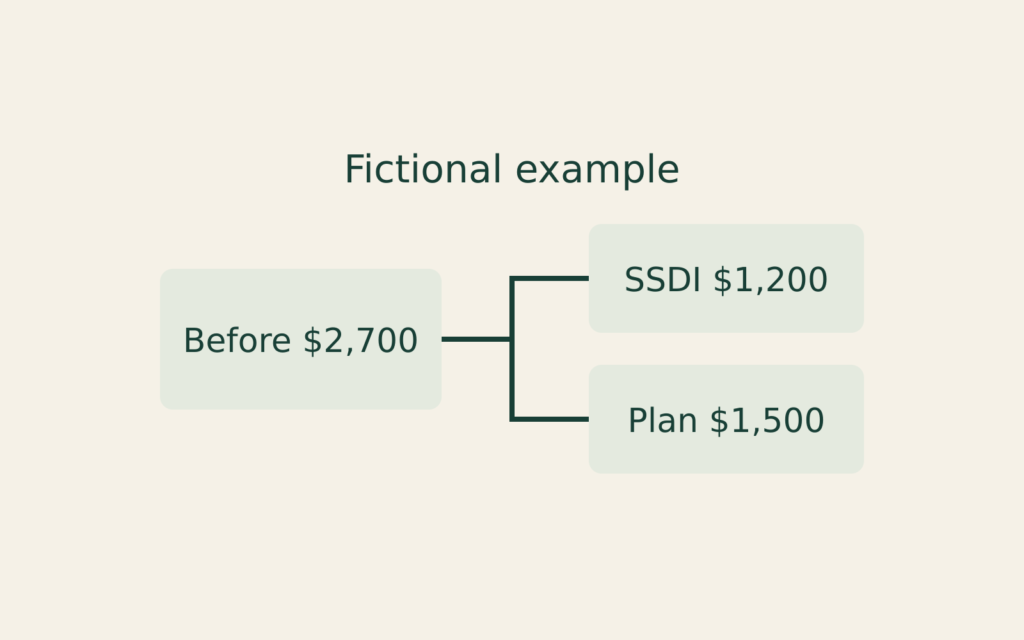
Fictional arithmetic only: assume an approved $2,700 monthly benefit before offsets, a $1,200 SSDI offset, and no other adjustments.
| Before offset | $2,700 |
|---|---|
| Less SSDI | $1,200 |
| Plan payment | $1,500 |
The two payments total $2,700, not $3,900. This isn’t a coverage finding, tax calculation or estimate of any person’s award. A real calculation needs the applicable plan and all its adjustments.
Check which payment is being reduced
SSA’s explanation says disability payments from private sources, including private insurance, don’t affect Social Security disability benefits. Workers’ compensation and certain public disability benefits can affect them.
That statement answers a question about SSA’s payment. It doesn’t tell a private plan how to calculate its own benefit. Read the payer’s name beside the adjustment: an insurer’s reduction isn’t automatically an SSA reduction.
This SSDI discussion excludes SSI and workers’ compensation calculations.
An approval belongs to a particular program
SSA’s eligibility guide explains that SSDI requires covered work and satisfaction of its disability requirements. Its definition differs from those of other programs; it doesn’t pay for partial or short-term disability. Workers can earn at most four credits each year under SSA’s rules.
The work requirement includes both how long and how recently a person worked under Social Security. The number of credits needed depends on age, and younger workers may qualify with fewer credits. A history of paying an insurance premium doesn’t supply that Social Security work record. Keep those different requirements visible when reading a decision.
This is a document-reading boundary, not a medical assessment. A diagnosis alone isn’t the complete set of program requirements. Questions about entitlement, work activity or continuing eligibility belong with the responsible agency and qualified advisers, not a comparison of bank deposits.
Taxability starts with premium funding
The IRS disability-income FAQ distinguishes who paid the insurance premiums and whether employee payments were after tax. Employer-funded benefits are generally included in income. When an employee paid the entire cost after tax, the benefits aren’t included; mixed funding needs the employer-funded portion identified.
The FAQ also explains that premiums paid through a cafeteria plan without being included in taxable income are treated as employer-paid. A deduction appearing on a pay stub therefore doesn’t, by itself, establish after-tax funding.
Ask payroll or the benefits administrator for the premium-funding record and its tax treatment. Keep that evidence separate from the benefit amount.
Withholding is a separate record
The 2026 Form W-4S instructions concern requesting federal income tax withholding from sick pay paid by a third party, such as an insurer. They say not to use that form when the employer or its agent makes the payments, because employer withholding rules already apply. Collective-bargaining arrangements receive a separate instruction to consult the union or employer.
The form distinguishes the amount withheld from each payment from the worksheet estimating annual tax. Those aren’t interchangeable numbers. A withholding entry isn’t a determination of final tax liability. The instructions also say the year-end Form W-2 reports taxable sick pay and federal income tax withheld.
For a payment inquiry, identify the payer and the actual withholding entry. This guide doesn’t select a withholding amount, complete a tax worksheet or instruct you to submit or revoke a form.
Use verification for the status it actually shows
SSA’s benefit-verification guidance explains that a letter can show receipt of benefits, an application, or no benefits. It’s personalized to the person’s benefit status and is often used for loan applications and housing assistance.
Read the status rather than assuming that every document called a benefit letter proves payments are already being received. If a lender requests proof, clarify which record it needs; the existence of a verification letter isn’t a promise of loan approval. A letter documenting an application doesn’t itself establish an amount available for repayment.
Keep the complete private copy, including its date and explanatory text. A cropped figure can leave the reader without the status it describes. Share personal records only through the intended recipient’s verified secure process, not public comments or an article’s contact form.
Keep the unresolved question precise
Use a separate, dated, legible working copy for annotations. Preserve the complete untouched original, and label your own notes so they can’t be mistaken for wording supplied by the issuer.
General U.S. financial education, not medical, legal, tax or borrowing advice. No actual claim, repayment obligation or personal eligibility is determined here. Sources checked October 30, 2026.


Roth Conversion and Account Clocks
Separate five-year tests.

ABLE Distributions Across Month-End
Separate retained purposes.