Buying a Business: Check the Funding Gap and Operating Cash
Build a business-acquisition funding plan that includes the purchase price, transaction costs, working capital, verified funding sources, and repayment cash flow.
Estimated reading time: 6 minutes
A business purchase brings several different numbers and documents into one financing conversation.
Identify what can continue after the purchase
SBA’s acquisition guidance calls attention to licenses, permits, zoning and environmental considerations when real property is involved. Buying the operation doesn’t eliminate the need to investigate these separate requirements.
Ask the relevant agency and qualified advisers what the proposed transaction requires. Don’t assume a seller’s displayed permit answers whether the buyer can operate under it. This guide doesn’t determine transferability or compliance.
Don’t turn undocumented sales into repayment evidence
Idaho SBDC’s acquisition FAQ emphasizes documented financial information and warns against counting a seller’s claims of unreported cash sales when evaluating cash flow. The claim isn’t a substitute for records supporting the business’s results.
If a seller presents two revenue stories—one in the records and a larger verbal estimate—keep that discrepancy unresolved. Don’t add the unsupported difference to a lender forecast.
The FAQ recommends obtaining at least three years of financial statements. That’s its due-diligence guidance, not a promise that three years alone satisfies every lender.
A valuation conclusion needs its scope
The IRS business valuation guidelines are instructions for its valuation work, not a universal buyer checklist. They nevertheless illustrate why a value should come with an identified property or interest, effective date, purpose, assumptions and limitations.
A report about a particular ownership interest on an earlier date shouldn’t silently become today’s price for a different bundle.
The guidelines also distinguish the benefit stream used in a valuation, such as pretax or after-tax income or cash flows, and the corresponding rate or multiple. Two figures labeled “earnings” need their definitions before they can support a meaningful comparison. The guidelines separately identify restrictions and agreements that may influence value. Preserve those qualifications instead of presenting a conclusion detached from its stated conditions.
Allocation is a tax question, not another purchase price
The Form 8594 instructions address covered transfers of a group of business assets where goodwill or going-concern value attaches or could attach and the purchaser’s basis is determined by the amount paid. Exceptions and transaction-specific rules matter; this isn’t a determination that every business purchase requires the form.
The allocation establishes the purchaser’s basis in acquired assets and the seller’s gain or loss for those assets. It doesn’t create a second price to add to the purchase.
The instructions classify inventory separately from equipment and distinguish goodwill from other specified intangibles. Furniture, fixtures, buildings, land, vehicles and equipment are generally Class V; inventory belongs to Class IV. A single “business value” label loses those distinctions. Have a qualified tax professional assess the actual allocation and any later price adjustment rather than assigning categories from a short article.
Check tax identity against the actual structure
The IRS’s new-EIN guidance organizes its answer by entity type. A changed business name or address alone doesn’t require a new EIN. Ownership and structural changes require a different analysis. The corporate list also distinguishes a surviving corporation after a merger from a merger that creates a new corporation.
For example, its partnership instructions distinguish taking over a partnership to operate as a sole proprietor from an ownership change that doesn’t terminate the partnership. The former calls for a new EIN; the latter doesn’t.
These are different described situations, not a choice of convenient paperwork. Ask the tax adviser which situation the completed transaction actually creates. Don’t apply for a number, reuse the seller’s number or select a tax classification solely from the business’s trading name.
Keep purchase money separate from operating money
An Illinois SBDC planning workbook illustrates a purchase price alongside additional working capital. Its historical example supports the planning distinction, not current lending terms.
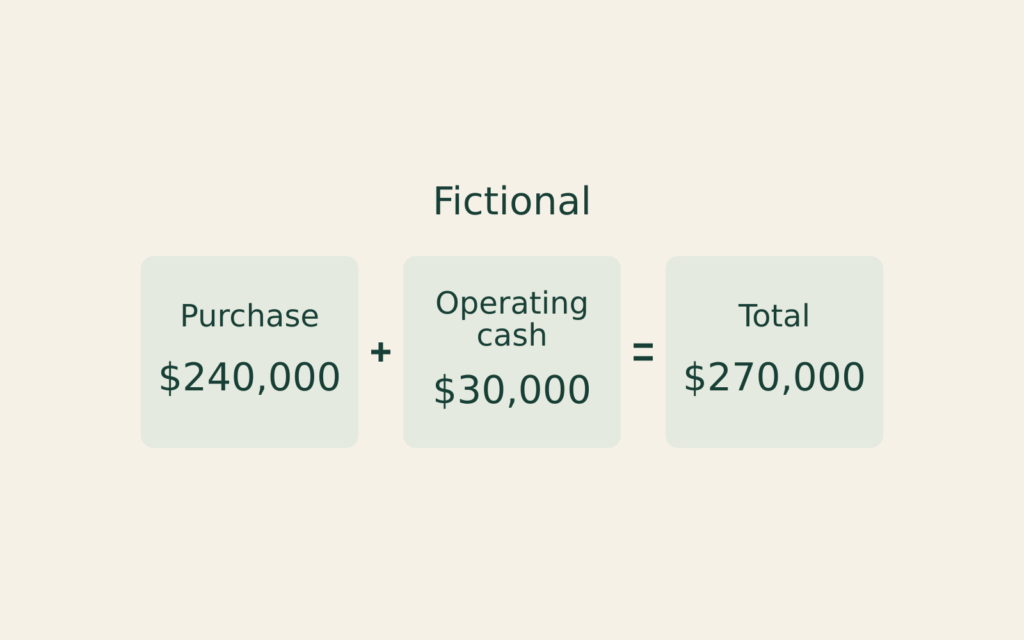
Fictional example: assume a $240,000 purchase and a separately estimated $30,000 operating cash need, with no overlap or other costs.
| Purchase | $240,000 |
|---|---|
| Additional operating cash | $30,000 |
| Combined need | $270,000 |
The $270,000 is neither a valuation nor an approved loan. Actual costs and funding remain unresolved.
Turn the price into a complete funding plan
Extend the earlier fictional example by adding $10,000 of separate transaction costs. The purchase price remains $240,000 and the initial operating cash remains $30,000; assume no overlap among the three amounts.
| Use or source | Amount |
|---|---|
| Purchase price | $240,000 |
| Initial operating cash | $30,000 |
| Separate transaction costs | $10,000 |
| Total cash uses | $280,000 |
| Buyer funds proposed for the purchase | $70,000 |
| Requested bank financing | $180,000 |
| Total proposed sources | $250,000 |
| Unresolved funding gap | $30,000 |
The requested $180,000 loan isn’t approval or available cash. Even if it were approved on those terms, the plan still needs another $30,000 or a documented change to its uses. Don’t fill the gap with assumed seller financing, an unapproved credit line or money already committed elsewhere. If costs are withheld from loan proceeds, compare net usable funding with the cash needed.
Use the business loan cash-flow guide to build the repayment schedule. The loan net proceeds calculator can separately illustrate a fee deducted from funding; it doesn’t establish the acquisition loan amount a lender will approve.
Check the first operating months as well as closing day
In a separate invented monthly forecast, suppose $6,000 remains after operating payments, taxes, existing debt, necessary owner compensation and planned maintenance, but before the new acquisition loan payment. A proposed $4,500 new debt payment leaves $1,500. If delayed customer collections reduce available cash to $4,000, that month is short by $500. Neither the seller’s revenue headline nor the purchase valuation resolves this timing problem.
Build the forecast from bank records, receivable and payable schedules, payroll, contracts and supported financial statements. Record the new debt payments on their due dates and carry the balance forward through subsequent months. The $30,000 opening operating cash is a starting balance in this forecast, not a new receipt to add again every month.
Before committing, leave each funding source labeled available, conditional, requested or unresolved, with the amount and expected date. This makes the gap visible to the lender and advisers before it becomes a closing-day problem. These figures illustrate cash planning; they aren’t a lender’s equity or coverage requirements.
A permitted loan purpose isn’t an offer
SBA’s 7(a) overview lists complete or partial ownership changes and working capital among potential loan uses. It also states that applications go through lenders and that required documents vary with the loan size, processing method and circumstances.
A conversation about an eligible purpose doesn’t establish approval for a particular buyer or price. No current rate or equity requirement is supplied here.
The overview distinguishes fixed-rate payments from variable-rate loans whose payment amounts may change. When reviewing a financing proposal, retain that distinction rather than assuming every installment stays unchanged.
Keep decisions with the appropriate review
General U.S. financial education, not an appraisal, tax allocation, legal opinion or recommendation to acquire a business. Sources checked October 30, 2026. No agreement, application or transaction is prepared here.


