Business Loan Affordability: Test the Cash Flow Before Borrowing
Test a proposed business loan against customer collections, operating costs, taxes, owner draws and existing debts, then check a slower month.

Estimated reading time: 8 minutes
Business loan affordability depends on usable cash after the business’s other commitments. Test the proposed payment against a weaker collection month, and keep that cash check separate from a lender’s ratio calculation.
A business loan payment has to fit the cash your business can use after its other commitments. Start with customer money actually collected, protect the cash uses your plan requires, and test the proposed payment in a weaker month. A healthy sales total alone can’t answer that question.
This guide builds a payment-capacity check for a U.S. business. It doesn’t calculate a lender’s maximum offer or the credit line needed to bridge a particular collection date. The example is fictional and isn’t a borrowing recommendation.
Business loan affordability: start with collections
The SBA’s business-finance guidance distinguishes recording a sale from receiving payment and highlights receivables, payables, available cash, bank reconciliation and payroll. Use those records to check that your forecast agrees with what actually happened.
For this exercise, count an invoice when its usable payment is expected to arrive. Don’t count the invoice value at issuance and again at collection. Separate borrowing proceeds, owner contributions and asset-sale receipts from recurring customer collections. Those inflows may cover specific dates; they don’t establish that customers will generate the same amount next month.
Exclude or separately reserve money that must be remitted or is otherwise unavailable. A bank balance containing that money isn’t entirely available for debt. Mark uncertain collections and document the evidence behind their timing rather than filling a gap with an optimistic sales target.
Give each cash use one home
The worksheet below starts directly with receipts and disbursements. It doesn’t start with accounting profit. Use mutually exclusive lines so that the same dollar is never deducted twice:
- Operations: payroll, ordinary supplier and inventory payments, rent and other operating cash paid. Put purchases at their payment dates; don’t also subtract a separate inventory or receivables adjustment for that same cash effect.
- Taxes and owner cash: distinguish business tax payments from money distributed to an owner. If the owner’s salary is already in payroll, don’t subtract it again as a draw.
- Equipment: show a planned cash purchase separately if it isn’t in operating payments. Use the cash payment, not depreciation.
- Existing debt: include required principal and interest. Exclude that interest from the operating line so it appears only once.
- Liquidity allocation: show any chosen reserve top-up separately. It remains business-owned cash earmarked for protection; it’s neither an expense nor a lender payment.
These are cash-planning labels, not tax rules. Entity structure and owner arrangements vary. If your records start with profit or combine these categories, have an accountant reconcile them to this cash view before using the result.
Worked example: one month leaves $5,000
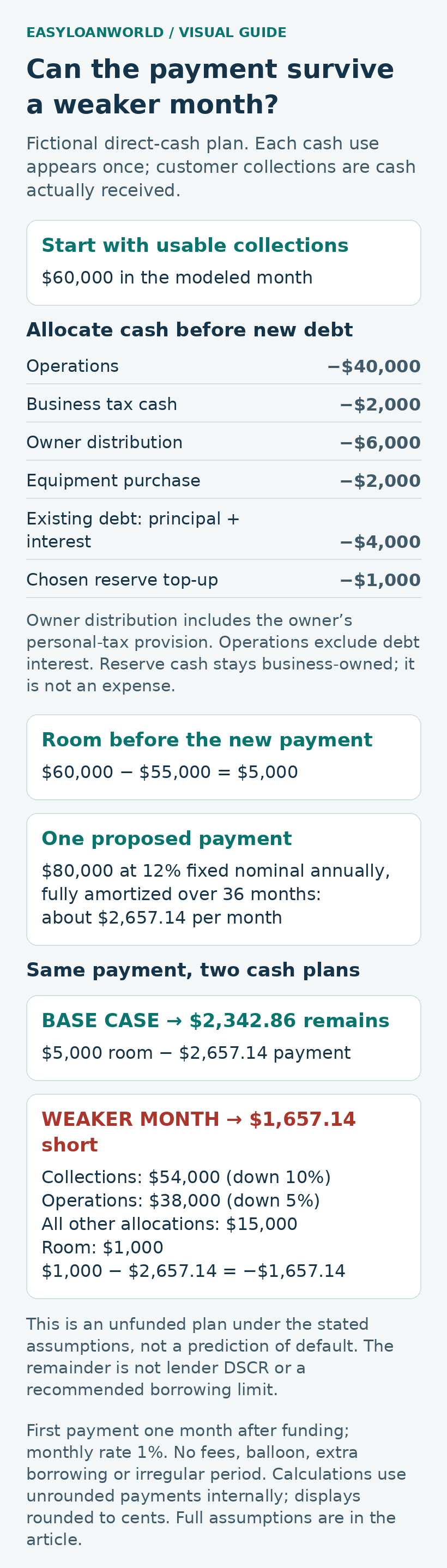
An invented business is considering new debt without assuming the financed project immediately increases collections. Its modeled month has these nonoverlapping allocations; all other flows are excluded:
- Usable customer collections: $60,000.
- Operating cash paid, including ordinary inventory, suppliers and payroll: $40,000.
- Separate planned business tax cash: $2,000.
- Owner distribution: $6,000, including the owner’s personal-tax provision.
- Planned equipment cash purchase: $2,000.
- Existing debt principal and interest: $4,000.
- Chosen liquidity reserve top-up: $1,000.
The $2,000 business-tax line is separate from the owner’s tax provision inside the $6,000 distribution. Owner salary isn’t duplicated here. Neither the equipment purchase nor the reserve top-up is a universal monthly requirement.
Room before new debt: $60,000 − $40,000 − $2,000 − $6,000 − $2,000 − $4,000 − $1,000 = $5,000.
That $5,000 is what remains after the selected cash needs and reserve allocation. It isn’t free profit, an accounting-statement subtotal or an amount the business should automatically commit to a lender.
Add the proposed payment
Assume a fictional $80,000 loan, fully amortizing over 36 months, at a constant 12% nominal annual interest rate. Payments start one month after funding; the monthly rate is 1%. There are no fees, balloon, extra borrowing or irregular first period. Calculations use unrounded payments internally.
The modeled monthly principal-and-interest payment is about $2,657.14. Subtracting it from the $5,000 leaves about $2,342.86 after all listed allocations. Real fees, rounding and contract conventions can change a quoted payment.
Business loan affordability with weaker collections
Change two assumptions: customer collections fall 10%, to $54,000, while operating cash paid falls only 5%, to $38,000. Keep every other cash use unchanged. This tests a situation in which costs can’t shrink as quickly as receipts.
- Room before the new payment falls to $1,000.
- The proposed payment remains about $2,657.14.
- The modeled plan is short about $1,657.14 after that payment.
This is an unfunded plan under the stated assumptions, not a prediction of default. Nor does it make $1,000 the recommended payment: spending all of that leaves no additional room beyond the selected allocations.
Rework the decision using changes you can substantiate, such as a smaller purchase, a delayed project, a different operating plan or an actual lower-cost offer. Don’t simply assume taxes can wait, owner cash can disappear, existing payments can be skipped or refinancing will be available.
Test business loan affordability using the payment model
Enter $80,000 principal, 12% annual interest and 36 months below. Expected monthly principal and interest is $2,657.14. This checks the fictional amortizing obligation; it doesn’t supply the cash available to pay it. Keep the collections and protected allocations from the worksheet beside the result.
In the base month, subtract the unrounded installment from the $5,000 remainder to obtain approximately $2,342.86 after the proposed payment. In the weaker month, subtract the same installment from $1,000 to reveal the $1,657.14 gap. The rate did not change between those cash cases; the collection and operating assumptions did.
Use a zero-rate boundary test to see whether interest alone explains the problem. Change only the rate to 0%, keeping $80,000 and 36 months. The payment becomes $2,222.22 because the principal still needs repayment. Against the weaker month’s $1,000 capacity, the modeled gap remains approximately $1,222.22. This is an arithmetic test, not an available offer or a claim that a lender would waive interest.
Restore the 12% input before discussing the original proposal. A lower modeled payment isn’t a new contract, and a loan without fees is only the example’s assumption. Ask for usable proceeds, actual charges and the full payment schedule in writing. A payment that appears affordable can still leave a separate purchase-funding gap if deductions reduce the cash delivered.
For a real business loan affordability review, give each cash assumption an owner and evidence date. Identify which customer collections are confirmed, which costs are committed and which reserve allocation is a planning choice. Test a weak period before counting any hoped-for benefit from the financed project.
If the payment fails the cash test, write the unresolved amount and the date it would be needed. Don’t convert it into assumed future borrowing, delayed tax payments or an unapproved extension. A revised project or financing proposal needs its own complete funding and repayment check. This calculator verifies the installment arithmetic while the cash worksheet tests whether the business can sustain it.
Keep your cash check separate from lender DSCR
As one program-specific example, the SBA says most 7(a) term loans are repaid through monthly principal and interest from business cash flow. That doesn’t make this fictional loan an SBA offer.
A debt-service coverage ratio, or DSCR, compares a defined earnings or cash measure with included debt service for the same period. Required principal and interest matter. Chase notes there is no universal “good” DSCR standard. Ask the lender for its numerator, adjustments, included debts, testing period and threshold.
Don’t divide this worksheet’s $5,000 remainder by the new payment and call it the lender’s DSCR. The worksheet already deducts existing debt and selected allocations; it was designed for a different purpose.
Bank of America’s lending guidance describes evaluating repayment alongside operating needs and a cushion. A lender may request a business debt schedule and current financial statements. Your forecast supports that conversation; it doesn’t replace underwriting or guarantee approval.
Write down the decision before committing
- Evidence: date range, collection records, seasonal patterns, one-off receipts and who owns each forecast assumption.
- Protected uses: operations, tax and owner treatment, equipment, existing debt and chosen reserves, with overlaps removed.
- Actual obligation: amount financed, net proceeds, fees, payment amounts and dates, rate changes, maturity and any final lump sum.
- Result: room before and after the proposed payment, the weakest tested month and assumptions still unverified.
- Open questions: lender definitions, covenant tests, required evidence and any contract language needing professional advice.
Test the expected borrowing period using seasonal records and realistic downside cases. One representative month can’t establish that a multiyear commitment works. Annual averages can hide weaker months, and weekly or daily payments need a dated cash check within the month.
End with a plain conclusion: the tested plan has room, depends on an unverified assumption, or shows a shortfall. The useful result is a documented decision you can revisit when the offer or business assumptions change.
Use the separate business DSCR worksheet when the lender asks for defined earnings and debt-service inputs.
Featured photo: Photo by Denny Müller on Unsplash. Used under the Unsplash license. Illustrative cash register. Photo by Denny Müller on Unsplash.