Tax Payment Options
Quick answer: Start with the current tax balance and a realistic payment schedule. Compare the IRS arrangement, a card and any loan over the same intended…
Estimated reading time: 6 minutes
Quick answer: Start with the current tax balance and a realistic payment schedule. Compare the IRS arrangement, a card and any loan over the same intended payoff period, including fees and ongoing charges. Confirm how much reaches the IRS and which debt remains afterward; a lower monthly payment alone doesn’t establish a lower total cost.
Identify the IRS arrangement
The IRS payment-plan guide distinguishes short-term plans of up to 180 days from monthly installment agreements. The short-term option has no setup fee. Longer plans have fees depending on application and payment method, with qualifying low-income waivers or reimbursements.
Confirm eligibility and terms; a preferred monthly payment isn’t approval.
Keep the penalty separate from interest
Under the IRS failure-to-pay rules, an individual who filed on time and has an approved payment plan receives a reduced penalty of 0.25% per month or partial month during that plan. That isn’t an annual borrowing rate.
For tax shown on a return, the ordinary failure-to-pay rate is 0.5% per month or partial month, capped at 25% of unpaid tax. Other circumstances can change the rate; don’t substitute the approved-plan rate before its conditions are met.
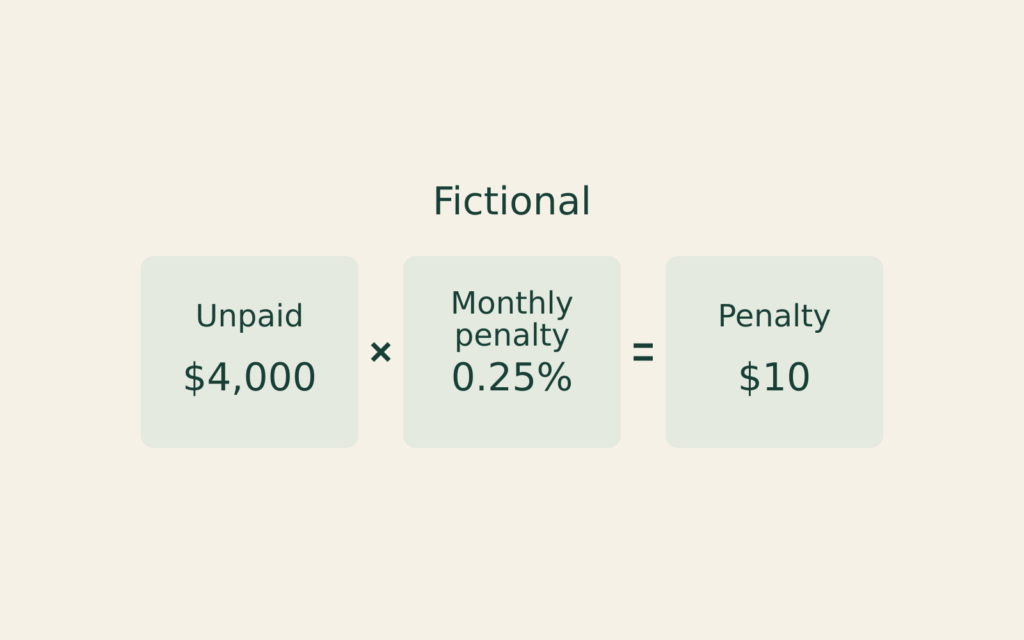
Fictional example: assume a timely-filing individual with an approved plan owes $4,000 subject to 0.25% for one penalty month, with no payments or other changes.
| Penalty calculation | $4,000 × 0.25% = $10 |
|---|
The $10 is penalty only, excluding interest and other charges.
The IRS applies a full monthly penalty even when payment occurs before that month ends.
Read the interest clock independently
The IRS interest guide says rates can change quarterly; a new rate doesn’t change the rate for earlier quarters.
For a meaningful comparison, obtain the applicable balance and dates rather than multiplying today’s quoted rate across every earlier period. This guide deliberately doesn’t forecast future quarterly rates or combine unlike charges into a purported IRS APR.
Add the card-processing charge
The IRS card-payment page lists approved processors with different debit, consumer-credit and commercial-card fees. Percentage charges can have minimums. Payments made while e-filing can have different fees again.
Use the row matching the actual card and route, not the smallest number in the table. The statement can show the tax payment and convenience fee separately; the fee isn’t another payment reducing the tax balance.
Read the personal-loan disclosure
The CFPB’s installment-loan guide identifies origination and documentation charges, possible late fees and insurance products among the costs to inspect. Credit and disability insurance are generally optional.
A quote showing only a recurring installment leaves unanswered what other charges the documents impose. Separate required borrowing costs from optional products and confirm what the quoted amount includes. Don’t add a charge twice if it’s already included in the disclosed payment total.
Use the actual written offer for that comparison, not a generic lender advertisement. Confirm the components before accepting the agreement. An offer with one origination charge and another with two differently named charges needs component totals, not a fee-count ranking. The presence of a listed fee category doesn’t mean every lender charges it or that every insurance product is mandatory.
Check whether the home becomes collateral
The CFPB’s second-mortgage explanation warns that a home-equity loan or line can put the home at risk if it can’t be repaid. Using another loan to pay a debt changes the obligation; it doesn’t make the replacement borrowing disappear.
It also cautions that moving shorter-term debt into a long mortgage can extend repayment and increase the interest paid. A lower immediate installment is therefore not the entire comparison.
For a proposed tax-payment borrowing arrangement, identify the pledged asset and final repayment date alongside the cash payment. Don’t label the transaction “debt eliminated” merely because the tax account could be paid from borrowed funds.
Separate payment rules from tax disputes
A final Treasury/IRS rule effective October 19, 2026 removes restrictions that prevented the IRS from paying card-processing fees under certain contracts. Under the permitted-fee contracts, the IRS must recoup those fees from taxpayers. Regulatory permission isn’t a promise of a free payment route; check the operational choices actually offered.
The rule distinguishes card-account errors from disagreements about the tax liability. Its card error-resolution provisions don’t decide whether the tax itself is correct. Paying through a card doesn’t turn a disputed tax assessment into a merchandise dispute.
If the liability is disputed, obtain the applicable tax response guidance instead of using this funding comparison to choose a challenge procedure.
Don’t substitute a relief advertisement
The FTC’s tax-relief warning describes firms charging large upfront fees or recurring maintenance fees while promising reductions they can’t guarantee. Some fail even to send the promised paperwork.
A seller’s claim that you qualify doesn’t establish IRS acceptance. Nor does another customer’s reported settlement establish your outcome. Keep that proposed service distinct from a written loan offer or an IRS payment arrangement.
Before paying for assistance, clarify the service charges, billing method and refund policy if promised work isn’t provided. A monthly service fee is another cost to evaluate, not proof that the tax balance is being reduced.


Roth Conversion and Account Clocks
Separate five-year tests.

ABLE Distributions Across Month-End
Separate retained purposes.