Career Training Before Borrowing
Read career-training obligations and funding conditions separately before treating named examples as a funding plan.
Estimated reading time: 5 minutes
Before borrowing for career training, read the obligations and funding conditions for each arrangement. The examples here below illustrate different arrangements; they don’t form a combined offer.
Read the refund conditions, not just the headline
Springboard describes a money-back guarantee, with eligibility assessed before enrollment and requirements varying by career track. Its general criteria are only a starting point. Eligible students must complete the specified requirements on time and fail to secure a qualifying position within the applicable job-search period before the refund protection applies.
Career coaching is available even to students who don’t qualify for that guarantee. Coaching access therefore doesn’t establish refund eligibility. Ask which track-specific terms govern, what counts as a qualifying position, and how completion and job-search requirements are documented. Read those terms before treating the advertised protection as part of a borrowing decision.
Follow the refund into the loan account
Ascent’s career-loan FAQ says a school refund goes to Ascent, subject to its stated limits; borrowers remain responsible for a balance after the refund, including applicable interest and fees. This is a separate lender example, not a statement that Ascent currently finances Springboard’s advertised program.
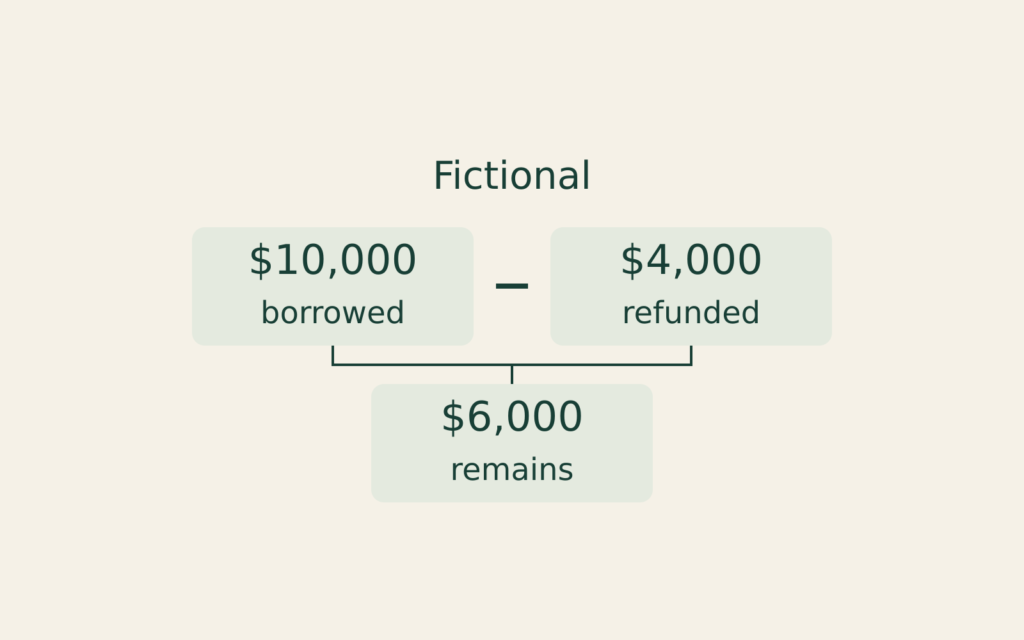
Fictional principal-only illustration: assume $10,000 was borrowed and a $4,000 school refund has actually reduced principal. The remaining principal is $6,000: $10,000 − $4,000. Interest, fees and payment timing are excluded. A refund isn’t necessarily full debt cancellation.
Identify the creditor and servicer in the actual loan documents.
Read the outcome report’s population and clock
CIRR’s student guide describes reports identifying the school, campus, program, course length, reporting periods and included graduates. It separates graduation data from graduates seeking employment, then describes employment outcomes at 180 and 360 days. Employment type and salary distribution matter alongside a median salary.
A useful comparison pairs the same program and reporting period, rather than placing an older campus result beside a different online course. Read whether employment means in-field work, another field, contract work or full-time employment. A historical median isn’t a salary promised to an individual borrower. This explains CIRR’s reporting framework; it doesn’t claim that either named provider above participates in CIRR.
Separate a training listing from a funding decision
Idaho’s Department of Labor explains that WIOA occupational-training providers generally need state approval before funds can pay for training, with specified basic-skills and preparatory-service exceptions. Inclusion on Idaho’s eligible-provider list is expressly not an endorsement. Participants should work with their career planner when selecting training.
The department also distinguishes approval to receive federal funds from inclusion as a WIOA Title I-B eligible provider: course offerings can affect the latter. For an Idaho training inquiry, identify the exact program, not only the school’s name. Ask the career planner which local training options and participant process apply before counting prospective support against tuition. Other states maintain their own lists; this isn’t a nationwide award determination.
For VA benefits, compare the actual training schedule
VA’s non-college-degree guidance covers eligible beneficiaries pursuing training such as HVAC repair, truck driving or cosmetology. For Post-9/11 GI Bill benefits, VA identifies weekly clock hours, service eligibility tier, class location, enrollment dates and active-duty status as payment factors.
For the other listed benefit chapters, VA distinguishes classroom-heavy instruction from predominantly hands-on training when defining attendance levels. The same weekly hours therefore shouldn’t automatically be treated as the same attendance category across those formats.
A course’s calendar can be more useful than its marketing description of “full time.” Have the school and VA clarify the applicable benefit and schedule before entering an estimated payment into a funding comparison. No current payment amount is calculated here.
Compare a paid apprenticeship as a different arrangement
Apprenticeship.gov describes Registered Apprenticeship as paid work with a mentor, progressive wage increases, classroom instruction and a portable, nationally recognized credential. Opportunities are offered through employers or program sponsors, with questions about a specific opportunity directed to them. American Job Centers offer guidance.
That arrangement differs from paying a school first in the hope of obtaining employment afterward. When comparing an actual opportunity, ask the sponsor about starting wages, the work and instruction schedule, and any costs the participant must cover. Don’t assume every course called an apprenticeship is a Registered Apprenticeship, or that a search listing means you have been hired. This isn’t a promised placement.
Check an existing 529 account’s permitted use
The SEC’s January 28, 2026 investor bulletin explains that 529 plans can cover certain postsecondary education and recognized postsecondary credential programs. It also identifies certain expenses required for participation in registered apprenticeships. The qualifying-use boundary matters; a course’s career-oriented name alone doesn’t establish it.
If education savings are already available, identify the program and specific expense before assuming a withdrawal receives favorable tax treatment. The bulletin warns that nonqualified uses can expose earnings to federal tax and an additional penalty, with possible state consequences. This guide doesn’t determine whether a particular bootcamp qualifies, calculate tax, or recommend opening or changing an investment account. Resolve that separate question using the plan’s documentation and appropriate tax help.


Roth Conversion and Account Clocks
Separate five-year tests.

ABLE Distributions Across Month-End
Separate retained purposes.