Allocated Losses
A reported activity loss does not identify the cash effect of removing it. Two fictional businesses can show the same report yet have opposite removal…
Estimated reading time: 5 minutes
A reported activity loss does not identify the cash effect of removing it. Two fictional businesses can show the same report yet have opposite removal outcomes.
Construct the identical starting reports
Consider two activities, A and B, over one period. A receives 100 and incurs activity-specific payments of 50, leaving 50 before the shared cost. B receives 80 and incurs activity-specific payments of 60, leaving 20. A shared payment of 60 applies while both operate.
All amounts use one common monetary unit. Receipts and payments occur within the period; there are no taxes, borrowing flows, depreciation or other noncash entries. These stipulated cash calculations are not a prescribed accounting presentation. No actual business or employee decision is being evaluated.
Total receipts are 180. Activity-specific payments total 110, and the shared payment adds 60. The combined result is 180 − 110 − 60 = 10. Equivalently, the two pre-allocation amounts sum to 50 + 20 = 70; subtracting the shared 60 again leaves 10.
Vary only the reporting fraction
For a reporting exercise, let w be the fraction of the shared 60 charged to A, with 0 ≤ w ≤ 1. The remainder, 1 − w, is charged to B. The displayed results are:
A: 50 − 60w. B: 20 − 60(1 − w) = 60w − 40.
Adding them gives 50 − 60w + 60w − 40 = 10. The two allocation terms cancel exactly. At w = 1/2, each activity is charged 30, so A displays 20 and B displays −10. At w = 9/10, A is charged 54 and B only 6, producing −4 and +14.
Nothing in those two calculations changes the initial receipts or payments. What changes is which activity displays a loss. Neither fraction is being endorsed as the correct reporting basis.
Locate every possible sign change
B’s displayed result is negative exactly when 60w − 40 < 0, or w < 2/3. At w = 2/3, B displays zero and A displays 10. A’s result is negative exactly when 50 − 60w < 0, or w > 5/6. At w = 5/6, A displays zero and B displays 10.
Between those two fractions, both activities display positive results. They cannot both display losses at any allowed w, because their sum is always positive 10. Thus the allocation family can label B as loss-making, label neither as loss-making, or label A as loss-making, without changing the combined result.
Specify a separate removal assumption
Now remove B. Stipulate that its receipts of 80 and its activity-specific payments of 60 both disappear, while A remains unchanged. Let k be the amount of the shared 60 that is actually avoided, with 0 ≤ k ≤ 60. The remaining shared payment is 60 − k.
The post-removal result is therefore 50 − (60 − k) = k − 10. Compared with the original combined result of 10, the change is (k − 10) − 10 = k − 20.
Removal improves this stipulated result only when k exceeds 20. It leaves the result unchanged at k = 20 and reduces it below that point. The reporting fraction w does not appear in that calculation.
Hold the report fixed and change the missing fact
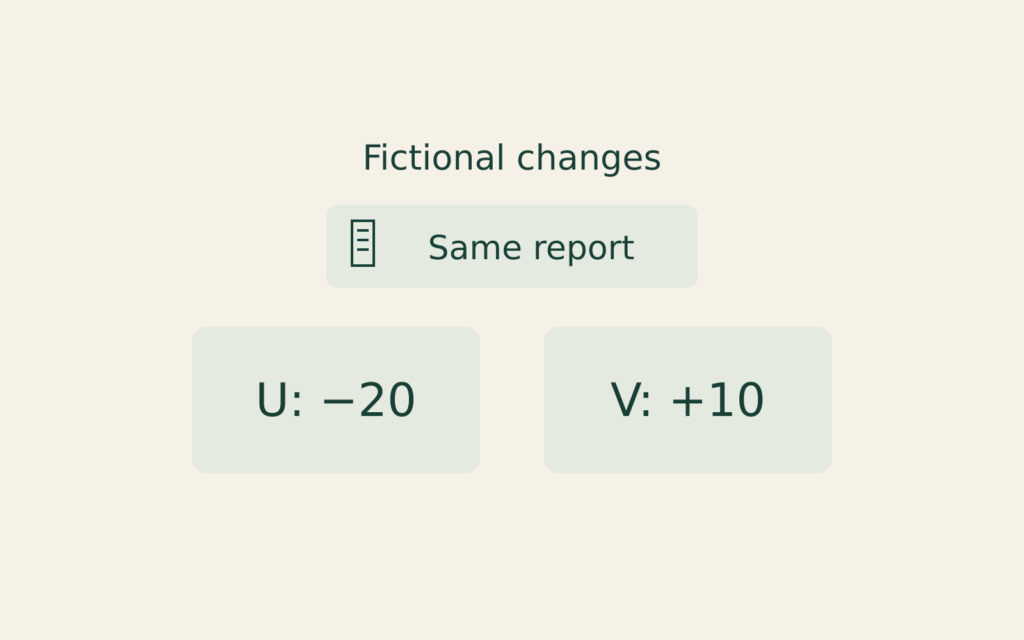
Use w = 1/2 in both fictional businesses. Each initially reports A at +20, B at −10 and the total at +10. They also have the same receipts, activity-specific payments and shared payment before removal.
In business U, independently stipulate k = 0: all of the shared 60 continues. Removing B leaves 50 − 60 = −10, a deterioration of 20 from the original +10.
In business V, independently stipulate k = 30. The remaining shared payment becomes 30. Removing B leaves 50 − 30 = 20, an improvement of 10 from the original +10.
The initial report is identical, including B’s negative 10. Nevertheless, the removal changes have opposite signs. Consequently, that report alone cannot distinguish U from V. The equality between V’s avoided 30 and B’s allocated 30 is a stipulated coincidence, not a method for estimating k.
This is not merely uncertainty about which allocation was used. From B’s displayed −10 and its pre-allocation 20, the assigned shared amount is 30. Dividing by the total shared 60 recovers B’s one-half share and hence w = 1/2. The reporting fraction is completely identified. Even after that reconstruction, both k = 0 and k = 30 remain compatible with the initial figures.
Separate the two variables when interpreting the result
ACCA’s Relevant costs explanation distinguishes reallocating unchanged costs from cash changes caused by a decision. Its shutdown example compares lost contribution with costs actually saved, rather than treating an allocated loss as sufficient evidence for closure. Here, w describes a reporting split; k describes a different cash-flow assumption. The calculation also depends on A remaining unchanged and B’s specified payments actually ceasing.