Business Property Coinsurance: Test the Limit Against a Higher Building Value
A worked three-scenario exercise with fixed fictional inputs, an inverse calculation and one alternative to discuss at renewal.

Estimated reading time: 8 minutes
Business property coinsurance needs a valuation check even when the dollar limit stays unchanged. Test the same loss against different values before discussing renewal.
A fixed dollar limit can look unchanged on renewal while the numbers behind the choice have moved. This exercise holds the limit constant, changes one valuation input and compares the resulting cash exposure. Every dollar amount and percentage below is fictional, not a quote or an estimate for your building.
Verify that your policy has an applicable coinsurance clause.
California’s regulator links building coverage to rebuilding, including permanently installed equipment. Confirm the valuation method, exclusions and endorsements with your broker.
Assume a $480,000 limit, an 80% clause, a $100,000 covered repair loss and a $5,000 deductible.
V means value at loss.
This follows Travelers’ replacement-cost example method: one covered building loss, all settlement conditions met, no other insurance, sublimits or payments.
The three valuations are alternatives for the same calculation, not a forecast of construction inflation. There’s no premium comparison, loss probability or financing proposal. No claim-payment date is modeled.
Business property coinsurance: one loss, three values
Use this procedure only for partial losses producing positive payments below the limit.
Multiply value by the clause percentage. Divide the limit by that result, using at most one. Multiply the covered loss by that ratio, then subtract the deductible.
| Building value V | Required limit R | Ratio q | Modeled payment P | Owner share U |
|---|---|---|---|---|
| $600,000 | $480,000 | 1 | $95,000 | $5,000 |
| $750,000 | $600,000 | 4/5 | $75,000 | $25,000 |
| $900,000 | $720,000 | 2/3 | $61,666.67 | $38,333.33 |
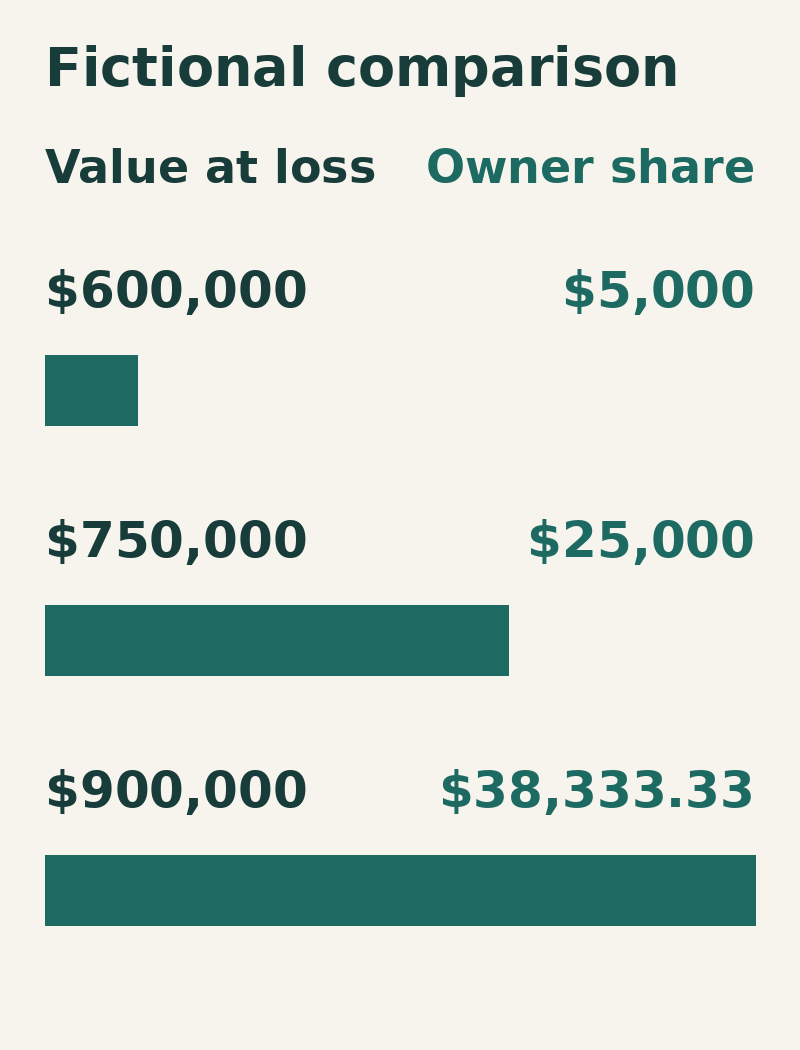
Here U is the $100,000 loss minus P. It’s the part of this stipulated loss left with the owner, not a complete recovery budget. The last row uses exact fractions internally and rounds only the displayed dollars.
For the middle row, $750,000 × 80% = $600,000. Dividing $480,000 by $600,000 gives 0.8. Then $100,000 × 0.8 − $5,000 = $75,000, leaving $25,000 with the owner.
Simply subtracting $5,000 from the $100,000 loss would produce $95,000. That exceeds the middle row’s result by $20,000, even though the modeled loss is well below the $480,000 limit. The $25,000 owner share already includes the $5,000 deductible; don’t add it again.
Find the value threshold
Reverse the first multiplication: $480,000 ÷ 0.80 = $600,000. That is the boundary for these inputs. At $600,000, the first row’s ratio is one. At the two higher chosen values, the ratios are smaller.
The jump from $600,000 to $750,000 is 25%, while the limit remains fixed. The middle row’s $25,000 owner share is five times the first row’s $5,000. These are consequences of this constructed example, not predicted changes for an actual renewal.
Business property coinsurance: change the repair loss separately
Use the middle valuation of $750,000 again, with the original $480,000 limit and 80% clause. The required amount stays $600,000 and the ratio stays 0.8. Change only the covered repair loss, keeping the $5,000 deductible and the original settlement assumptions.
With a $50,000 covered loss, the proportional amount before deductible is $40,000. Subtracting $5,000 leaves a modeled $35,000 payment. The owner share is $50,000 minus $35,000, or $15,000.
That $15,000 consists of $10,000 from the proportional reduction plus the $5,000 deductible. Adding the deductible to $15,000 would count it twice. The owner share isn’t an extra charge imposed on top of the repair bill.
For an independent $250,000 covered loss, 0.8 times the loss is $200,000 before deductible. Payment becomes $195,000, leaving $55,000. Both of these variations still produce positive payments below the stated limit.
The ratio is identical in the two calculations, but the dollar effect changes with the loss. A single owner-share dollar figure therefore can’t represent every possible partial loss at the same valuation.
These are alternative events, not two claims added together. The exercise says nothing about aggregate limits, multiple buildings, multiple occurrences or how a policy would respond after a previous payment. Those require their own terms and inputs.
Keep the deductible change in its own comparison
Return to the original $100,000 covered loss at the $750,000 valuation. Now change the deductible alone from $5,000 to $10,000. The limit, required amount and 0.8 ratio don’t change.
The proportional amount remains $80,000. Payment becomes $70,000 after the $10,000 deduction, and the owner share becomes $30,000. Against the original middle row, payment falls $5,000 and the owner share rises $5,000.
This doesn’t mean every deductible variation in an actual policy works this way. It follows from the specific subtraction method assumed here. Percentage deductibles, endorsements or other settlement provisions must be read before substituting numbers.
A comparison record should name the one input being changed. Otherwise, a lower payment after a renewal could be attributed entirely to coinsurance even though a deductible or covered-loss definition also changed.
Business property coinsurance: check the ratio cap at the higher value
At the fictional $900,000 value, the required amount remains $720,000. For an independent $600,000 limit, the ratio is $600,000 divided by $720,000, or five-sixths. Keep the $100,000 loss and $5,000 deductible.
Using the exact fraction produces $83,333.33 before deductible, rounded for display. The modeled payment is $78,333.33 and the owner share is $21,666.67. Calculate with the unrounded fraction and round only the final displayed dollars.
Raising this alternative limit to $720,000 reaches a ratio of one. The payment becomes $95,000 and the owner share $5,000 for the specified partial loss. A further increase to $800,000 still uses a ratio capped at one in this exercise.
It therefore doesn’t produce more than $95,000 for this unchanged $100,000 loss after the deductible. Dividing the larger limit by the required amount without applying the cap would give a misleading result.
That result is narrowly about this loss. It doesn’t show that the extra limit lacks value for other events, or that $720,000 would fully rebuild the building. This method’s threshold and adequate total-loss protection are separate questions.
Turn the arithmetic into a renewal question
Keep a dated sheet showing the valuation basis, clause percentage, limit, deductible, assumed covered loss, required amount, ratio and result. Store the relevant policy wording with it so a broker can identify a provision that changes the method.
Separate building value from sale price or the remaining mortgage balance. The original calculation requires the value specified by the applicable clause. A convenient number from a different financial document isn’t automatically a valid substitute.
Next, ask which losses or settlement conditions the example leaves out. Record an unresolved endorsement or valuation as a question. Filling that cell with zero would silently assert that it has no effect.
Finally, attach actual quoted premiums and payment timing only when obtained. These examples compare modeled claim amounts, not the total cost of insurance or the cash needed to restart operations. Their practical purpose is to make a precise renewal conversation possible.
Check the worksheet in reverse as well: payment plus owner share must equal the stipulated covered loss. At the middle valuation, $75,000 plus $25,000 recovers $100,000. That identity can catch a duplicated deductible or a subtraction error. Passing it establishes only consistency within the model; both amounts could still be based on the wrong valuation or an inapplicable policy method.
Test one different limit
Keep the middle row’s $750,000 value and every other input, but substitute a $600,000 limit. The ratio becomes one, P becomes $95,000 and U becomes $5,000. The limit rises by $120,000; this particular modeled payment rises by $20,000. Those are different quantities.
Meeting this threshold doesn’t establish adequate total-loss coverage. Ask your broker to confirm the valuation and all applicable terms.
Neither alternative has a premium attached, so this exercise can’t establish which offers better value. Nor does the smaller owner share prove that repairs can be funded before reimbursement. Keep those questions open rather than turning the calculation into a recommendation.
California’s guide also describes inflation-guard endorsements. Ask whether yours changes the limit, how that change works and whether the revised figure supports your updated valuation.
For a renewal discussion, replace the fictional inputs with dated, confirmed figures and rerun the same alternatives. Keep an unresolved input visibly unresolved. The useful result is a specific difference to discuss, not a promise that a future claim will match this table.
Sources: Travelers; California Department of Insurance.
For other property and cash-flow questions, compare business interruption income loss and cash needs and commercial-property financing valuation gaps. Insurance loss estimates and lender valuations serve different purposes.


