Student Loans: Paid Capitalized Interest
Separate servicing columns from tax allocation.
Estimated reading time: 1 minute
A servicer’s principal-payment column can include previously capitalized interest for federal tax purposes.
Reconcile one completed payment
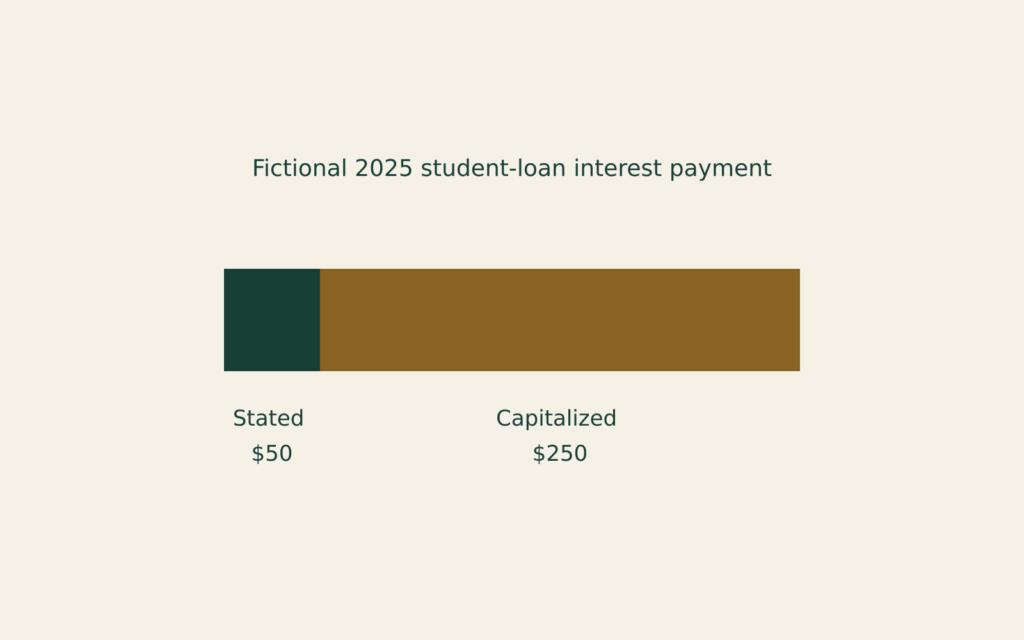
In a fictional 2025 case, the legally obligated borrower pays $300 from personal funds on a verified qualified student loan. At the payment’s due date, $50 of stated interest and $400 of previously capitalized interest remain unpaid. There are no origination fees, assistance benefits, other payments or adjustments.
The servicer records $50 as interest and $250 against principal. Under the tax allocation, the payment first covers $50 stated interest, then $250 capitalized interest. Thus $300 is treated as interest for this calculation; $150 of capitalized interest remains unpaid. None of this payment reaches original principal under that allocation.
IRS Publication 970 (2025) explains that tax allocation can differ from the lender’s statement. Capitalization alone is not payment. Match the unpaid-interest history and actual payment; $300 is not automatically the final deduction or tax savings. Eligibility, income limits and other deduction requirements remain separate.


Roth Conversion and Account Clocks
Separate five-year tests.

ABLE Distributions Across Month-End
Separate retained purposes.