SNAP: From Wages to Allotment
Reconcile deductions before calculating benefits.
Estimated reading time: 1 minute
SNAP’s food allotment uses net income, not simply 30% of gross wages.
Consider a fictional two-person household in the contiguous United States, certified eligible for all of October 2026. Neither member is elderly or disabled. Its only income is $1,000 gross wages. Verified allowable shelter costs total $400, including the applicable utility allowance. There are no dependent-care, child-support, homeless or other deductions, proration, recoupment or special adjustments.
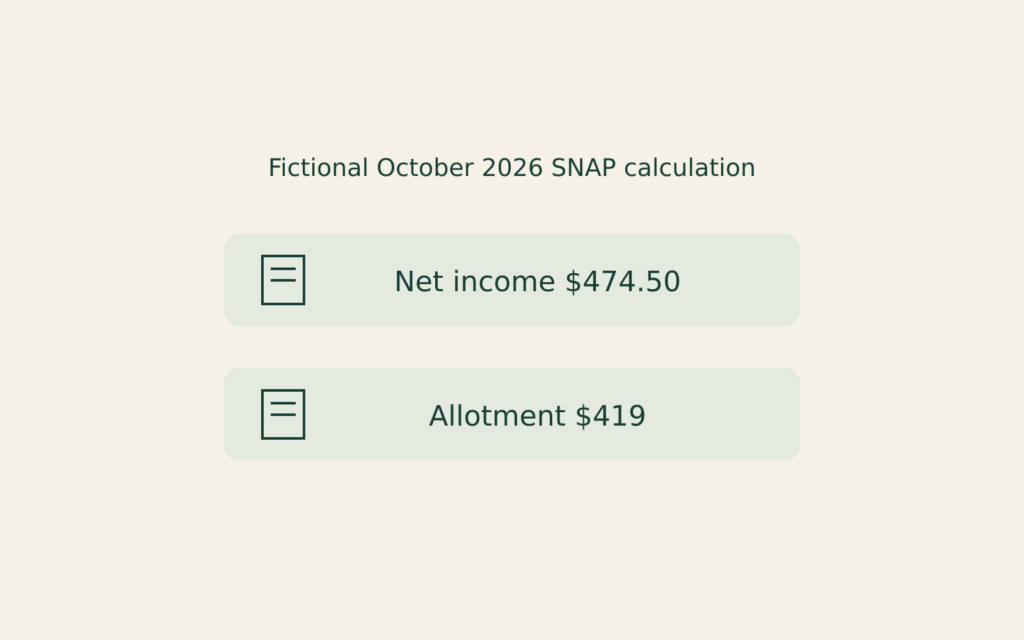
Under USDA’s calculation, subtract the 20% earned-income deduction and $217 standard deduction: $1,000−$200−$217=$583. Half is $291.50; shelter exceeding that is $400−$291.50=$108.50, below the shelter cap. Net income is $583−$108.50=$474.50.
Multiply by 30%: $142.35, rounded up to $143. Subtract that from the $562 two-person maximum: $419 for the full month, not $262 from subtracting 30% of gross wages.
This reconstructs the ordinary allotment, not eligibility, an EBT balance or issuance date. Match the income, deduction and benefit-period records.


Roth Conversion and Account Clocks
Separate five-year tests.

ABLE Distributions Across Month-End
Separate retained purposes.