Repossession Gain Records
Reconcile seller payments and basis.
Estimated reading time: 1 minute
Repossessing land can create seller gain even without a new cash payment.
A fictional nondealer sold unimproved investment land to an unrelated buyer in 2023 for $100,000 using the installment method. Adjusted basis was $60,000, with no selling costs, assumed debt or adjustments. The original note was secured by the land and had adequate stated interest.
Gross profit is $100,000−$60,000=$40,000; divided by $100,000, that gives 40%. Before default, the seller received $60,000 principal across 2023–2024 and reported $24,000 gain: 40% of those payments. Interest was separately accounted for.
In 2025, the seller repossesses the land to protect those security rights, satisfying the original remaining $40,000 note. No additional consideration, repossession costs, prior bad-debt deductions or other adjustments apply.
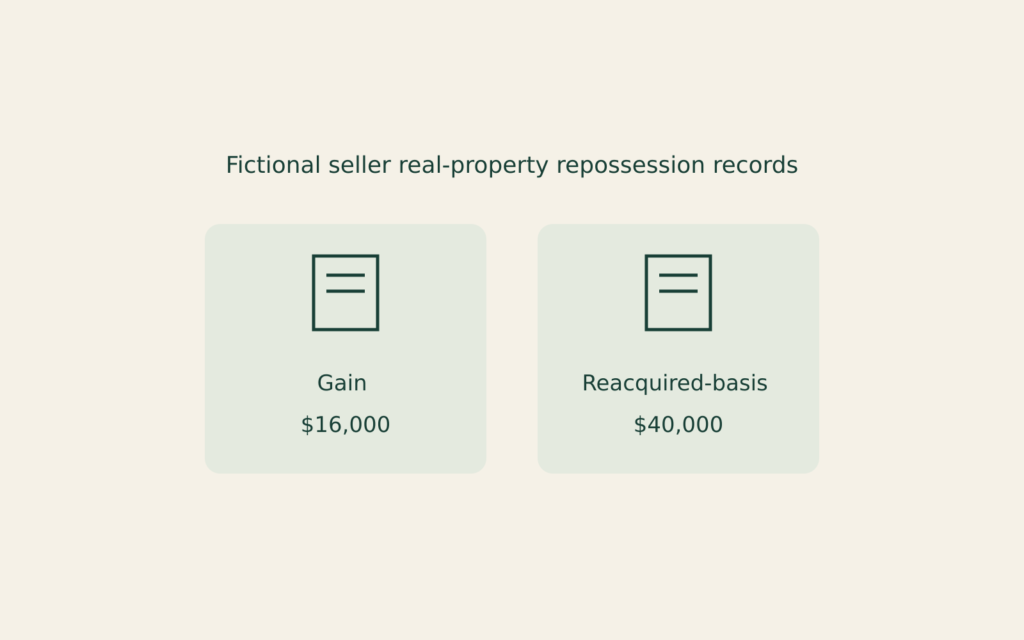
Publication 537 compares payments less previously reported gain, $60,000−$24,000=$36,000, with the remaining gross-profit cap, $40,000−$24,000=$16,000. Repossession gain is $16,000.
The note’s basis is $40,000−($40,000×40%)=$24,000. Add $16,000 repossession gain: reacquired land basis is $40,000, not the original $60,000. These are tax records—not new cash, property value or final tax.


Roth Conversion and Account Clocks
Separate five-year tests.

ABLE Distributions Across Month-End
Separate retained purposes.