Employer-Paid FICA: Reconcile the Gross-Up
Separate employee wages and employer taxes.
Estimated reading time: 1 minute
Paying an employee’s Social Security and Medicare share can increase the wage base on which that share is calculated.
Fictional 2026 case: an ordinary U.S. business pays a common-law employee $923.50 before income-tax withholding and other deductions, and bears the employee’s FICA (Federal Insurance Contributions Act) taxes without deducting it. This is neither household nor agricultural employment. All pay is covered; annual wages including this gross-up remain below $184,500, with no Additional Medicare tax or other adjustments.
IRS Publication 15 includes employer-paid employee FICA in Social Security/Medicare wages, creating further employee tax. The combined employee rate is 6.2%+1.45%=7.65%.
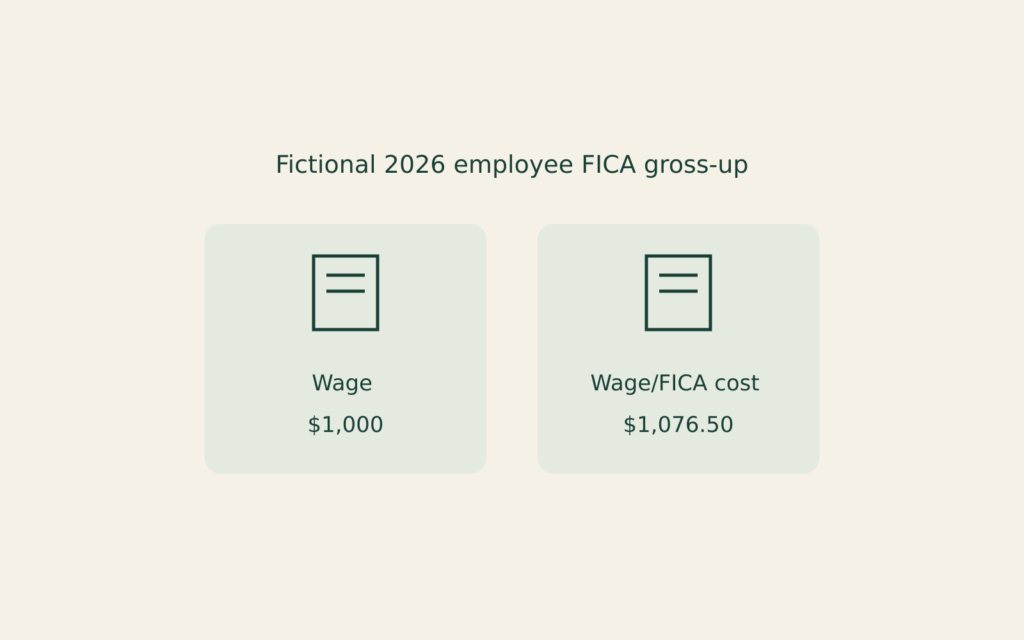
Let G be the grossed-up wage. G=$923.50+0.0765G, so G=$923.50÷0.9235=$1,000. Employee taxes are $62 Social Security plus $14.50 Medicare, totaling $76.50.
The employer separately owes another $76.50. Thus this wage-and-FICA cost is $1,076.50, excluding unemployment taxes, benefits and other costs. The employer’s own share is not another employee wage addition. Neither $923.50 nor $1,000 is guaranteed final take-home pay.


Roth Conversion and Account Clocks
Separate five-year tests.

ABLE Distributions Across Month-End
Separate retained purposes.