Dental Plans and Non-Duplication
Calculate the secondary payment.
Estimated reading time: 1 minute
Delta Dental describes some contracts with non-duplication provisions: the secondary plan subtracts the primary payment from what it would otherwise pay. This is not every plan’s rule.
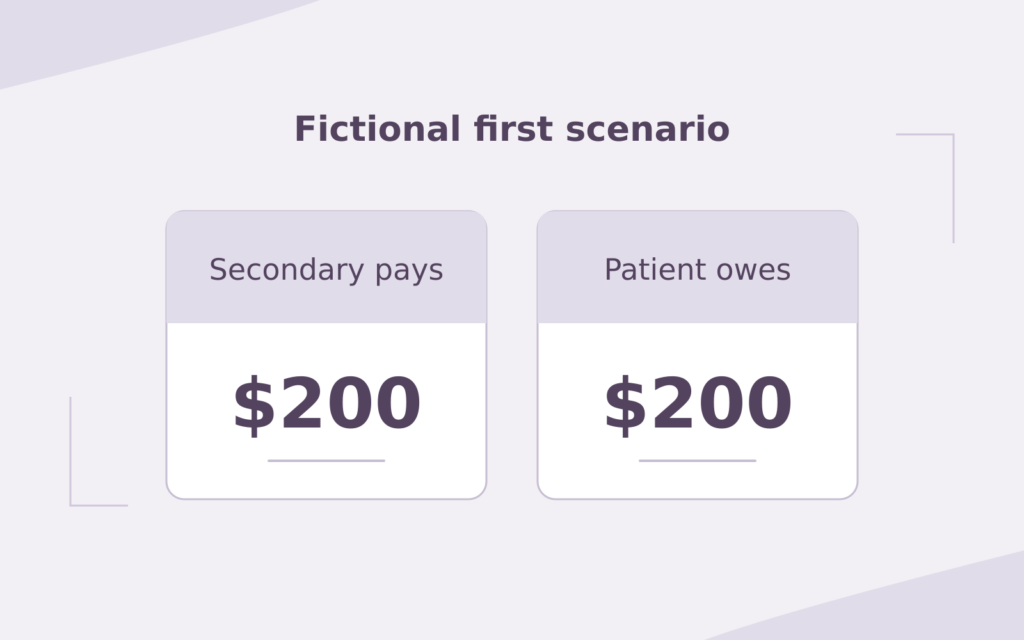
Fictional example: the dentist’s agreed total charge and both plans’ allowed amount are $1,000. Assume this coordination method legally applies, payer order is confirmed, deductibles are met, and no benefit limits or other restrictions reduce coverage.
The primary plan pays $600. The secondary plan would pay 80%, or $800, if primary. Its additional payment is $800 − $600 = $200. Combined benefits are $800, leaving $200 for the patient.
Applying 80% to the remaining $400 would incorrectly predict a $320 secondary payment. Adding an unrestricted $800 would also be wrong.
In a separate case, if the primary pays $900, the secondary pays nothing under this rule. The patient owes $100; the calculation does not create a negative benefit.
Before financing the balance, ask both plans to confirm coordination and obtain the provider’s reconciled estimate. An estimate is not guaranteed payment.