Indexed Annuity Loss Limits
Distinguish the protections.
Estimated reading time: 1 minute
A 10% buffer and a 10% loss floor are not equivalent. SEC investor guidance distinguishes protection absorbing initial index losses from protection limiting the investor’s maximum loss.
Compare two fictional indexed-annuity options, each starting at $100,000. Measure only end-of-term index losses, with no withdrawals, fees or other adjustments. One absorbs the first 10 percentage points of decline; the other limits your loss to 10%.
At a 5% index decline, the buffer leaves $100,000; the floor leaves $95,000.
At a 15% decline, the buffer leaves $95,000 after a 5% loss; the floor leaves $90,000 after a 10% loss.
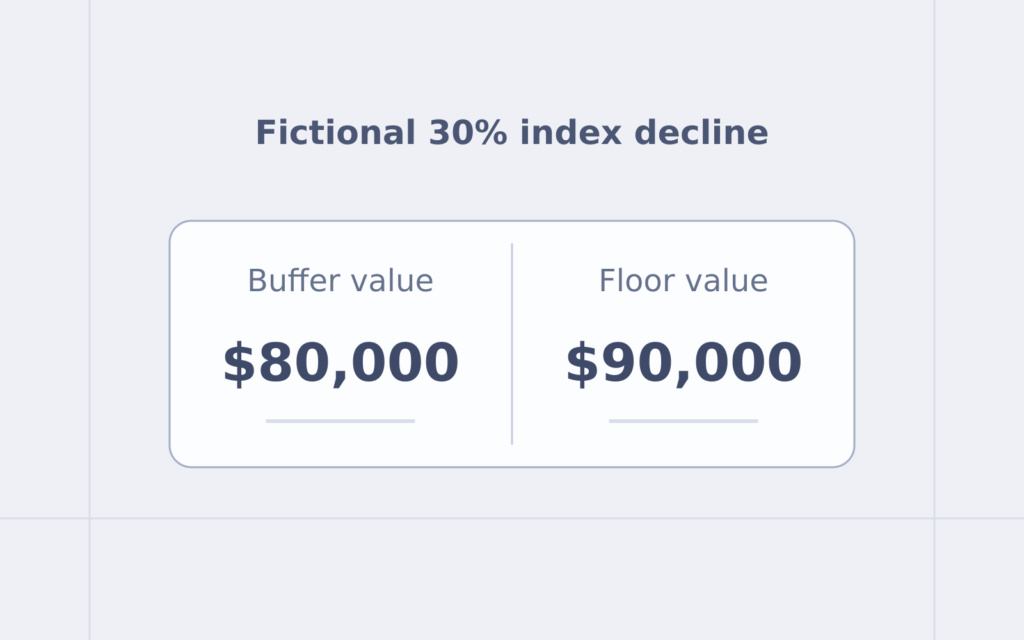
At a 30% decline, the buffer leaves $80,000 after a 20% loss; the floor leaves $90,000.
Both leave $90,000 at a 20% decline. The buffer handles smaller losses better; the floor limits larger losses.
Compare actual terms, upside limits and costs too. These are not surrender values or product recommendations. Early withdrawals can change results, and payments depend on the insurer’s ability to pay.