First Student Loan: Check the Delay
Verify dates with your school.
Estimated reading time: 5 minutes
A first federal student loan can be approved before the money is available for rent, transportation or other bills. For some first-year undergraduates, a specific 30-day disbursement delay is part of the explanation. Even when it applies, that waiting period is only one part of the cash timeline.
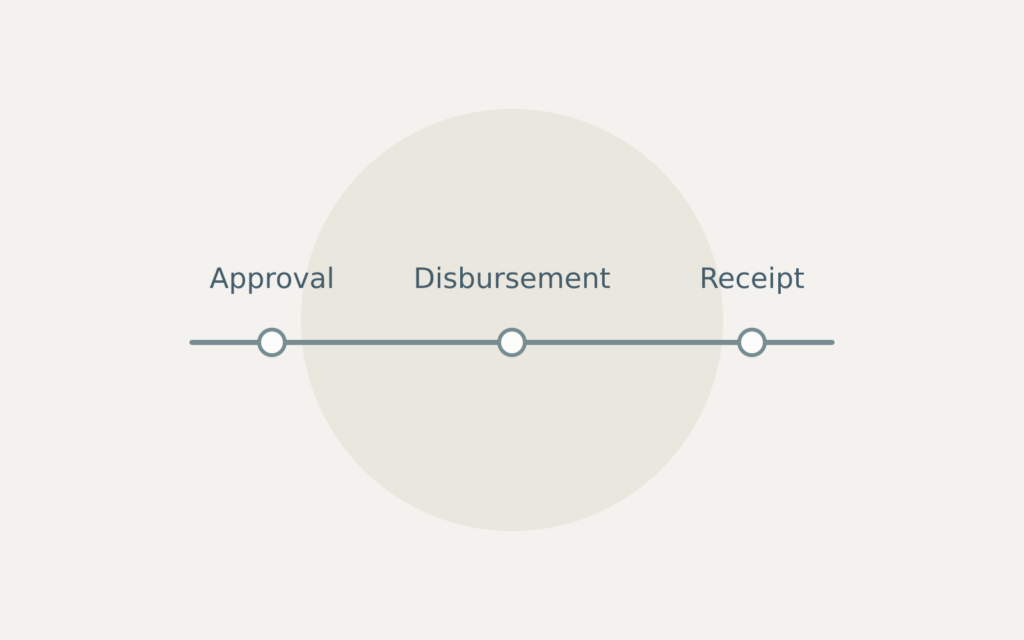
Separate three events: the school confirms loan eligibility, the school disburses funds, and any money payable to you becomes available. A date attached to one event should not automatically be used for all three.
Who is covered by the 30-day restriction?
Under 34 CFR 685.303(b)(5), the restriction concerns first-year undergraduates who have not previously received a Direct Subsidized or Unsubsidized Loan, a subsidized or unsubsidized Federal Stafford Loan, or a Federal Supplemental Loan for Students. Unless an exception applies, the school cannot disburse a Direct Subsidized or Unsubsidized Loan until 30 days after the first day of the student’s program.
School cohort-default-rate exemptions and a separate qualifying study-abroad exception exist. Ask the school which exemption, if any, applies to your loan.
34 CFR 685.303: loan disbursement restriction and exceptions
Being new to a particular campus is not, by itself, the complete test. Give financial aid accurate information about prior borrowing and ask how it classified you. A friend’s release date at another school may not answer your own question.
Use a calendar, not “about a month”
For a fictional program beginning October 1, adding 30 days gives October 31. If the restriction applies, that is the earliest date permitted by this particular waiting period, not a guarantee of disbursement or a bank deposit that day. Other requirements and processing still matter.
Keep a timeline with separate entries for the program start, the school’s expected disbursement, any remaining requirement and the expected payment to you. Label dates as confirmed or estimated. If a portal shows only “scheduled,” ask what could still change before using that date to promise payment to someone else.
Ask whether the displayed amount is the whole loan award or the particular installment being released. Also ask which amount will actually be credited after any applicable loan fee. A large annual award figure is not necessarily the amount arriving with the next transaction.
Disbursement and a credit balance are different
A Title IV credit balance occurs when federal Title IV funds credited for a payment period exceed allowable charges for that period. Under the general rule, it must be paid as soon as possible, no later than 14 days after it occurs if that is after classes begin, or 14 days after the first class day if it occurs on or before that day.
34 CFR 668.164(h): Title IV credit balances
A permitted voluntary authorization to hold funds can affect the ordinary release process. The federal handbook also explains that a credit-balance payment may be made by check or electronic transfer. Confirm the method and any authorization on your account; the rule is not a promise that your bank will show spendable money on the loan’s disbursement date.
Federal Student Aid: 2026–27 disbursement and credit-balance guidance
Work out the amount you are actually waiting for
Suppose, purely as an illustration, $3,000 of Title IV funds is credited to a student’s school account, allowable charges for that payment period total $2,200, and there are no other entries affecting the calculation. The resulting credit balance is $800, not $3,000. This example assumes the disbursement has actually occurred.
If the student has $500 of rent and $150 of transportation costs due before the money arrives, the immediate cash requirement is $650. With $200 already available, the early gap is $450. The later $800 does not remove the earlier timing problem.
Write those two calculations separately: expected school-account balance and cash needed before receipt. That prevents an estimated future payment from being counted as money available today.
Ask the right office the right question
- Financial aid: Does the first-year, first-time restriction apply to me, and is the school exempt?
- Financial aid: Are there any unfinished loan or eligibility requirements?
- Student accounts: Which charges will be covered, and what amount is expected to be paid to me?
- Student accounts: What payment method and release date are recorded?
- Billing: What arrangement is available if my bill falls due before confirmed funds arrive?
For books or transportation needed immediately, ask about the school’s available assistance or payment arrangements. Do not assume a particular program is offered or that asking guarantees funding. Compare any proposed borrowing with its costs and repayment terms before accepting it.
When a date changes
Save the latest notice and record what changed: eligibility review, a missing document, account charges or payment processing. Ask for the specific next step and who handles it. Rechecking an unchanged portal is less useful than resolving the identified issue.
If a promised release has passed, contact the responsible office with the date, amount and reference number. Keep sensitive banking details in the school’s secure process. The goal is a verified amount and timeline, not simply reassurance that a loan exists.

Parent Pays Student Loan Interest: Who Deducts?
Separate payment and obligation.

Returned Loan Debit: Two Fees?
Trace the payment and fees.

Rehabilitation Payment Too High?
Check an alternative request.